Will Google.Me Cure Our Social Blues or Just Our Insomnia?

It’s looking more and more like I was right about Google.Me.  It’s sort of good to be right (particularly in the face of all the internet hype about how Google.Me is going to reinvent the internet and so forth), but bad that Google.Me is shaping up to be an expanded Google Buzz, mashing together a disparate bunch of applications, some of which Google is buying as we speak, into an inelegant, Gmail-captive mess.  I hold out hope that I’m wrong about this, but the likelihood that I am diminishes with every new leak and rumor.

Google.Me will apparently be built on the back of Google Buzz (as I predicted long ago), which exists as an awkward bolt-on to Gmail.

TechCrunch says:

We’ve also heard more from sources who’ve worked with Google on the product. “Google Me is not a product, it’s a social layer across all products” (not so helpful). But there’s more – “Google Me will produce an activity stream generated by all Google products. Google Buzz has been rewritten to be the host of it all. And the reason Google Buzz isn’t currently working in Google Apps is because they’ll use the latest Buzz to support the activity stream in Apps…All Google products have been refactored to be part of the activity stream, including Google Docs, etc. They’ll build their social graph around the stream.”

This is very bad and all the huffing and puffing in the blogosphere is not going to make it good.  When someone describes their world-changing product with a bunch of gibberish that sounds vaguely like a ton of other failed products, that’s reason for concern if not full-on panic.

What Google should do is build a completely new service, largely from the ground up, using its own technology and that of the many, many applications and services it has acquired over the past few months.  Gmail could be the digital hub for our online lives.  For example, the recent expansion of more services into Google Apps has already led me to try (and fail, but at least it made me try) to like my Start Page (e.g., iGoogle).  But stuffing more tossed together junk into Buzz, which was already tossed into our Gmail accounts sounds like the opposite of elegant.  Candidly, it sounds like a snoozefest of meetooism.

I really hope I’m wrong, but at this point I can’t help but believe that the general reaction to Google.Me is going to be one big yawn.

Once More, With Ennui: RSS Is Not Dead

RSS is dead.  Long live RSS!
RSS is dead. Long live RSS!

My buddy Robert Scoble gets a lot of stuff right.  But he has a habit, shared by many of the internet technorati, of trying to make things into bigger things.

You know, everything is the next big world-changing technology.  Facebook is the Google killer.  Google.Me is the Facebook killer (actually, even the most impassioned technorati can’t say that with a stright face).  On and on.

Now the story is, again, that Twitter and Facebook are killing RSS, and as a result RSS readers.

Sigh…

No, they aren’t.  Bloglines died due to neglect.  Seriously, before today when was the last time you heard of Bloglines?  I figured it was already dead.  Is Bloglines the new Franco?

This past weekend, I drove a big U-Haul truck from Grand Rapids, Michigan to Bellaire, Texas (Lambert’s Café, home of the throwed rolls, in Sikeston, Missouri is the coolest restaurant on the planet) in less than 36 hours.  As such, I’m too tired to write another dissertation on why Robert is kidding himself.  So, I’ll just share two relevant thoughts.

One, while Bloglines and Franco are still dead, Google Reader is actually growing.  Yes, Google (being Google) doesn’t really have a plan for Google Reader, and has stuffed some unnecessary bloat in there, but Google Reader is, simply stated, the best tool on earth for managing, reading and sharing a lot of information in a reasonable time.

Those who think Twitter is the place to get most of your news and content (1) are lovers of the chaos and/or (2) have WAY more time to screw around on the internet than I do.

Two, an example, in pictures.

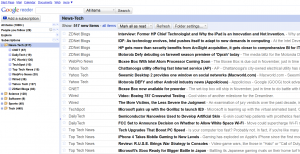
greader2010-300x154

While I was driving and driving and driving, my news items got a bit backed up.  Thousands over all, and 517 in my Tech News folder.  It would take days and days, and be a profoundly miserable and frustrating process, to find and consume this much content via Twitter or Facebook.  It’s just not feasible.

With Google Reader, it’s easy and fun to quickly scan the headlines, read the articles that interest you, and share (via the Send to feature) the most interesting stuff.  Total catch-up time: 25 minutes or so.

Long live Google Reader

When Did Craigslist Become the New Hamsterdam?

Netizens (there’s that word again) everywhere are taking brief Farmville breaks to express outrage over the fact that pimps and hookers are suddenly not allowed to sell their goods and services on Craigslist.  What is the world coming to if we have to get in our cars and drive around seedy areas to buy illegal services that may be exploiting other human beings?  What’s next, are they going to tell us it’s not OK to kill people?

bunnycolvin-300x180

We need a revolution, and we need one now.  Paging Fidel.

Seriously, could this whole brouhaha be any sillier?

Danah Boyd does a good job of presenting the Bunny Colvin plan.  You know, let’s gather up all the criminals and give them a designated place on the internet, where they can ply their illicit trade while we . . . you know, watch them.  That way, the rest of us can go about our business of raving about Twitter and trying to become the mayor of Taco Bell without worrying that some cyber-dwelling prostitute will flash her boobs at us. Well, except for the Facetime thing, but let’s not get distracted from the dogged pursuit of justice here.

Lots of other defenders of our right to party have chimed in as well, including the usually reliable TechDirt.

Let’s face it, this is all about the “c” word.  No, not that one.  Censorship.  And everyone knows that just the mention of that word will guarantee that you win the debate.  Any debate.

See?

Look, if we’re going to do this, let’s at least do it right.  We shouldn’t require that Craigslist take down the Adult Services (what a hoot of a word) section.  We should make them add a Murder for Hire section.  A Ransom Notes page, where kidnappers can freely express themselves.  Why spend all this money on national security and Iraq and whatnot, when all we have to do is put a Terrorism category on Craigslist?

It worked for Bunny.  By George Bush, it will work for us.  I said that just so I could say bush in a blog post.  Freedom is a wonderful thing.  Well, except for the women who allegedly get traded like rookie cards via Craigslist ads.  It’s probably not all that wonderful for them.

On a semi-serious note (but only semi-so), Craig Newmark has always struck me as a good guy who genuinely cares about people (even if he hasn’t accepted my Facebook friend request).  As such, I sort of hate to see him dragged over the coals about this, particularly since he has long made it clear that he does not have operational responsibility for Craigslist.  Having said that, he shouldn’t be terribly surprised that this issue came up, and it is, after all, his list, at least in name.  I guess I wish this were a golf game instead of a gigantic PR nightmare, so we could give him a mulligan.

All we can hope for now is a resolution that strikes the proper balance.

I just don’t know that Hamsterdam 2.0 is the answer.

Live Writer Beta + WordPress 3.0 = Jumbled Mess (for Now)

NOTE: This blog post is going to be all jumbled up.  I am trying to show the Live Writer developers a problem that exists with the current beta and WordPress 3.o

I love Live Writer.  I’m even willing to learn to live with the Ribbon in the beta version.  I love WordPress, and find 3.0 to be a nice advance of the platform.

But, at least for now, the Live Writer beta and WordPress 3.0 do not play well together.  The problem is that the photo or other graphic layout (location, placement, etc.) created in Live Writer does not make the trip through WordPress 3.0 and onto the applicable blog page.

Here are some examples, using some random screen caps.

image

There’s a screen cap of my Facebook profile.  I am a Go Dog Go-ocrat, because I think just about every single problem we face in society originates from the moment the first person decided it was really important to differentiate himself from all the other people.  In other words, once dogs start driving cars, it’s all over.  More importantly for purposes of this post, that graphic is supposed to be above this paragraph.

Here’s a picture of a book I just read.  I liked it.  That graphic is supposed to be below this paragraph.

image

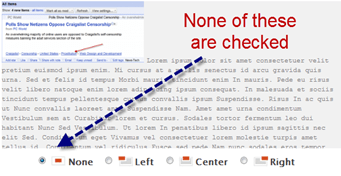
For some reason, the alignment and other information is getting lost between placement in live writer and publishing to a WordPress 3.0 blog.  When I look at the published and jumbled post under the WordPress dashboard, the graphics appear to have no placement information associated with them.  By that I mean nothing is shown under the graphic, not even “None.”  That graphic is supposed to be under this paragraph.  None of these images should have words beside them.

image

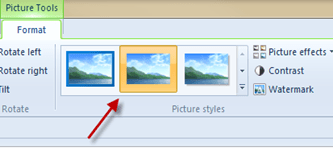
I suspect that this problem has to do with the photo setting “Inherit from Blog” in Live Writer.  It may be that you need to specifically set the information for each photo or graphic to “None” by double clicking on the image and selecting the second choice under Picture Tools.  Let’s see if that helps.

image

Nope.  It’s still a mess.

Live Writer and WordPress are two of the three applications (along with Google Reader) that I use the most.  I’m sure this will get fixed.

I’m just doing my part to try and help.

Maybe PC World Should Rethink the Whole Self-Censoring Thing

Maybe PC World needs to think about a little self-censoring itself, as opposed to proclaiming, based on perhaps the most unscientific poll ever by Mashable,  that netizens (awesome word) oppose Craigslist self-censorship.

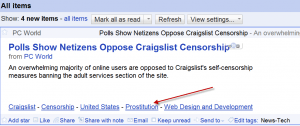
Here’s the news reader (crappy partial feed) entry for the PC World story about Craigslist’s so-called self-censorship.  There are so many tracking links, ad server calls and whatnot embedded in the link that it took me about 6 tries to get the article page to load.

feeditem1-300x126

In the meantime, I decided I’d click on one of the links sitting there, without comment, at the bottom of the (crappy partial) feed.

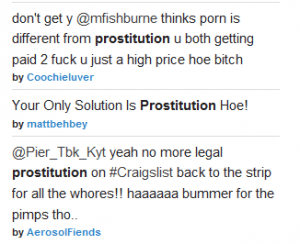
The noted link takes you to a page on something called Shyftr (which I vaguely recall reading about a year or two ago), where you can get lots of great, thoughtful commentary on the selected topic.  Really impressive stuff like this.

badcomments2-300x244

That’s the kind of thing I just can’t get enough of.  Who needs the New York Times when there’s this sort of thing just a click or two away?

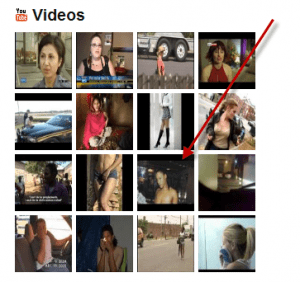
And, there’s more.  Under Videos, you can browse through all sorts of thought-provoking, supposedly related videos.

badvideos3-300x282

Like the one noted above, for example.

videodetail4-300x127

Seriously?

And, if that’s not enough, there’s a helpful list of “Related Keywords” at the bottom of the page.

That is one big heaping example of awesome.  Not.

It looks like the path from PC World to Shyftr goes through one of the endless ad servers, in this case Pheedo.com.  I’m guessing that PC World is using Pheedo to serve ads (we certainly need more of those) in its RSS feed, and Shyftr is buying some of those ad spots.

Still, you can’t ignore the beautiful irony of this.

The Holy Grail of Social Network Sharing: Single Clicks, Native Shares & Clean Streams

Enchanter-300x165

I’ve been thinking about the distribution of my content across the various social networks.  My challenge is to use the social networks in a way that benefits me and my readers, while keeping control of my brand and managing my content at a central, owned-by-me location.  That location being here at Newsome.Org, and my primary distribution tool being the “Send to” feature of Google Reader.  I consume 90% of my online content via Google Reader.

Networks I Use

At this point, I use two primary social networks.

I use Twitter (follow me, if you’re interested in hand-picked links to good tech, music and life articles) as a largely list-and-search-driven resource for third party content.  You simply have to rely on lists and saved searches to manage what would otherwise be complete chaos.   Via Twitter I  give (via my hand-curated “Interesting” links) and receive (via lists and saved searches) links to stories of interest.  In other words, the “what are you doing” Twitter updates are of very little interest to me (mostly because, as we’ll see in a moment, I find Facebook much better for that sort of thing), but the pointers to news articles and blog posts are very much of interest.

I use Facebook (Friend me, if we are)  as more of an interactive, conversation stream.  I find the connections between people on Facebook much more meaningful, and much more enjoyable, than on Twitter.  In other words, Twitter feels like an internet creation.  Facebook feels more like real life.

They are very different things.

How I Share

Which means that content producers like me need to carefully decide what parts of our content get pushed where.  Until today, I pushed all of my Twitter content into my Facebook stream.  Primarily, this was to get my curated “Interesting” links into both Twitter and Facebook, via a one-click “Send to” Google Reader process.

grshare-300x110

I would send an item to Twitter, which in turn would be  sent to Facebook.  It worked, but it was noisy.  There was too much static on the line.

For example, when I publish a new blog post, it gets linked in my Twitter stream, via the WP to Twitter plug-in.  Then, in turn, it would show up on Facebook, the same way.   Like this.

newpostimport-300x41

But Facebook’s native sharing process produces a much better stream entry, with a thumbnail, etc.  It looks less spammy and more elegant, giving a result like this.
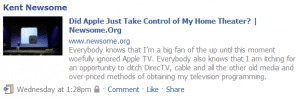
fbnewpost-300x99

Duplication and Dirty Streams

Which meant that I had to either allow duplicate new blog post entries in my Facebook stream (bad) or manually delete the automatic Twitter posting and then re-post the item using the Facebook’s native sharing process (inefficient).  Ultimately, I found myself rushing to Facebook to delete certain Twitter-imported items and replacing them with native Facebook shared links.  I felt like George Jetson on the treadmill, with no Jane in sight.

Then I finally realized I was doing it backwards.

The interactive quality of my stream (both incoming and outgoing) is better and more valuable at Facebook.  So that’s where I need to use the most care.  I very much wish I could one-click export selected items from my Facebook stream to Twitter.  That would allow me to pick and choose the links and other content that I wanted to send over the Facebook walls, without having to clutter my Facebook stream with a bunch of imported content.  But you can’t do that.

Tossing Twitter Out of Facebook

So I decided to cut the cord.  As of today, my Twitter feed is no longer pushed to Facebook.  Rather, my curated “Interesting” links will continue to be the most valuable part of my Twitter stream, and any of them that I want to also share in my Facebook stream will have to be re-shared.  This double effort will serve as a mighty filter on my Facebook stream, which is good and bad.  Good because the quality of the content will be higher.  Bad because there will be some interesting stuff that never makes it into my Facebook stream.

Call Me Percival

holygrailcup2-270x300

Which leads to the search for the holy grail.

What I want, but have not yet found, is a way to share content from Google Reader one of three ways:

1. To Twitter (can do this);

2. To Facebook (can do this); or

3.  To both simultaneously, but using each service’s native sharing API (cannot do this).

There needs to be a way to select, slice and dice and distribute content via a Google Reader “Send to” (or the equivalent), which will send the selected content to Twitter and Facebook, simultaneously and separately (without going into one and then being imported into the other).  Another, likely easier to develop, solution would be to create an application that only pushed certain content from Twitter to Facebook.  It would be rules based.  For example, I could create a rule that would push any Twitter post that starts with “Interesting:” to my Facebook stream, but would not push other Twitter posts.

For me, this is the holy grail of social network sharing.  I thought perhaps Ping.fm might be a vehicle to do this or something acceptably close, but I don’t see a way to push the same link through Ping.fm to Twitter as a Twitter post and to Facebook as a natively shared (as opposed to imported) item.  In other words, it seems my ability to push things from my Twitter stream to my Facebook stream is an “all or nothing” decision.

In the meantime, I guess I’ll have to share especially interesting items twice, in order to keep my Facebook stream clean.  But I’ll keep looking for the holy grail.  It’s out there somewhere, or will be one day.

Good News for (at Least a Few) Google Apps Users

google_apps-300x223

I’ve been a Google Apps user for a long time.  Though I am generally satisfied with the email and light word processing features, I have also been highly critical of what I see as some gaping deficiencies in the experience.  In general, these deficiencies are:

1. The fact that the suite of apps looks tossed together, both in design and function.  Some of the apps, like Gmail, are beautiful.  Others, like Sites and Moderator (whatever that is), are so bad I can’t even suggest how to fix them.

2. The fact that few of the new apps and features that Google releases find their way into Google Apps.

Finally, it looks like there is hope.  Wired tells us today that Google has invited “select users” to test a version of Google Apps that includes all the features that regular Google users have:

[Google’s] now asking some Apps users — known as Trusted Testers — to help test out the infrastructure, according to an e-mail seen by Wired.com.
Good.  I hope this represents a trend that will ultimately make all these features available in Google Apps.  For everyone.

Did the Fighting Dinosaurs Just Get Gobbled Up Like an Apple?

You just have to feel bad for Google.  Poor little thing.

It’s running around, buying everything in sight, trying to cobble together something that can avoid being immediately killed by Facebook, and here comes Apple, announcing Ping, a social network built around iTunes (and its massive day-one user base).

It reminds me of those Saturday afternoon movies, where one brave but doomed dinosaur is bravely trying to fight a bigger dinosaur, only to have some bigger, larger, scarier creature stomp up out of nowhere and devour them both.

I don’t know that Ping can unseat Facebook as the sharing, dating, time wasting, etc. hub for the masses, but I know that it has a better chance of competing with Facebook than anything I have read or reasonably imagined about the forthcoming (for months) Google.Me.

For a company that makes its money via advertising, Google seems unable to properly market itself.  Everyone from Amazon to Roku saw this coming and at least tried to make a pre-emptive grab for relevance.  Meanwhile Google just keeps buying arms and legs, leaving us to wonder what manner of creature it is assembling.

I’d like to be wrong.  I’d like to see Google get it right and release something powerful, and elegant.  Not tossed together and crammed into Gmail.  I’m trying to keep my hopes up, but that rumbling sound in the distance scares me.

Poor Google.  It just can’t buy a break.