 Mark Evans has the best, most concise post I’ve seen yet on the Net Neutrality Act, AOL’s money grabbing email tax and the absurd attempts to create more money where none exists.
A good read by a smart guy.
Tags:

Mark Evans has the best, most concise post I’ve seen yet on the Net Neutrality Act, AOL’s money grabbing email tax and the absurd attempts to create more money where none exists.
A good read by a smart guy.
I don’t want to be a hater. I always tell people not to be haters. Just last night while I was watching a basketball game on TV, my wife came in and asked me to feed the dog. I looked at her and said gently “don’t be a hater.”
But every time I think I have my hatred of the MPAA and its other brother the RIAA under control, something like this happens.
A-Hole Number 1
Determined to take away all of our digital media rights, the MPAA now wants to force, via Congressional mandate, manufacturers of devices that can convert analog signals to digital ones (like camcorders, some handheld devices and computers) to include some sort of proprietary watermarking technology called VEIL (someone accidently switched the V and the E, so I will refer to it by its correct name). As best we can tell, the way it would work is that the recording device would seek out the EVIL watermark and respect any do not record instructions contained in the EVIL watermark.
A-Hole Number 2
A Princeton professor called the company that makes EVIL for the MPAA and asked if they would show him how EVIL works. Get a load of the response (as quoted in the Boing Boing story linked above):
[O]nly if he pays them $10,000 and signs a non-disclosure agreement. And they’ll only tell him how the decoder works — there’s no price you can pay to find out how [EV]IL encoding works.
As Cory and the Professor point out, that should end the discussion right there. But you can be sure the MPAA will continue lobbing bombs at media rights until someone makes them stop.
You Want a Bill, Here’s a Bill
How about a Congressional bill outlawing any attempt to restrict the fair use doctrine? Huh? How about a bill like that?
A-Hole Number 3
In the birds of a feather work together category, check out Cory Doctorow’s encounter with Brad Hunt, the guy leading the charge for the MPAA, as quoted by Thomas Hawk:
This Hunt’s an interesting character. I once was at a meeting with him where we had no Internet access, so I went and got the conference center to turn on an Ethernet jack. Before I could get hooked up to it and turn on a WiFi service for the room, Hunt grabbed it and hogged it for the rest of the afternoon, refusing to turn on connection sharing so that a room full of TV, electronics, and film people could get online too.
This little encounter says a lot about the MPAA’s views on both cooperation and the rights of other parties.
If we aren’t careful, the MPAA and the RIAA are going to completely destroy the fair use doctrine and take away all of our media rights.
I really don’t like those people.
Now I have to go meditate.
Don’t…be…a…hater…
Today comes word that the MPAA has filed a new round of lawsuits in a continuing effort to stuff the cat bag into the bag.
I have a few questions.
 Do the MPAA and its even more aggressive cousin the RIAA really think they can curb file sharing by suing a bunch of random people once in a while? Do they also think it’s possible to make water naturally flow up hill?
I don’t think anyone at the RIAA or the MPAA really believes they can curb file sharing. It’s too late and they have to know that. So what is the real goal here? Are they trying to slow down the growth of file sharing while they come up with some technological solution?
Do they understand that the only people they are hurting by mandating DRM-infested product are themselves and the remainder of their once loyal customer base? Surely they know hacker technology will trump copy protection every time.
Is the plan, or part of it, to force us to buy the same thing over and over? Is that how they think they can save their dying business model?
If it’s OK to sue a search engine that allows someone to search for pirated material, where’s the line? Is it OK to sue the companies who make the computers that allow someone to access the search engine that allows someone to search for pirated material?
I want someone of importance at one of these organizations to tell me what the real goal is here? Not the scorched earth campaign to spread fear of litigation, but the realistic one that they must have talked about.
So tell me, exactly, what is the end game in this futile effort to stuff the cat back into the bag.
I really want to know.
I really enjoyed The Blog Herald and am sorry that Duncan Riley sold it, but he (or whoever wrote this post) is simply wrong.
Just because no one has devised a profitable way to cram a bunch of RSS ads down our throats is no excuse for partial RSS feeds. Particularly when we can read another paper that provides full feeds.
Matter of fact, I suspect that part of the reason why RSS ads don’t work is because (a) no one clicks on them, and (b) the advertisers know that. Just because they don’t work the way publishers wish they would is no excuse for forcing readers to the web site for the full story.
Newspapers who understand this will provide full feeds and take readers from those who don’t.
As Steve says, in the future, “we will look back and laugh how quaint it was that we received our news on dead trees.“
We will also think it quaint that publishers tried to drag us back to their ad-infested web sites by dangling half of an article in front of us.
Susan Crawford has an interesting post today about the “me-TV” that has resulted from today’s wide selection of media outlets.
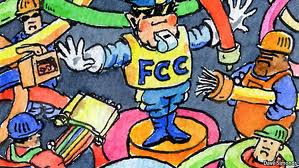
It seems Michael Powell, the former chairman of the FCC gave a speech yesterday at the University of Colorado. Susan talks about one of the themes of his speech: that there are so many media outlet choices that we have lost the communal media experience.
I’m not sure what communal media experience really means (it’s one of those “pre-owned cars” phrases), but I think it means that we don’t all get our news from Walter Cronkite. Which, for better or worse, is true.
The part that I do understand and agree with is the notion that there are so many targeted old media outlets that you can find news that matches up perfectly with your existing beliefs and preconceived biases and, as a result, avoid having to really think about the issues.
But this is nothing new. There have always been a ton of organizations, some with captive media outlets, that are happy to spoon feed beliefs to the masses. This is precisely why I stop listening to anyone who tells me, near the beginning of a conversation, that he or she is a republican or democrat. I don’t want to hear why the other side is wrong. I want to hear both sides of an issue and try to arrive at a solution that might actually work.
Too many people want to avoid the middle truth in favor of the lunatic fringe.
As Susan points out, the same thing has happened to a large extent with old media. She mentions Fox news as one example. Air America is another. You can find someone semi-famous to tell you you’re right, 24 hours a day, 7 days a week. But if you really think you’re right, shouldn’t you want to hear the other side of the argument just to make sure? Sadly, the answer seems to often be no. My take on it, of course, is that the political parties have conscripted the minds and mouths of far too many people who run around spouting off viewpoints they have memorized, but not tested.
There used to be this guy on the radio in Houston. He was the most right-wing, holier than thou person I have ever heard. His predictable responses and black and white approach to every issue made me not only dislike him, but also start to wonder if I should change my views on the things I agreed with him about, just so I would never be on his side in any debate. But I know a lot of people who thought he was the smartest guy around. Well, until he got indicted for indecency with a child. Then they didn’t think he was so smart.
This sort of extreme viewpoint is not limited to the right. You can find the same sort of gibberish on the other end of the dial. I quit listening to KPFT in Houston just so I wouldn’t inadvertently hear Democracy Now. It’s just as extreme, only in the other direction.
I tend to relate more to the liberal viewpoints, but someone needs to tell the liberal commentators that just because it can be said doesn’t make it feasible. In its continuing effort to discredit the right, the left has lost touch with reality. Their stories generally sound better, but in a fairy tale sort of way.
The actual solutions offered by both sides are few and far between. Most of the talking points force fed by the political parties are more about attacking those who disagree than trying to do any real good. And the content of the associated media outlets reflect this.
I had already written the part above when I noticed a discussion of another theme of Powell’s speech on David Isenberg’s blog. Apparently Mr. Powell believes partisanship is out of control too. David paraphrases:
The Washington DC political process is more broken now than at any other time I’ve seen in my life. It has collapsed in on itself. I went home and asked my father [Colin Powell] if I was missing something, and he agreed with me that the process has collapsed into pure partisanship. The power of the incumbency has grown. People are not concerned with what’s right or what’s in the nations interest, they are purely interested in killing their opponents.
This political and philosophical polarization is one of the major reasons why I remain hopeful and excited about the citizen media movement. The citizen media movement, by virtue of the way it is presented, forces a much needed move to the middle. Because there is not just one Walter Cronkite in citizen media. There are millions of them, and each of them has a roughly equal platform from which to be heard.
And unlike when I see a story on TV, if I read something on a blog that I don’t agree with, I can immediately add a comment and/or post a counterpoint here and link back for a cross-blog conversation. People who disagree with what I say here can do the same thing. And it happens. It happened last night and it happened over the weekend. And it’s happening right now.
Is it chaotic? Maybe, but it’s better to pick at the plate of many than be force fed from the plate of one.
Why, when people are spending all kinds of money buying TIVOs and satellite radio purely to avoid ads, is so much of the newish tech-related business we read about based primarily on ad revenue?
I believe that it’s a proven fact that most people who have the know-how and hardware to receive these Web 2.0-related products will go out of their way and come out of their pockets to avoid ads. In fact, I believe most people hate ads and will go to great lengths to avoid them.
Now comes word that some publishing company is going to hawk ad-supported eBooks. Well, actually just one (eBook, that is), according to the article. But if anyone decides this folly just might work, it will go from experiment to movement in the click of a mouse.
Let me say it again: in the medium and long term, relying primarily on ad revenue is simply not a good business plan. Nobody wants to see them and nobody is going to click on them. Even if this nutty business gets legs, the advertisers who are paying with cash and not in kind will quickly realize that the system is flawed.
Another dancer in the conga line of bad ideas.
Technorati Tags:
ebooks
First Google and Yahoo decide to start throwing their money away- Google to Dell and Yahoo to searchers. Now HBO aims a gun straight at its foot by trying to get the right to prohibit people from recording its shows on TIVOs or VCRs. Next they’ll say it’s illegal to remember the last episode of Deadwood without paying them extra.
How stupid and consumer unfriendly is this? Let me count the ways.
If people can’t record HBO shows, they just won’t watch them. The days of planning your schedule around a TV show are over. If people can’t time-shift HBO shows via recording them, they’ll just record content from other providers. And this business of paying HBO again for on demand watching? That is the most greedy, consumer unfriendly idea I have ever heard. No one is going to pay again for content they’ve already paid for. Eric Bangeman nails the true goal when he says “[T]his not about stamping out piracy. Sure, it will cut down on piracy- at least the casual file-trading that goes on. But at its heart, its about finding new ways to monetize the content. And by “monetize the content,” I mean “charge you multiple times for the same thing.”
Once again someone is trying to get deeper into our pockets by making us pay over and over for the same thing. The record label cartel has been trying to do this for a long time via DRM and suing dead grannies. Now HBO wants to get in on the action. Not to stop piracy, they know they can do that. But to get more of our money. In a way, they are asking us to subsidize piracy.
All that’s going to happen if this somehow gets approved is that HBO will have to decide to do the right thing and let people record shows they’ve paid for or do the wrong thing and go ahead and blow off its foot. HBO will be at the crossroads of greed and right- and we simply can’t trust these media companies to make the right turn. That’s why HBO needs to be told no now, before all this imaginary additional profit gets too embedded in its revenue projections.
Punishing the many for the sins of a few in the name of a greater profit is simply not a good or acceptable strategy. The HBOs and the record labels need to get rid of the greedy technophobes who are making these decisions and hire someone who understands that you have to work with, not against, technology and with, not against, your customers
Otherwise, we’ll just find other ways to spend our entertainment dollars. Can you say Netflix?.
Technorati Tags:
hbo, digital rights, tivo
 After tossing up its Google Video store to less than rousing reviews, the latest rumor is that Google is about to enter the online music fray. I suggested the other day that Google buy Pandora, my favorite online listening spot.
But the perceived money is in downloadable songs. And while I am on record that I won’t buy any DRM infested music, a lot of people will. So unlike selling downloadable videos, which I think is a supply in search of a demand, I think there is something to be said for selling downloadable songs.
There are two ways to build an online music store. From the ground up, which may result in a better, more innovative product, but takes longer to develop and much longer to generate any meaningful market share. The other way is to buy and incorporate an existing store. Yahoo got music by acquisition when it bought Launchcast and then MusicMatch.
So the word on the web is that Google is thinking about buying Napster, the popular, but DRM-infested namesake of the once innovative and much maligned by the RIAA peer to peer music service. Or maybe not. Once again, we’re all talking about something that might be a creation of the blogosphere.
I think buying Napster is probably Google’s best avenue to enter the online music business. For one thing, Google can’t afford the fallout from another blown opening. Additionally, while I don’t use Napster, I’ve read pretty good stuff about it. Napster gives Google instant market share and music credibility. Plus we know what Napster looks like already, so there won’t be hundreds of “are you kidding” posts the day Google goes live with it.
I’d love to see Google change the world again by bringing forth a new, innovative online music store. But the legal restrictions, the RIAA-gone-wild problem and the somewhat mature market make that unlikely. Plus, if Google thought Google Video was going to rock the house, then I’m not sure I want it to try to reinvent too many wheels.
So buying entry might be the way to go. But Google must recognize and remember that online music is quickly becoming a commodity. Online music stores are no longer destinations. They are online gas stations, dispensing song files they squeeze out of the record label cartel.
As such, brand building is almost an exercise in futility and the online music stores will always be at the mercy of the record labels. Exxon just proved that you can make money in commodities, but to do so you must have an inherent advantage or learn to operate cheaply and quickly. One of the best advantages in a commodity game is the ability to predict where the market is going next. Predicting the actions of the granny hating, catless bag holding, all-in-a panic record industry sounds like a tough order to fill. So I don’t see much chance for an advantage.
Without an inherent advantage and with what most believe to be very thin margins that don’t leave much room for competing on price, Google has to compete on service and name alone. That’s harder to do. There’s a lot of demand for online music, but it is, at the end of the day, a commodity. Since people care less about where they buy a commodity, it makes sense to enter the game by acquiring someone who has market share. But the price has to be right.
All in all, it’s a good move for Google. If the price is right.
Technorati Tags:
google, napster, digital music
It seems the TV networks are taking a page from the record label cartel book and raking in almost all of the $1.99 per episode charged to download their shows onto our iPods and computers.
I still want someone to explain to me why there is a big market for downloadable videos, other than the few tech savvy, long distance rail commuters and the guy whose TIVO hiccuped and failed to record last night’s episode of Lost. Seriously, I want to know.
Selling downloadable video is the biggest much ado about nothing since Y2K.
Even if there are teens of teens who actually want to buy these reruns of free TV shows, how much jack does Apple stand to make if Apple’s take for each sale is only 54 cents. Let’s see 10,000 downloads of Lost equals $5400. Net out your costs, and put a few grand in the bank.
Yes, iPods are driving a significant portion of the online content economy. And if you have one of those video iPods I suppose you have to find something to watch on it. But in weeks and months, after the new and the cool fades, how many people are going to regularly buy and download this stuff?
The more I read about this stuff, the less I get it.
Google is now admitting that it screwed up the much ballyhooed launch of Google Video by not adequately promoting all the great free TV shows that could be bought, downloaded and watched in a tiny box on your iPod or computer. Somehow things would have been different if all those free shows for sale had been pasted all over the Google Video homepage.
Well, friends, now there are links to Brady Bunch and I Love Lucy episodes right there on the homepage. Buy as many as you want for $1.99 a piece. Or you can tune into TV Land any night of the week and watch them on your TV for free.
There’s also a link to the CSI-Name any City show that anyone who cares has already seen. You can buy it and watch it for a whole day for $1.99. That’s right, a whole day.
But it’s just cooler to watch them on your computer. Right.
Steve Rubel points out that this is the week for tech titans to fall all over themselves admitting their mistakes and promising to do better. He also says that smart people knew all along that Google was blowing it. He cites an article from January 10 questioning the announcement and content of Google video. Steve must have missed my post of January 6 where I asked if anyone was going to line up to pay to watch repeats of boring NBA games and otherwise free TV shows on their computers.
I don’t think the homepage has all that much to do with it. I just don’t think anyone wants to buy much of what they’re selling. For this to get legs, there will have to be a lot of stuff there ain’t right now. Fat, cheap pipe; better hardware on the receiving end to manage; and enough content providers to let you cut the cable. Among other things.
I can see a modest market for downloadable, DRM-infested video courtesy of frequent travelers who need something to watch while on planes and in airports. I use Movielink for just that purpose. So while people might want to download something to watch on the plane or train, how many people will do that regularly? My guess: very few.
For one thing, it’s a little hard to watch a video on a laptop or iPod, even on a long flight. I know, because I sometimes watch movies on my Tablet PC on long flights. But more often than not, I end up turning off the movie and reading a book or sleeping. Plus, people don’t like to pay twice and all of us already have access to these shows via our TVs and TIVOs. Finally, how many long distance commuters (a) prefer watching I Love Lucy to sleeping, talking or staring out the window and (b) have the means and methods to find, download and play I Love Lucy on their iPods or laptops?
I’ll say it again: Other than the occasional lottery scam video, I just don’t get the whole downloadable video thing. Maybe one day, but not today.
I think someone’s trying to create a market for a demand that doesn’t exist.
 Newsome.Org