Evening Reading: 7/3/07

Chris Kasten on FolderShare.  I use FolderShare all the time, and have written about how underutilized it is many times, including here and here.  FolderShare could be the backbone behind some really useful technology, if Microsoft would just pay a little attention to it.

All FeedBurner features are now free.  UNEASYsilence has a summary of the new free features.  Unfortunately, I only got to read about 50 words of the post because they are doing partial feeds.  What is up with that guys?

InstaBloke on blog coaches: “On the face of it the term is self-explanatory, and the long and short of it is they are recruiting minions to click on their ad-laden blogs or hire them as consultants / speakers to make them rich.”  The problem with the blogosphere is the same as with email, faxes and the telephone- those looking only to make a quick buck screw it up for the rest of us.  The blogosphere is Deadwood, full of prospectors and prostitutes.  Yet, like Deadwood, it is also full of adventure and potential.

Gary Reid: “Why there is no room for tech blogs is because they are eating each other, there’s no real news, any scoop one gets the rest have blogged 5 minutes later. It’s become a place of ‘brands’ [and] there’s no real difference between any of them, so you read the brand you like.”  This is about the best summation of the blogging problem I’ve ever read.
avatar

I already created me as a Southpark character.  Here’s me as a Simpsons character (get yours via the link).

Jeremiah Owyang on the sustainability of Digg traffic spikes.  Organic growth is really hard to achieve in the blogosphere.  I am convinced that a little traffic from a lot of places is better than intermittent traffic spikes from one place.  But that’s easier said than done.

It’s not surprising that the Sci-Fi Channel is reaching out to bloggers, but it’s smart nonetheless.

This should go over like a lead balloon.  Here’s my special offer: I can print, stuff, stamp and mail all by myself, thank you very much.

Note to Mashable:  I dig your blog, but Pownce isn’t a Pownce rival.  Otherwise, they have a good read on the so-called “mini-blogging” applications.  Here’s my take: the blogosphere is on the verge on self-imploding thanks to the collective attention span of a gnat and the resultant attention dilution.

Note to the guy/gal with the flashing MyBlogLog icon.  I’m blocking you here, and I suspect others will too.  Flashing graphics were annoying in the nineties.  They still are.

Pramit Singh has a really interesting idea for Michael Moore’s next movie.  I think the privacy angle is the most compelling one, and I continue to be amazed that hordes of people are not demanding that Google stop sticking its nose (and its ads) in our business.

I would never have believed this is real, but Rob Gale and Snopes say it is.

@Scoble: The problem with Twitter is that the archival features of a blog post are absent.  It’s like writing in invisible ink.

Valleywag has an update on the latest Federated Media conversation, advertisement, money making thing.  I really don’t see the value to the advertiser in this, and I see no value whatsoever to the readership/public.  I predict this little experiment will die quietly on the vine.

Technorati tags:

Pownce: Initial Thoughts and Invites to Give

I finally got a Pownce invitation tonight (thanks Miles!).  Installation of both Abobe’s AIR (a requirement to run the Pownce software) and the Pownce software itself was quick and easy.

pownce Here’s my Pownce page.  My user name is Kent N.  If you’re one of my blogging pals, add me as a Friend and we’ll put Pownce through its paces.

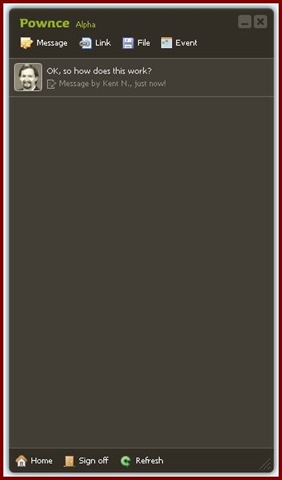
So far, it looks like it combines a web-based, Twitter-like conversation page with an IM-like application (pictured to the left) that allows you to send and receive messages, links, files and events.  The first three are self-explanatory.  Events are messages with associated dates- good for letting people know about, well, events.  You can send any of the foregoing to the public, all of your Friends (the Web 2.0 word for contacts), or just a specified Friend.  You can group your Friends into sets, which seems very handy for project collaboration, etc.

You can send files of up to 10MB.  For $20 a year (Paypal accepted), you can send 100MB files and have an ad-free experience (though so far I haven’t seen any ads).

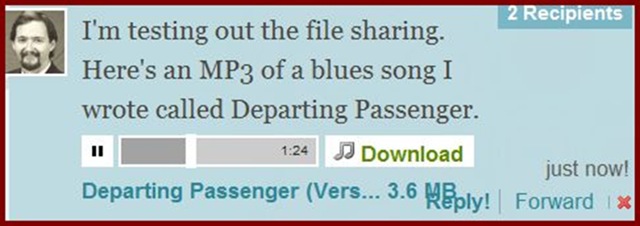
I sent my Friends an MP3 of my blues song Departing Passenger.  Lucky player3231 fellows.  The file uploaded reasonably fast and, presto, it was there on my Pownce page.  There is a player application that loads a tad slow, but sounds good.  The navigation below the player is a little jumbled, probably because of my monitor size and resolution.  A lot of pages have this problem, including both Morningstar and CNN, which is surprising to me.

Finding friends is similar to Facebook.  You search for them and then send a Friend request.  The recipient can accept or decline.  If the recipient declines, you become merely a Fan of that person.  I’m going to apply my Pink Floyd Policy to Pownce, which means that I shall be merely a fan to no man (or woman).

Of all the times I have experimented with all the various IM and IM-like programs, right now and Pownce seem the most compelling to me.  Twitter brought a lot of folks into the collaborative IM space and Pownce may just be the next evolutionary step.  Stan Schroeder says Pownce may, in fact, be the Twitter killer (at least it isn’t Quixotically aiming at YouTube like everybody else).  I think there’s room for both, though Twitter is clearly behind in the feature race.  It’s too early to tell how well Pownce will scale, though it did have a short outage earlier tonight.

If Pownce wants to seep deeply into the IM space, it will need to address the same incompatibility problems the other IM applications face.  As I have said before, IM needs to be like the telephone.  Not like a series of tin cans tied to a proprietary string.

Now what I need is some Friends to use it with.

I have a few Pownce invitations to hand out.  I’ll send them to the first 5 people who leave a comment asking for one, on the condition that everyone who gets one agrees to return to the comment thread here and send invitations to others in the queue.  I am particularly interested in getting my core blogging buddies signed up.

You know who you are, so let’s get started.

Technorati tags: ,

Annoying Windows Vista Problem Solved

Ever since I installed Vista on KN-1, my home built computer, I have had one extremely annoying problem.  After my computer runs for a while, the toolbar gets all out of whack.  Like this:

mess 2

The buttons get all jumbled up and stop responding.  It is very, very annoying.

The only solution I could come up with was to reboot, which was very disruptive to whatever task I was working on.  The problem was even more irritating because when this happens, the restart button stops responding, and I have to do the control-alt-delete thing just to restart.  This mess has been a major drain on my efficiency and I had even begun to consider trashing my computer and starting over- in a desperate attempt to solve this problem.

Weekends in the Houston language translates to “rains all day.”  So I decided to use my forced indoor time today to see if I could find a solution to this problem.  Of course, I started with the answer machine- Google.  After running down a few wrong trails, I came across this inviting Microsoft Knowledge Base page.  I first tried the work around:

1. Press CTRL+ALT+DEL.
2. Click Task Manager.
3. Click the Processes tab.
4. Click the explorer.exe process.
5. Click End Process, and then click End process.
6. Click the Applications tab.
7. Click New Task.
8. Type explorer in the Open box, and then click OK.

Lo and behold, that fixed the problem.  At least now I wouldn’t have to control-alt-delete and restart every hour or so.

Next I installed the hotfix from that page.  It installed.  I was hopeful.  I rebooted, even though I wasn’t prompted to.

Four hours later, I am still working and my toolbar looks normal.  And the buttons work.

I can’t adequately explain how happy I am to (cross my fingers) have this problem solved.

If this post can help one other person solve this problem, it will be worth it.

Evening Reading: 6/30/07

It seems Twitter, which granted is a neat little application, is out looking to turn that neatness into cash.  Download Squad reports that Twitter is trying to raise its first round of venture capital funding, and then wonders if the old standby, getting bought by Google, may not be the answer.  As Download Squad says in the article: “Twitter is extremely focused on growing their network of users before making money, and they really don’t have an evident business model as of yet.”  There is a universal assumption by those looking to make money on the internet that traffic can always be monetized.  I don’t think that’s always the case.

JPEG Enhancer is a free application that promises to help clean up old blotchy photos from your first digital camera.

Martin Gordon does a mini-review of Lifehacker’s Top10 iPhone Applications.  He found some usability issues.

Mashable has a feature by feature comparison of 14 personalized homepages.  God, I hope social networking isn’t really “the next evolution of the start page concept.”  The more I see these start pages try to be average at everything instead of excellent at one thing, the more I think making your own start page is the way to go.

Dave Wallace has created a History of Disability in South Australia website that tells stories of Australians involved with disability issues.  Here’s Mike Seyfang’s review.

This guy’s baby book showed up on eBay.  Being a second child, I never had much of a baby book.  Delaney (our second) has a sparse one.  Luke (our third) doesn’t have one at all.  We promised ourselves we wouldn’t do that.

@Seth: I agree that marketing by fear in a way that benefits only the marketer is bad.  I really don’t like it.  But, as you mentioned, CNN and every other news organization do this all day, every day.  When all that matters is attention, what better way to get it than to shout danger at every opportunity.  It is a corruption of the preservation instinct in the name of a dollar.

Everyone may be gunning for YouTube, but the war is over.  All that remains in to see who gets the most scraps.

Techdirt, which has always been at the forefront of the music industry debate, has a must read post about the record stores doing their part to keep the industry screwed up.  I used to enjoy going to record stores…back in the 80’s.  If I can browse music from my desk, hear clips without having to use waxy communal headphones, click a button and have the CD show up two days later, I don’t need a music store.  Particularly if it’s going to take a page from the RIAA’s empty book of logic.

Thomas Hawk on iPhonestock.  I don’t know how you can read Thomas and not pull for Zooomr.  I guess that means he’s doing he job.  I just wish they’d make the sign-in process easier.  I signed up back when it first launched, lost my credentials and am caught in OpenID hell.

Donna Bogatin takes a look at iPhonestock too.  Justine has a post on the Summer of Phone.  Meanwhile Scoble has lost his buzz and noticed that he has a mild headache.  But at least he’ll be able to tell his grandchildren he was there, and be telling the truth.

Jeff Balke on mixing his band’s new CD and the loudness problem.  I’m not generally in the studio when my songs are recorded (being solely a songwriter at this point), but I have always felt that far too many records are mixed too hot.  The video Jeff found is spot on: when there is no quiet, there can be no loud.

Technorati tags:

3 Reasons Blogging is Like Songwriting

All the people at this party
They’ve got a lot of style
They’ve got stamps of many countries
They’ve got passport smiles
Some are friendly
Some are cutting
Some are watching it from the wings
Some are standing in the center
Giving to get something

– Joni Mitchell

I’ve said numerous times that blogging has largely replaced songwriting as an outlet for my need to write, share and reach.  The more I think about it, blogging is very similar to songwriting.

Here are three reasons why.

1) They Both Need Good Hooks

Blog posts and songs both need good hooks to be successful.  In songwriting, the hook is the part of the song that sticks in the listener’s mind.  The part that is the most memorable.  It’s also often the first part of the song that is written.  Hooks can be, but are not necessarily, the title of the song.  In my song Your Turn to Fall, the hook is the line “Your face is familiar, but I can’t recall your name girl,” which was inspired by a button my sister gave me.  It was also the first part of the song I wrote.  Similarly, the rhyming couplets “sober” and “over” and “drank” and “thank” from the chorus of Bloodshot Eyes were the beginnings of that song.

Hooks in blog posts are even more important than in songs.  With hundreds of people writing about the same stuff, there needs to be something about the post to catch the attention of the prospective reader and linker.  In traditional journalism, the tag at the end of the article serves as the big send off.  But a good tag at the end of a boring blog post will never get read.  Thus, I believe that in almost every case the hook in a blog post needs to be the title.  When readers are skimming their feeds in a news reader, something has to grab their attention and cause them to slow down and read the post.  For me, and I suspect others, the second best way to get me to read a post is to have a catchy title (the best, of course, being to ping me with a link).

When I wrote my Fear and Loathing post the other night, I almost called it “All My Friends are Going to Be Strangers,” after the Larry McMurtry book (a line I also used in Your Turn to Fall).  But as I thought about it (and counted to 10, given that I was seriously irritated at the time), I decided that more people would know of and relate to the Fear and Loathing title, which is obviously also a literary reference.  Plus, I thought the former title was too personal to me, and I wanted to make points that had application beyond me and my blog.  I wanted a title that was reasonably descriptive and likely to make people a little curious as to its content.

The post that really got things moving on this blog was my post from January 1, 2006 called Why It’s Impossible to Build a New Blog in 2006.  The title put me squarely in the middle of the gatekeeper debate, and not everyone agreed with me, so a lot of good discussion ensued.

2) Every One of Them Can Be Improved Upon, But Should You?

One of the hardest things about songwriting is trying to figure out when a song is finished.  That’s because, as every writer knows, every song in the world can be improved with a rewrite.  I have literally hundreds of songs lying around in boxes and on tapes that are not, in my mind, ready to be heard.  Heck, when I browse my Err Bear Music page I can’t find one song that I couldn’t make better with a tweak here or there.  I know writers whose songs are like the Winchester House– they keep writing them forever.  And never record or release them.  But at some point, if you want to get your material out there, you have to let it go.  Even if part of you believes it would become a number 1 hit with one more rewrite.

Blog posts are the same way.  When I read old posts of mine, I’m often amazed that I could write such drivel.  I see obvious and powerful points that I failed to make.  There’s not one post on my blog or any other that the writer couldn’t make better with an edit.  There are also posts made without all the facts and/or in the heat of the moment that you wish you could withdraw.  But there are no mulligans in the blogosphere- RSS and Google make sure of that.  So once it’s out there, new versions are just that.

On the other hand, much of the stuff we write about has a relatively short half-life.  So if we want to be part of the conversation, we need to get it out there.  My neighbors could hear me pounding on the keyboard the other night after I saw Louis Gray’s post.  All of this means that bloggers, like traditional journalists, are often under a deadline of sorts.  The beauty of blogging, however, is that it is sort of a hybrid between email and article writing.  It’s conversational nature is more forgiving.  Like email, the standards for typos and grammar are relaxed a little in the interest of immediacy.

So just because a song or a blog post could be improved with a few more rewrites doesn’t mean they aren’t ready for publication.  It’s a balance, but one that does not demand perfection.

3) Talent Does Not Ensure Success

I grew up listening to country music, but I haven’t tuned into an over the air country radio station in years.  Because the music that’s available there is not really country music- at least not the way I think of it.  It’s regurgitated pop made by pretty little media creations designed to grease the wheels of commerce.  The cycle goes like this: find someone photogenic who can at least croak out a melody, get the talented, starving and desperate songwriters in Nashville to come up with some commercial sounding songs, hire some magician-cum-producer to make it sound good and get the CDs into Walmart and Best Buy.  Much of the rock genre is the same way.  Meanwhile amazing talents like the Star Room Boys, the Drive-By Truckers and others gig away in obscurity.

The blogosphere is the same way.  You can write the best posts ever written, but if you don’t get the star making machinery behind you, few will ever read it.  On the other hand, if you can tap into the collective affection, all you need is cat pictures (I’m not dumping on the cats, as they have more readers than I have letters on my blog pages; but it’s not exactly Pulitzer material).

The music industry and the blogosphere are very inefficient entities.  But they are also similar avenues for self expression and the pursuit of a common experience.

Getting a link from another blogger and hearing your song being played, you know it’s the same release.

From Creation to Abandonment: the 5 Stages of Blogging

abandonmentBetween my earlier ScobleFeeds series and my current swivel feeds experiment, I have read a lot of blogs.  During this time, I have been looking for patterns and commonalities.  While it’s hard to draw too many universal conclusions about the blogging experience without front-end data, there are a few patterns that emerge.

One of them is what I think of as the 5 Stages of Blogging.  The stages of a blog’s life from the hopeful day of creation to the sad and sometimes seemingly inevitable day of abandonment.  It may not seem that way in the often competitive blogosphere, but the loss of every legitimate blog is a loss shared by all legitimate bloggers.

Which is a good reason to study the patterns and search for a way to reroute the process towards a better end.

All bloggers don’t experience all 5 stages.  The low financial and technical barrier to entry results in many hastily created blogs that end up abandoned during one of the early stages due to boredom or the lack of a genuine interest in blogging.  Some bloggers aren’t concerned with growing an audience and never reach the frustration stage when their blog’s growth rate stalls or reverses.  And once in a very great while a new blogger actually gets accepted into the warm, chummy place I talked about last night, and happily avoids the pain of the later stages (more often than not, there is an ancillary relationship that triggers this acceptance, but it does happen).  But the pattern is pretty clear, particularly in cases where new bloggers joins the fray in search of conversation, inclusion and readers.  It’s less clear in cases where the blogger is primarily concerned with making money or selling a product.  The psychological investment in blogging is less in those cases, and if the money isn’t made or the product isn’t selling, the blogger often just moves along to the next marketing angle.

If you believe, as I do, that the blogosphere ought to be about conversation and sharing information, as opposed to merely a new manner of media distribution and/or prospecting for gold, then you should be concerned about the high attrition rate in the blogosphere.  If you want to have conversation, then there must be others to converse with.  Encouraging new bloggers and promoting blogging as a means of communication is in the best interest of all legitimate bloggers, from the top of the A-List to the very bottom of blogger’s hill.

People tend to forget this very important fact: without the long tail, there is no short tail.

So why is there so much blog attrition?

Here are my 5 stages of blogging, from creation to abandonment.

Stage 1: Excitement

This is the early stage of a blog, during which a platform is selected and a template evolves, widgets and other ancillary content are added, and the initial blog posts are written.  Like the band who has been gigging for years before making a record, new bloggers – at least the ones who have done a little planning – generally have an albums’ worth of really good topics to toss out.  Those initial posts generate a little reaction, particularly if the blogger does his homework, identifies the established bloggers who are amenable to new voices and cultivates them.

Excitement is high during this stage and expectations are intact and rising.

Step 2: Expectation

After the blog is launched and the blogger has learned his way around the blogosphere, it’s time to start building traffic and readers.  There are three related ways to measure this growth: blog visitors, subscriber numbers and links.  During this stage, a little traffic goes a long way.  I still remember how excited I was when I had 100 inbound links (not from 100 different blogs; I’m talking 100 total).  I called my wife into my study to show her the first time my blog was on Techmeme (then known as Tech Memeorandum).  It takes work to pass those initial milestones, but they generally come within a reasonable period or time.  At this point, the new blogger is certain that before long he and all those guys and gals he reads about will soon be yukking it up in cross-blog conversations like old college buddies.  But like college, this stage doesn’t last forever.

One of two things will happen.  Once in a blue moon, the blogger will catch lightning in a bottle, get swept up by the blogging elite, and become a recognized name in the blogosphere.  Much more often, the blogger will hit a plateau and the growth of his still new blog will slow or flatline.  He’s not the new guy any longer, his album’s worth of posts are getting a little stale, and the lizard-like blogosphere has been distracted by all the other flies buzzing around.

At this point the once hopeful blogger finds himself writing away to what seems like a diminishing rate of return.

Stage 3: Frustration

Once the honeymoon is over, the blogging work that seemed so new and interesting at first starts to feel hard and frustrating.  And very, very inefficient.  The blogger can’t figure out how to generate enough traction to achieve the organic growth that is an absolute requirement to maintain a popular blog.  He writes thoughtful posts on hot topics, links like crazy to other bloggers and waits. And waits.  He gets a few links here and there, but the small return on the huge effort is profoundly discouraging.  The blogging elite doesn’t notice him and many of the other new bloggers are too busy fighting for attention to engage in any meaningful conversation.  The blogging happiness trend is going down pretty quickly, but not in a straight line.  Small victories occasionally conceal the larger defeat and the blogger bounces between the rock of discouragement and the hard to maintain place of synthetic optimism.

At this point, the blogger begins looking for a new angle to kick-start and accelerate the growth process.  Perhaps he crafts alliances with other similarly situated bloggers, which, like any attempt to change the status quo, only works as long as it has critical mass.  Inevitably, some will become convinced that they can muscle their way into the club and take advantage of the very forces that once kept them down.  It’s the same dynamic as the driver who slows down to rubberneck at a traffic accident, telling himself that he’s already paid his dues by waiting in the long line of cars.

For the new blogger, the collapse of his wagon train is just one more setback in a journey that grows more frustrating with every step.

It is during this stage that pandering, agitating and extreme positions in search of a reaction begin to occur.  Like the preschooler who acts out for attention, however, this approach is not sustainable over the long term.  Angry or effusive posts create a self-fulfilling prophesy, whereby the blog’s growth is even more negatively affected as a result of posts, cynical or sycophantic, inspired by the blog’s lack of growth.

This is probably the least happy time for most bloggers.  The former excitement is replaced by frustration and the growing belief that time spent blogging might better be applied elsewhere.  Many bloggers abandon ship at this stage.  Other trudge along wearily to the next stage.

Stage 4 Alienation

After the blogger’s capacity for frustration is exceeded, he does an about face and, instead of seeking inclusion in the conversations, he rejects the entire process completely.  At this point, the tailspin towards abandonment has begun.  The blogger’s mental image of the blogosphere as unicorns and butterflies in a field of wildflowers is replaced with an equally distorted image of a dark and wicked place, full of conspiracies and evil doers.  The benefit of the doubt is cast aside in favor of broad condemnation.

This alienation manifests itself in one or more ways.  Perhaps it takes the form of cynical posts about the unfairness of the system.  Or long periods without posting anything, followed by a week or so of active posting.  Rote behavior, in an effort to find the hidden key that will unlock the gate.

Some blogs exist in a near perpetual state of alienation.  Eventually, the alienation gives way to abandonment.

Stage 5: Abandonment

Next comes the unsatisfying end game for the discouraged blogger.  His once cherished blog is either cast into the abyss via the delete button or, more often, left to lie silent by the side of the road like a burned out jalopy.  A testament to the inefficiency of the process.

I am amazed at the number of abandoned or nearly abandoned blogs I come across.  All the information in all the posts that were never published lost- not just for now, but for all time.  The development of the collective consciousness interrupted.  Once here, twice there.  Before long the entire process is in jeopardy.

I don’t have an easy solution to reduce the rate of blog attrition.  I do what I can by trying to find and highlight blogs from the blogosphere’s mostly invisible middle earth.  I don’t know if that will make a difference or not.  I hope so, but I am not immune to discouragement.

What I do know is that all legitimate bloggers, regardless of our motivation for blogging, have a vested interest in nurturing the blogosphere and encouraging the creation and continued existence of legitimate blogs by people we don’t know yet who have a lot to say, a lot to share, and a lot to teach us.

Technorati tags: ,

Evening Reading: 6/28/07

I’m glad to see Bill Liversidge blogging again.  I really enjoy his writing.

C|Net has a photo gallery of tech’s most hyped product launches.

Survival Topics has a good read on the 5 Basic Survival Skills.

I know a guy named Frank Smith, but HearYa has a write up on the band by the same name.  The clip sounds really good.  Love that steel.

Dave Taylor looks at whether the iPhone will be a business phone.  I love me some Dave, but if it won’t synch with Outlook, it won’t be a business phone.  Thousands of IT departments whose bosses already fear anything resembling online data storage are not going to risk their jobs by forcing the issue.  Not when there are so many Blackberries out there that accommodate the safe decision.

Stereogum is my Marc Andreessen.  I just have to link to it every day.  Here’s its list of the 20 loudest albums of all time.

Dennis the Peasant is hilarious.  “It’s only a short step from Cole Porter to Edith Piaf. But I’m not one to withhold credit when credit is due: You’ve got to be an authentic phoney to listen to Edith Piaf and then act like it was a treat. I mean, it isn’t just that she’s French – although that should be enough for most people – it’s, it’s that she sounds like someone is goosing her at a rate of about 30 times a minute.”

Technorati tags:

Fear and Loathing in the Blogosphere

First my old buddy Mathew Ingram links to me, and then goes back and removes the link.  Even though I challenge you to find anyone who took a more even-handed approach than I did to the Federated Media/Microsoft discussion.

Now, Louis Gray (who I have linked to at least six times in the past month)  calls me a cheater.  Says I and those like me are ruining Technorati’s credibility by participating in viral tag link arounds.  He says my Technorati count is bogus.  Implies that I am a fraud who engages in a sultry practice.  He suggests that I lead by example and renounce my wicked ways.

Those are pretty strong words, particularly since Louis doesn’t know the first thing about me, including how to spell my name.  Apparently he doesn’t know much about the blogosphere either.

The blogsphere is not a level playing field.  Louis said as much the other day.  We’ve been talking about the gatekeeper thing for years.  There are a hundred theories about the cause, but there is only one effect: that there are those on the inside, where the blogosphere is all warm and chummy, and there are those on the outside looking in.  Personally, I think a lot of it boils down to three factors: (1) people blog for a lot of different reasons and blogs often have cross-purposes; (2) those who have proximity in career or geography can more easily create relationships that transcend the blogosphere, resulting in more shared attention; and (3) human nature.  It’s the human nature part that creates the walls that are the hardest to scale.

In other words, the walls may be naturally formed without malice.  But there are walls.

Those on the outside looking in can either accept it and move on (thus the high rate of blog attrition), pander to the A-Listers (take a look at Louis’s blog roll on the right side of his blog page for a great example of that) and hope you’ll one day get invited to the club (with the chance of success being roughly equal to the chance a high school basketball player has of making the NBA), or take the blogosphere for what it is and play the game with everyone else.  I have tried the first two and found them lacking.  I have tried the latter exactly twice.  Once here, which generated virtually no links, and once here, which generated quite a few.

Do those posts add value for the reader?  Of course not.  Do the ads we suffer through in feeds and on blog pages add value for the reader, of course not.  The latter are designed to line the pockets of those who see the blogosphere as a way to make money.  For me, the former is a small attempt to end run around the fact that, despite writing hard for years, I simply cannot get many of the popular bloggers to allow me into the conversation.  If bloggers like Dave Winer, Fred Wilson, Guy Kawasaki, Om Malik, Steve Rubel and others won’t let me join their conversations, what am I do to?  If waiting patiently doesn’t work?  If giving blogging up isn’t appealing?  If I am truly the hardest working man in the blogosphere and have so little to show for it, what is left?

I could write away in obscurity and support the machine for the benefit of the empowered.  I could establish some artificial moral standard that no one would know or care about- that would only apply to me, since almost everyone else is gaming the system in one way (ads, products or services to sell) or another (linking mostly to those in their circle of friends).  Or I could keep writing hard every day and try to find another way up blogger’s hill.  Try, as in two posts out of 1,262 posts.  That’s .002%.  I get far more “bogus” content than that every single day when I see all the ads my feeds.

The viral tag links are not nearly as meaningful as a link from a blogger engaging in cross-blog conversation with me.  But are they that different from the hordes of links Scoble and others get when they post about arm farting and whatnot?  Is a link from some other blogger via viral tags that much worse than all those upstream “I agree” or “look at me, please” links from some pandering wannabe?  I think not.  At most, they are equally worthless.  So don’t condemn one unless you’re willing to condemn both.  Those who live in glass houses, and all that.

If ads designed to separate readers from their cash are perfectly OK.  If partial feeds are OK.  If undisclosed conflicts of interest are conveniently ignored…how can sharing links be the great evil that needs to be exposed and eradicated?  And if sharing links for the sake of links is a sin, why didn’t Louis call me a cheater and a fraud when I did this?  Or this?

Dave Sifry, who knows a little about Technorati, says that “in this new world of conversation, the hyperlink is becoming a new form of social gesture between people.  It’s something akin to a tap on the shoulder.”  Maybe these viral tags are the blogosphere equivalent of the mosh pit where the disenfranchised jump around wildly to the horror of the ruling class.  Maybe they’re the Boston Tea Party where terrorists-cum-revolutionaries toss the highly taxed authority count into the sea.  Whatever they are, those who engage in them do not deserve the condemnation that Louis espouses.

The blogosphere isn’t a perfect place, but it’s the only one we have.  Bloggers aren’t perfect either.  As Louis will tell you over and over, I’m not either.

But if we’re going change the nature of the blogosphere, then there are a lot better places to start than calling me out as the poster child for bad behavior.

Technorati tags: ,

Evening Reading: 6/27/07

Pageflakes has apparently left the semi-crowded portal space and jumped into the insanely crowded social network space.  Social network is the most over used and meaningless term in the history of the internet.  It’s just links to people and information of interest, loosely wrapped around some commonality.  There have been social networks since the old BBS days.  All this stuff (I’m talking about the social network craze here, not Pageflakes) is just better technology aimed at capturing users to drive value for developers and venture capitalists.

I’m interested in Kevin Rose’s new instant messaging service, Pownce.  There needs to be a more intuitive and efficient way to share information.  Hey Kevin, want to hook me up so I can review it?

I guess the girls do get prettier at closing time. (via Obscure)

When we got married, my wife couldn’t name all four Beatles (she’s not all that into music).  Neither can Larry King.  Stereogum has the hilarious transcript

Dwight was a good write-up on the latest iPhone hype and mania.

Jeff Pulver is doing an Everyday Heroes project.  It’s a collaborative effort to feature amazing and inspiring stories of ordinary people.  I think it’s a great idea, and plan to participate.  I can think of several people who have a profound positive effect on the lives of those around them.  Now I just have to talk one or more of them into telling their story on film.  In the meantime YesButNoButYes has an everyday hero clip to kick things off.

Robert Hruzek has a list of interesting quotes.  I like the way Neil Young says it better that the way John Kenneth Galbraith does.

Scott Hanselman on escalating the communication.  There are a couple of people in my office who use the “Reply to All” button as a medium for self-promotion.  It drives most people crazy, but it also seems to work on occasion.  Sort of like spam, I guess.

MySpace for dogs?  Are you kidding me? What’s next DogPee, to help find the nearest fire hydrant?

Technorati tags:

Swivel Feeds, Group 7

This is an update on my swivel feeds experiment, in which I ask bloggers I read to help me rebuild my reading list by adding 5 of their favorite blogs to the list.  I’ve had a generally positive response so far, and my new reading list is coming together nicely, with a diverse and interesting mix of bloggers.  When the list is complete, I will share it and upload an OPML file for those who are interested.

Here’s how it works.  Every few days I ask a group of 8 of my favorite bloggers to each recommend 5 blogs to add to the list.  I’ll post the recommended blogs in a subsequent update, and add them to my swivel feeds list.  Each update has a list of the recent blog recommendations, followed by the next 8 bloggers who I am asking to add blogs to the list.

Here are the swivel feeds recommendations so far from the sixth group, plus any stragglers from prior groups.  Note that, when possible, I designate blogs by the name of the blogger, because I like to know who I’m talking to.

Adam Ostrow
Ah Soon
Alan Patrick
Andy Abramson
Blognation
Brian Balfour
Chris Marston
Crystal Jackson
Don Dodge
Ewan McIntosh
Funny Junk
Greg Sterling
Jeff Masters
JonnyB’s Private Secret Diary
Joshua Porter
Just Elite
Kfir Pravda
Liz Stauss
Nick Carr
Official Google Blog
Rod Begbie
Seamus McCauley
Stereogum
T-Critic
Tina Roth Eisenberg
Tom Evslin
Tony Hung
Twangville
Yes But No But Yes

I have subscribed to all of the recommended blogs, and all but two of them are new to me.

These blogs join the following prior recommendations and participants in the fifth edition of my new reading list.

A Cons. Experience
Adam Gaffin
Alan Levine
Amyloo
Anne Zelinka
Assaf Arkin
Ballastexistenz
Beth Kanter
BldgBlog
Blogging Pro
Blonde 2.0
Bob Meets World
Bonnie Staring
Brad Feld
Brad Kellett
C.C. Chapman
Chip Camden
Chris Brogan
Christine Thurow
Christopher Carfi
Claus Valca
Corey Clayton
D’Arcy Norman
Daily Cup of Tech
Dan Santow
Dave Rogers
Dave Taylor
Dave Wallace
David Cohen
David Rothman
Deborah Schultz
Dennis the Peasant
Donna Bogatin
Doug Karr
Dwight Silverman
Earl Moore
Ed Bott
Engtech Lite
Eric Olson
Ethan Johnson
f8d
Father Bob
Fear Not the Gods
Frank Paynter
Fraser Kelton
GAS Tech. News
Greg Hughes
Haydn Shaughnessy
Heise Security
Hilary Talbot
Howard Lindzon
Hugo Ortega
ICH Cheezburger
Ian Delaney
Ian Forrester
Ilker Yoldas
IT|Redux
J.A. Konrath
J.P. Rangaswami
Jackson Miller
Jay Neely
Jeff Balke
Jennifer Slegg
Jessica Hagy
Jing Chen
jkOnTheRun
Joe Wikert
John Tropea
John T. Unger
John Walkenbach
Jon Udell
Josh Kopelman
Justine Ezarik
Kevin Burton
Les O
rc
hard

Lisa Stone
Long Zheng
Lost and Gone Forever
Madame Levy
Marek Uliasz
Mike Miller
Nancy White
Nashville Is Talking
Natalie Goes to Japan
New Scientist
Nick Hodge
Nick O’Neill
Opacity
Paddy Johnson
Paul Colligan
Paul Greenberg
Paul Lester
Paul Stamatiou
Penelope Trunk
Phydeaux3
Quasi Fictional
Read/Write Web
Reg Braithwaite
ReveNews
Rex Hammock
The River
Robert Andrews
Robert Hruzek
Robert Nagle
Rory Blyth
SBWLTN
Scott Adams
Scott Hanselman
The Struggling Writer
ThoughtWorks Blogs
Tom Matrullo
Tom Moody
Tresblue
Trevin Chow
Tricks of the Trade
UNEASYsilence
Valleywag
War on Folly
Will Truman
Wonderland or Not
Wondermark
Zen Habits

From Group 6, I haven’t heard from JD Lasica, Jeneane Sessum, Jeremiah Owyang or Jeremy Zawodny.  Jimmy Huen has not yet made his picks.  From Group 5 I haven’t heard from Guy Kawasaki, Henry Blodget, Hugh MacLeod or Jake Ludington.  My general policy is to assume non-participation after 2 weeks.

From Group 4Eric Scalf, Frank Gruber and Fred Wilson did not respond.  All have been dropped from the swivel feeds list.

Now for the next 8 bloggers, who I am asking to add 5 blogs to the list:

John Dvorak:  I enjoy John’s magazine articles greatly.  My Evening Reading segment was inspired by his column.

John Watson:  Father, blogger, software developer.  I love the way he captures universal truths – and sometime just humor – in his conversations with his kids.

Karl Martino:  Another long time read who blogs about new media, software and life in general.

Kate Trgovac:  Kate writes about social media, marketing, Web 2.0 and other interesting topics.

Kevin Briody:  Kevin is a Oregon Ducks fan living in Seattle.  Hopefully he’ll participate even though my Deacons came to his hometown and owned his Ducks in the 2002 Seattle Bowl.

Kevin Hales:  This Kevin is an NC State fan (Wake owns them too), a champion Scrabble player and one of the best writers I know.  I wish he blogged more.

Kevin Maney:  The former USA Today tech columnist has been a regular read of mine for a year or so.  He’s a musician too.

Larry Borsato:  Another long time read who writes on tech, media and all sorts of interesting things.

That’s the seventh group of bloggers I’m asking to help rebuild my reading list.  If you’re willing, please recommend 5 of your favorite blogs to add to the list.  Use the comments, your blog or email, whichever you prefer.