‘Tis But a Firewall

google

Google, taking a break from trying to build some more internets, has announced that it will combine its instant messaging service with Gmail, its web based email service. No word yet whether there would be one joint service for all internets or a separate service for each of the internets (can you tell I am irritated by the prospect of Google’s new internets?).

Anyhow, the idea seems to be that you’ll be able to chat directly from your Gmail account, without having to log into a separate chat program. Google figures that saving those 5 seconds will cause a cyber-stampede of users to drop their AIM and Yahoo IM accounts and thunder on over to Google. Somebody needs to tell Google that most companies not owned by Google block chat and web based email programs so their employees will actually do some work.

The good (by good I mean only mildly ludicrous) news is that the chat application will be able to communicate with other chat programs, including Earthlink’s chat program. It will be handy to be able to chat with the nine people who use it. Still no interconnectivity with AOL, Yahoo or MSN for all the reasons I talked about back in August.

I’m starting to think that Google took all that money it should have used to buy Flickr, Delicious and Technorati and bought some lost episodes of Monty Python’s Flying Circus.

Newsome.Org’s Web 2.0 Wars

93136022_25afa7e458-721640

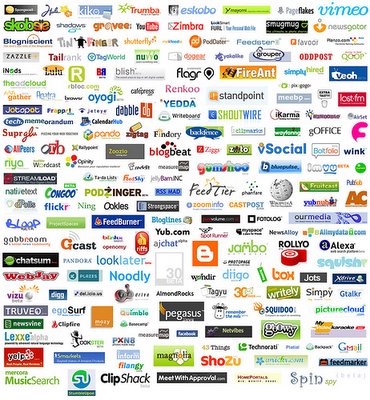
A larger version can be viewed at Flickr.

This aggregation of Web 2.0 logos has been floating around the internet today. I decided to count how many of these companies I have heard of (a low standard, since it doesn’t require that I know anything substantive about them) and how many I haven’t.

By my rough count, I have never heard of over half these companies, and I follow and write about this stuff. So either I’m in store for some treats as I learn about these companies (my wish) or there are too many companies chasing too little demand (my hunch).

Introducing the Newsome.Org Web 2.0 Wars

I like a good contest, so I am going to create my own little face off. Here’s how it’s going to work. I have divided the companies into groups based on the line on which their logo appears above. I will take a look at the web site of each company and then pick the one I think has the best prospects. There will be one winner for each group (no ties). After that, we’ll move to the semi-finals and then crown a champion.

Yes, I use some of these services now, and that may give those companies an advantage. But I will try to minimize that influence and I will mention it when I already use a service.

Without further adieu, here are the contestants for Round 1:

Spongecell
Hula
Kiko
Trumba
Eskobo
Mayomi
Pageflakes
Vimeo

Spongecell is a web based calendar. You can text message to add events, and it recognizes “Dinner with Om at 8:00 to discuss why he hasn’t linked to Newsome.Org in 513 days” as an event and adds it to your calendar. Sounds interesting, but it’s in a bit of a crowded space.

Hula is also a web based calendar. Novell has something to do with it. It is open source.

Kiko is also a web based calendar. Drag and drop functionality, but the demo (still in beta) has a less than appealing interface.

Trumba is, you guessed it, a web based calendar. You can get a free trial, but it costs $40 per year to use. PC Magazine likes it- says it would be a good choice for families and groups. It better be really good if they want people to pay for it (that may be sad, but it’s the reality of the Web 2.0 customer mindset).

Eskobo is not a calendar. It’s a content aggregator similar to Netvibes. It appears to be in early beta, as the “About” page is blank.

Mayomi is a “mind mapping tool.” I’m not really sure what that means, but it sounds like project or goal charts with a database sharing element.

Pageflakes is a content aggregator, like Eskobo and Netvibes. It looks very similar to Netvibes (I don’t know which came first). It seems further along than Eskobo.

Vimeo is a video sharing and search service. I can’t tell if they host video content (like Castpost) or not. There is very little information available on the front page.

Before Today I’d Heard of:

0 out of 8

And the Winner of Round 1 is:

Pageflakes in a squeaker over Trumba. I imagine Trumba is pretty cool, but there’s that money thing. None of them blew me away.

Technorati Tags:
,

Why Isn't There a Texas Version of Gillmor Gang?

I just listened to the latest Gillmor Gang podcast. Gabe Rivera of Memeorandum was a guest. Mike Arrington seems to have joined the gang. Doc Searls, Dan Farber and Steve Gillmor were also in attendance.

Lots of great conversation both with Gabe about Memeorandum and about blogs and meme trackers in general. I really enjoyed listening to this podcast.

Why isn’t there a local, Texas based, group podcast with a similar tech-wide approach? I like reading these guys’ blogs, but the interaction on the podcast was so interesting.

Or is there a local group podcast like this that I don’t know about?

Dwight Silverman, James Kendrick (who does a great mobile tech podcast already), other Texas based tech bloggers: why aren’t we doing something like this?

I realize that Gillmor Gang is a hugely popular podcast of national interest, but it seems to me that something like this would be of interest to local readers and listeners.

Tags:

coComment: Comment Tracking

One of the hot topics on the internet the last couple of days has been the private beta launch of coComment. coComment allows you to track comments you make on other blogs and display them via a customized page at coComment, a side bar component (like I do with Most Recent Inbound Links on the right side of the main Newsome.Org page) and/or via an RSS feed. The service is free and it looks very promising.

Solution Watch has a very good summary of how it works.

Here’s what I have been doing to track my comments and my initial impressions of coComment.

My Old Plan

Previously I have been bookmarking my comments on other blogs via Delicious with a “mycomments” tag. Here is that page on Delicious. Then I use RSS-to-Javascript to create a java script that I display on my Comments Elsewhere page (Update: no longer in operation). I didn’t think this up. I read about it on A Consuming Experience or Fresh Blog or somewhere similar.

It works pretty well, though occasionally RSS-to-Javascript is slow or down. But it has been a pretty reliable system so far.

My New Plan

Now I am going to start doing my comment tracking and serving via coComment. There’s not much I can add in the way of an introduction to the service that isn’t covered by the Solution Watch post, but here are my initial impressions. I’m not going to talk about bugs and whatnot, since that is the whole purpose of beta testing and I’ll post those reports in the coComment beta forum. But here are my initial thoughts on the service.

The bookmarklet that you use to integrate your comments into the coComments feed is simple to install (at least in Firefox) and very unobtrusive. It only requires a single click before posting a comment to another blog and a little icon appears in the comment box to indicate that you’re good to go. All in all, the commenting process is the same as it was before, with only a single additional click required. This should solve one of the concerns Mike Arrington had yesterday about using a third party service for commenting. It’s much more like Delicious in this regard than it is a third party central commenting platform (which is a good thing).

So the comment tracking seems to be very well implemented and easy to set up and use.

The side bar comments serving is also an improvement over my current approach. I have not added that content to the main Newsome.Org page yet, but I have been testing it on a separate page. I don’t know if I’ll add it to the main page or not, but at a minimum I’ll reconfigure my My Comments Elsewhere page to use coComment.

The most promising feature is the RSS feed of your comments. I am still playing around with this feature and will talk about it more in my next coComment article.

Current Conclusions

A very promising service. Wonder if they can figure out a way to do the same thing with inbound comments?

The Kawasaki Rules

Guy Kawasaki has a great post today about email etiquette. I agree with pretty much all of his rules, but there is one that should have a series of treatises written about it:

Use plain text. I hate HTML email. I tried it for a while, but it’s not worth the trouble of sending or receiving it. All those pretty colors and fancy type faces and styles make me want to puke. Cut to the chase: say what you have to say in as brief and plain manner as possible. If you can’t say it in plain text, you don’t have anything worth saying.

Amen. I could write 10,000 words and not begin to tell you how much I dislike html emails. I don’t get many html emails at home, since most of the people who email me at home fall on either end of the html email spectrum: they either don’t know how to send an html email or they know better.

But at the office- that’s a horse of another color. Typically a pastel color, with little cats or bears or yodas or something on them that is intended as stationary but ends up as rage inducing fluff. I would guess that around half the emails I get at the office are html email. The colorful text is bad enough, but the fancy, funky, indecipherable fonts on top of the wild colors and dancing yodas turn communication into frustration.

Outlook lets you force emails to display as plain text, and I use that feature some. But elaborate emails that contain something I need to read can get all jumbled up when transformed from foolishness to function.

I really, really, really don’t like html email.

Tags:

Reviewing the Memeorandum Chasers

Mike Arrington (who will one day link to Newsome.Org, even if he doesn’t know it yet) has a post today about the various real-time news aggregators who are racing to be the next Memeorandum. Some of them I knew about, some of them I didn’t. I’m going to take a real-time look at each and see what I think.

Memeorandum

Do I Love It: Madly. I’ve talked a ton about Memeorandum, so there’s not much more I can say. It is the New York Times of the blogosphere and the first site I read every morning.

Does It Love Me: Most of the time. Many of my posts show up there. There have been periods in the past where they don’t for a while. But I have defended it as one of the most equal opportunity sites in the blogosphere and I will continue to do so.

Conclusion: The undisputed king of the hill.

Megite

Do I Love It: We just met, but so far I’m pretty infatuated. I like the interface a lot, even though it is not as eloquent at Memeorandum’s. I’ve found a lot of good stuff here. One of my daily reads.

Does It Love Me: So far. Many of my posts show up there.

Conclusion: Definitely has legs and will be a major player in the aggregation and content mining game.

Chuquet

Do I Love It: Pretty much, though it is a work in progress. I mentioned it the other day. It seems to have a broader focus (but not too broad), which gives me links to stories I don’t always see elsewhere. I like the Flickr Wall.

Does It Love Me: So far. Some, but not all, of my applicable posts show up there.

Conclusion: A work in progress, but very promising.

Technorati Kitchen

Do I Love It: Well, as a self-proclaimed customer evangelist for Technorati, I better say yes. The truth is that I like it OK, but I don’t use it nearly as much as I do some of the others. Plus, it seems a little heavy on the A-Listers, which may mean that it’s solely link driven.

Does It Love Me: I don’t know. I’ve never seen one of my posts there, but I haven’t looked all that much.

Conclusion: I like it, but I don’t love it.

Tailrank

Do I Love It: I’m starting to have feelings for it. I like its straight forward interface, more than Chuquet’s but a little less than Megite’s. I read it every day, so it must be doing something right.

Does It Love Me: At first it hated me, now it’s starting to like me a little. Some, but not nearly all, my posts show up there. Hopefully, we’re going to start going steady soon.

Conclusion: Part of the Big Three princes in Memeorandum’s kingdom, along with Megite and Chuquet.

Blogniscient

Do I Love It: I don’t know. It seems extremely weighted toward the “Top 100” blogs. I didn’t see any links there I haven’t seen elsewhere already today. Maybe this is designed as a way for new blog readers to find the most popular blogs. I do like the page design a lot. I just don’t know how inclusive it is.

Does It Love Me: I don’t know. I can’t see any way to view the archives or to search the site. My hunch is that it doesn’t love me.

Conclusion: Seems like it might be a closed system to me, but I can’t be sure. Requires further study.

Blogrunner

Do I Love It: Sort of, but it’s more of a straight news site and I get that sort of news elsewhere. I can see the attraction for someone more news-interested, though. The sub-pages are too busy.

Does It Love Me: Almost certainly not.

Conclusion: Good execution, but less interesting to me than many of the others.

Blogsnow

Do I Love It: Not really. It’s simple interface would be good for mobile users.

Does It Love Me: Sadly, no. There are posts that link to me in the list, but none of mine.

Conclusion: I’m impressed that someone could create this, but I get most of this content already elsewhere.

Topix.Net

Do I Love It: Not really. It’s a part of a larger content aggregation page and it has blogs on all topics in a single category. Too broad for me.

Does It Love Me: I don’t know. Probably not.

Conclusion: Not a true blog aggregator by my definition.

On Deck

Newroo and Tinfinger (launching soon). I’ll write about them once I have the chance to check them out. Beta invites welcome.

Internet Email Face-Off

Months after I got invited to beta test Gmail and Windows Live Mail (the upcoming successor to Hotmail), I finally got my invitation to beta test the new version of Yahoo Mail the other day. Now that I’ve used all three, here are three things I like and three I don’t about each.

Was the wait for Yahoo Mail worth it? Maybe- it’s pretty cool. Let’s take a quick look at all three applications:

Gmail

I Like:

1) The ads are unobtrusive. This is a huge advantage at the moment.

2) The Compose Mail window is the best of show. Lots of features, clean, uncluttered layout.

3) The Gmail Manager extension for Firefox makes it very easy to manage multiple Gmail accounts. A big advantage if you use multiple email addresses.

I Don’t Like:

1) No folders: I am still a folder guy when it comes to email storage.

2) If you’re used to Outlook, it’s a little hard to navigate.

3) Web Clips should be in addition to, not in lieu of, full RSS features.

Windows Live Mail

I Like:

1) If you use IE, the layout, look and feel are very similar to Outlook.

2) The multiple sort options in you inbox (by date, from, subject and size).

3) Great integration of email, calendar and contacts.

I Don’t Like:

1) Many features don’t work with Firefox. The Live Mail team is working on this and I suspect it will be a temporary problem.

2) I couldn’t figure out how to import calendar and contacts from Outlook. Hopefully this is coming. If I could synch between my home and office computers using Live Mail, that would be a huge advantage.

3) Needs RSS features.

Yahoo Mail

I Like:

1) It seems very well designed in general. The slight leader over Live Mail at the moment.

2) The calendar view and features are great.

3) RSS implementation is well done. I’ll never read the majority of my feeds in an email application (for these reasons), but some RSS feeds (like newspaper headlines, etc.) are perfect for reading in an email application.

I Don’t Like:

1) It crashes sometimes when I access it with Firefox.

2) Bad ad implementation- a great big ad at the top right. Again, use unobtrusive text ads.

3) I don’t like the contacts view nearly as much as I like the view in Outlook. Give us some display options here.

Conclusions

I have moved my RSS feed reading almost exclusively online. But because my primary email address is not a Gmail, Live Mail or Yahoo address, I still read most of my mail offline, via Outlook. Yahoo lets you retrieve your other email, which is handy if you want to access your email via someone else’s computer. But if you have your computer, it’s always going to be easier just to access your other email directly, via Outlook, etc.

All three applications have great features working in their favor. All three are still in beta, so the story isn’t over. But as of today, if I had to pick one to use as my primary email application, it would probably be Yahoo, because of the RSS implementation and the ability to access my primary email if I need to. If Live Mail gets Firefox friendly and adds RSS capability and POP mail retrieval, its Outlook-like features will give it the edge.

My prediction: Yahoo is ahead at the moment, but Live Mail will catch up. Gmail will be everyone’s “second” email address for a while until Google capitulates and makes a more traditional inbox structure an option.

Long term, all three will have significant market share, which is a win for the consumer.

Google to Acquire World

buytheworldAt least according to this article in the Times of London (which presumably is read by the Werewolves of London).

I don’t even know where to start, so let’s take this story paragraph by paragraph.

Google is working on a project to create its own global internet protocol (IP) network…

I was thinking just the other day that I wanted another internet. If one is good, two or three would be better. I was going to call my old jogging buddy Al Gore and ask him to invent another one. Now I don’t have to, because Google already did it.

Last month, Google placed job advertisements in America and the British national press for “Strategic Negotiator candidates…

Strategic Negotiator must be a negotiator who uses more strategy. I bet the frugal ones drive Pre-Owned Cars. I don’t know what dark fibre is (the re must mean that it’s not a thread), but this all sounds too James Bond to be real. I think Google is messing with us.

Dark fibre is the remnants of late 1990s internet boom where American web companies laid down fibre optic cables in preparation for high speed internet delivery…

OK, now I get it. Sort of like what 360Networks was going to do back in the nineties when I bought all that stock that later became worthless. Maybe Google can get into alchemy too while they’re trying all these old get rich quick schemes.

Late last year, Google purchased a 270,000 sq ft telecom interconnection facilities in New York. It is believed that from here, Google plans to link up and power the dark fibre system and turn it into a working internet network of its own.

This paragraph pretty much speaks for itself. Shoot, everyone should have their own internet. Maybe Google can mass produce internets at some of the abandoned automobile plants that Michael Moore likes to talk about. I think I see a movie possibility here.

It was also reported in November that Google was buying shipping containers and building data centres within them, possibly with the aim of using them at significant nodes within the worldwide cable network…

I actually know a guy who wants to buy cargo containers and turn them into housing for retirees. When he told us about it the other day on the way to Galveston, I laughed so hard I almost wrecked the car. I hope he doesn’t care that I’m talking about it on this internet, or that Google is going to corner the market on cargo containers the way the Hunt brothers did with silver back in the day.

Google has long been rumoured to be planning to launch a PC to retail for less than $100…

Well, that was sort of a left turn, but someone has to use all these new internets and what better way to ensure that happens than to give a bunch of really crappy computers to poor people and make them watch Google Ads over one of the Google Internets while using a Google Computer. I predict a line of cars will be the next step in Google world dominance. After they abandon the mass production of internets, they’ll have to find something to do with all those automobile/internet factories.

[[[I’m going to skip a few paragraphs because they aren’t ludicrous enough to warrant comment.]]]

However, industry insiders fear that the development of a network of Google Cubes powered over a Google-owned internet network will greatly increase the power that Google wields over online publishers and internet users.

Really? Ya think?

Should Google successfully launch an alternative network, it is theoretically possible for them to block out competitor websites and only allow users to access websites that have paid Google to be shown to their users.

Nobody will be upset about that, particularly after all the hell raising Google and others have done about the telecos trying to toll the pipes on the existing internet. Assuming this isn’t a joke (and I believe it is either a joke or a tragically funny misunderstanding), this is just Google thumbing its nose at the telecos. PR by satire.

However, the moves towards providing equipment for as little as £60 will prove popular with home users and even governments, who will welcome the spread of the internet to homes that could not previously afford the intital costs of purchasing PCs.

Well isn’t that heart warming. We’re going to build a bunch of internets and give you some near-computers so you can stare at our ads and use our internet(s) all day long. I’m surprised the Red Cross hasn’t already done this.

Contacted by Times Online today, a spokesperson for Google denied that it had any such plans…

Let’s hope not, because if it’s true, we’re all living in a Monty Python movie.

Technorati Tags:
,

Don Dodge: Interview with Gabe Rivera

Don Dodge has a very interesting interview with Gabe Rivera, the creator of Memeorandum.

In the interview, Gabe talks about the creation of Memeorandum and addresses several of the issues I talked about the other day when defending Memeorandum from what I felt was undue criticism.

Memeorandum is not perfect, but it is the place to start if you want to know and read about the hottest tech topics of the day.

Tell Me Why I Should Care About IE 7

ie7I’ve been vaguely following the release of the public beta of Internet Explorer 7. There have been some good reviews, some bug reports and a lot of hubbub in general.

In the past, I would have immediately downloaded the program, installed it and used it exclusively. But this time…I am profoundly uninterested. I am convinced that IE has fallen so far behind Firefox (mostly thanks to the multitude of add-ons and extensions) that the race is over. Some reviews cheer the addition of RSS and predict that IE 7 will spell the end of many feed readers. I think not.

For one thing, there are a lot of very good feed readers out there now, and anyone who is already using one is, by virtue of knowing what RSS is and how to read it, reasonably tech savvy and unlikely to abandon whatever reader he or she is currently using in favor of IE 7. Additionally, the killer news reader application will be an online, not offline, reader. The sole reason I use Bloglines is because, while not perfect, it provides synchronization of my feeds, regardless of whether I use my home computer, my office computer or my laptop. If I mark a feed as “read” at home, it’s still “read” when I check later from the office. No need to reread and remark old posts, the way I would have to with an offline reader.

I suggested weeks ago that Microsoft figure out some way to easily synchronize feeds over multiple computers, perhaps via Foldershare. Until that happens, RSS in IE is a nice feature, but it won’t reshape the RSS world.

The other stuff IE 7 adds is nice, but again, Firefox is so far ahead, I think Microsoft is playing for second- at least as far as the technorati goes. Granted, IE will always have a huge user base because it will be the browser of choice for the out of the box computer users. But I just can’t get fired up about it.

Can anyone tell me why I should care about IE 7?