ZumoDrive vs Dropbox

zumodrop

Well, no one hooked me up with a ZumoDrive beta invitation the other night (sort of like nobody ever responds to any of my other @Twits, but that’s a topic for another day), but that’s OK because ZumoDrive opened to the public today, which means even lowly outsiders like me can use it.  And use it I did.

Here’s my report and the reason why I prefer Dropbox.

Sign Up and Installation

Sign up is simple and, like Dropbox, involves the installation of a local application to mount the service as a virtual drive on your computer.  Upon installation, ZumoDrive shows up as a removable storage device on your computer.  Here it is, amid the extraneous and empty disks courtesy of my card reader.

zdmycomp

The virtual drive looks and operates like any other hard drive on your computer.  You can drag and drop files, add new folders and generally manipulate the virtual drive the same way you would with your local hard drives.  ZumoDrive installs itself as the “Z” drive on your computer, which worked fine for me, but might be a problem if you already have a disk mapped to the “Z” letter.  I saw a post in the ZumoDrive forums indicating that there may eventually be a way to change ZumoDrive’s drive letter.  This should be a priority.

You can install the ZumoDrive application on as many computers as you want, and each computer can then access the files in the same manner, via Windows Explorer.

All of this works well.  It’s similar to Dropbox, except that your storage space shows up as a virtual drive as opposed to a “Dropbox” folder in your Documents folder.  ZumoDrive has the advantage here.  It also has a slight edge in the web page design category, though so little of my activity will be through the web interface that this doesn’t really matter.  So far, ZumoDrive works as advertised and is a very solid application, particularly for one that went public today.

Sharing

But there lurks a dark lining inside of every silver cloud.

Oddly enough in these social media/sharing crazed days, the ZumoDrive experience breaks down when you try to share your files.  As a test, I uploaded an MP3 of one of my songs (“I Know Better Now”) to ZumoDrive and to Dropbox.  It was an easy drag and drop experience in both cases.  Next, I tried to share that file, so I could link to it, use it on my Blip.fm page, etc.  With Dropbox, it was as simple as right clicking on the file right there in Windows Explorer and selecting Dropbox > Copy Public Link.  The URL is copied onto your clipboard for easy use.  Blipping the song on Blip.fm is as simple as pasting that same URL into the search box.  Easy as pie.

When I tried to do the same thing with ZumoDrive, things got a little complicated.  When you right click on the file, again right there in Windows Explorer, you have an option called ZumoDrive Share.  Click on that and a box pops up with 3 options.  Link, where you get a link that supposedly links to the file (more on this in a moment); Shared file, where you can enable other people to access and modify the file (this looks similar to the way access is granted in Google Documents); and Embed, where you get code to embed the file in a web page, using an iframe (flash would be cooler, but OK).  Unfortunately, the embed feature did not work with my MP3 or another MP3 I tested it with.  That wouldn’t be a big deal, as long as the Link feature worked.

But it doesn’t.

The link that ZumoDrive presented for my MP3 doesn’t link to the actual file, which means that it doesn’t play when you click it, and you can’t use the file on Blip.fm or any other similar service.  Rather, the URL links to a page at ZumoDrive where you can access the file.  If that’s not enough of a buzz kill for you, you can’t even play the song from that page- or at least I can’t.  I get a message that the file cannot be viewed and may be corrupt.  Sure, you can download the file, but that’s three steps to listen when it ought to be one.

zdmessage

Maybe there’s a way to do what I’m trying to do via ZumoDrive, but a half hour of hard looking, a reading of the FAQ and a visit to the user forums did not uncover it.  It took no time at all to figure out how to do this via Dropbox.

iPhone Applications

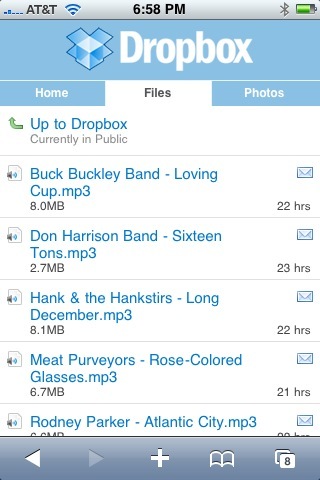
Of course, to get total love, an app like this has to be accessible via my beloved iPhone.  Dropbox has an iPhone-designed web interface, which seems fast and stable.  It’s easy to select and stream a song right from Safari.  I’d actually prefer a dedicated iPhone app, but it’s hard to find anything wrong with Dropbox’s iPhone integration.
dbox
Some mighty fine music in there

ZumoDrive offers an actual iPhone app called Supersize me (iTunes link), which interestingly turned up as the only search result when I searched the App Store from my iPhone for Dropbox.  Accessing files through this app is as easy and enjoyable as trying to access the files via URL was frustrating.  The app is stable and fast, and my song streamed quickly.

zdiphone
Only one song in there so far, but it’s a good’un

Overall, I’d give both services high marks for their iPhone implementations.  Maybe the slightest of edges to ZumoDrive because it is an app.

Price

You can’t truly decide between the two without comparing their prices.  ZumoDrive gives you 1GB for free and Dropbox gives you 2GB for free (or stated another way, paying customers subsidize a free gigabyte or two on every desktop).  Here’s how the paid plans compare:

Dropbox ZumoDrive
1GB N/A Free
2GB Free N/A
10GB N/A $2.99/mo.
25GB N/A $6.99/mo.
50GB $9.99/mo. $11.99/mo.
100GB N/A $19.99/mo.
200GB N/A $37.99/mo.
500GB N/A $79.99/mo.

At the present, Dropbox only offers the 50GB paid plan, but the FAQ says other plans will be available in the future.  I’d say ZumoDrive is one good reason to hurry that up.

Dropbox is cheaper, at least for the comparable 50GB plan.  If I were to go all in, I think 100GB would be my sweet spot, which is a bit of a drawback for Dropbox.

And Then Comes the Deal Stopper

It would be a tough call if the URL sharing for ZumoDrive worked as well as it does for Dropbox.  But, at least as of now, it doesn’t.  The jacked up way ZumoDrive handles URL sharing is a deal stopper for me.  If they fix this, it would be a virtual tie: Dropbox’s lower price battling it out with ZumoDrive’s larger space options.

I’m going to watch both of these horses.  When I reach my free space limit, I’ll probably jump on one of them (unless my historical preference Box.Net matches some of these plans, in which case it would have the incumbency and good customer service advantage).  But for now, I’m going to enjoy my free gigabytes and watch those ponies run.

Zebra Melody Rocks with a Great Twitter App

Earlier tonight, my buddy Dave Wallace tipped me off to a great music site, with an even cooler Twitter app.

zm Zebra Melody is a new music aggregation site where you can search for and view music videos and hear songs from your favorite artists.  For example, a search for one of my favorite bands, Slobberbone, turned up a bunch of songs, including excellent live videos of Josephine and Engine Joe, two of my favorites, and an audio link to Lumberlung, my favorite Slobberbone song.

After finding an artist, there’s a music discovery tab (“Similar”), where you can explore for new music.  The “Similar” tab for Slobberbone includes Old 97’s, Uncle Tupelo and the Drive-By Truckers, among others.  That seems pretty accurate.  There’s also a tab where artists can add tour info and other events.

Now for the cool part.  Send a Twitter message containing the name of an artist or song to @getsong, and magically, Zebra Melody will send a reply with a link to the Zebra Melody web page for that artist or song.  I first threw a softball by inquiring about Whiskeytown.  I got a reply with a link to this page, full of videos and song files.  Interestingly, some of the listed songs are covers (see Dancing with the Women at the Bar, for example).  This is cool with me, as anyone who has been following my recent Blip.fm covers series would know.  Next I threw a little heat by inquiring about another of my favorites, the Deadstring Brothers.  I immediately got a reply with a link to this page.  More musical goodness.

The navigation (particularly clicking on songs in the “Top Melody” list) is a little shaky, but all in all, I think this service rocks, figuratively and literally.   Check out their blog for more (eventually).

Reason No. 572 Why I’m Glad We Didn’t Have the Internet When I was a Kid

brain

British neuroscientist says that Facebook and other social networks are bad for children’s brains:

Social networking websites are causing alarming changes in the brains of young users, an eminent scientist has warned.

Sites such as Facebook, Twitter and Bebo are said to shorten attention spans, encourage instant gratification and make young people more self-centered.

She also says that computer games and “fast paced” TV shows are also causing damage.

Well, there’s always the golf channel.

Evening Reading: 2/23/09

Here’s a list of the Oscar nominated movies on Netflix.  I wish Mickey Rourke had won, just for the acceptance speech.  Mostly, I’m glad the Oscars are over so I won’t have to keep reading about them.  Unfortunately, SXSW is about to take its place in the media overload department.

You know the economy is irrevocably messed up when it costs more to use a bank’s ATM than to buy a share of its stock.  My hands are bloody from trying to catch that falling knife.

Two-fer squirrel humor:  sort of funny & utterly hilarious.

I love my iPhone.  I love my AppleTV.  I like my Mac Mini.  I hate iTunes, mostly because it pisses me off that I can’t create folders.  I’m glad to see I’m not the only one.  The Apple command center should be as elegant as the hardware it controls.  It is not, by a long shot.

News Flash: Bebo now emphasizes lifestreaming.  Wow, I wonder why nobody else thought of that.  More on this earth shattering development.  I love me some Bebo.

I am very, very interested in ZumoDrive.  Anyone got a beta invite to spare?  If it does what it says it does for something close to the quoted price, I’ll sign up for at least 50G on day one.  Come on Dudes, hook me up!

Whoa, Last.fm puts a Mike Arrington-like beat down on TechCrunch for claiming Last.fm gave listener data to the RIAA.  I don’t care if they did or they didn’t, but I like a good blogospat.  Mathew Ingram defends TechCrunch with the everybody does it argument.  I’m not sure I buy that, but, again, I could care less if they did it or not.  Like NASCAR and hockey, I’m just here for the violence.

OK, much of the Alltop content aggregation pages are underwhelming to me (I’ve been doing a mini-version of that for so long I forgot about it), but this is cool.  Hey Guy, how about a Monty Python version!

Monday Night Mellowness: Gillian Welch and OCMS do the Band.  Stunning.

In the sheer joy to utter disappointment category:  Today I thought I had discovered that you can play the Apple II game Odyssey on the frickin’ internet.  This would have been a before and after moment.  I’ve posted about that game several times.  I used to LOVE that game.  Then it wouldn’t load.  Tears.

I got (upper case) Friended today by Chris Mills, one of my all-time favorite songwriters and musicians (sample of why).  That’s cool.  Go buy all his stuff here.

Technorati Tags:

Evening Reading: 2/20/09

I am putting some good music up on my Blip.fm page.  Here’s a sample:

I really needed this in college.  Although had I had that, that would mean I would’ve had the internet and had I had the internet, I would never have graduated from college.  Got it?

This dude fought the (digital transmission) law and won, sort of.  I feel like shooting my TV every time I watch a Wake Forest game.  Maybe if I drank more, I could learn to express my feelings.

I keep posting on Twitter, and I still like it, but I’m not finding it all that “social.”  I’d estimate the response rate on my @ replies is somewhere south of 10 percent.  Maybe I’m just boring.  Nah, that can’t be it.

The other thing Skype 4 does is not work worth a crap.  Tin cans and string would have been more effective than Skype 4 on our (attempted) podcast the other night.  My microphone stopped working about every 10 seconds.

This lady didn’t know the first rule of farting:  make sure it’s a fart.

Is this litigate like a pirate day?

All these eggheads can continue to navel gaze into the future of newspapers, but the reality is that old media didn’t have the first clue about the internet, so they tossed all their content out there for free in some virtual land grab and only began to realize they couldn’t pay the taxes on that land when the black gold ad revenue dried up.  It’s a pretty simple equation: either you have something to sell that people want to buy, or you don’t.  If you do, then you can make money by selling it.  If you don’t, all the hand-wringing in the blogosphere will not create a business plan based on giving away all your goods.  The internet is the paper.  It is the words that go on that paper that determine value.  As usual, Nick Carr is the most right.

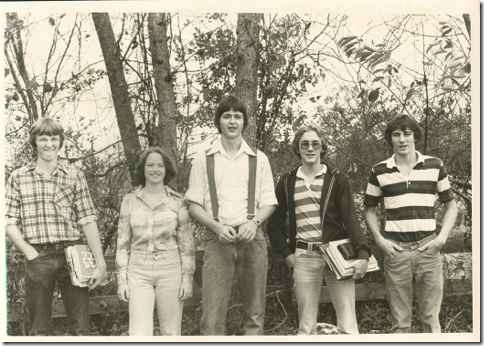
One of the cool things about my recent Facebook experiment is seeing the old photos some of my (both upper and lower case) friends have posted.  I found a photo of my first grade class.  So I created a Hall of Ancients photo album and uploaded some old pictures, including this one of me and some friends from 1978.

1978
Kevin Morris, Karen Winburn, me, Alan Smith, Michael Graham

Both Kevin and Alan (we called him “Side”) are mentioned in my song The Kansas Reflector Incident.

Facebook Revisited

As anyone who reads Newsome.Org, listens to our podcast, knows me in the real world or receives my ESP transmissions knows, I do not drink the Facebook cool aid.  I’ve consistently found it to be restrictive, chaotic and generally uninteresting.

I also readily admit that I am apparently in the minority where Facebook is concerned.  Millions of people and many of my (lower case) friends seem to live on Facebook, and they wouldn’t do that unless they were getting something out of it.  I was talking to my buddy Taters at work today.  He was telling me how much his (lower case) friends like Facebook.  Taters is a young guy, so he and his crowd were a part of the target demographic before Facebook let all the geezers in.  He’s not a Facebook user, but admits that at some point he’ll probably capitulate and join.  Interestingly, he had never heard of Twitter.

knfbpage Anyway, we were talking about Facebook, and I told him how non-intuitive I find the Facebook layout and navigation routines.  He said while they may be confusing to old farts like me, they are second nature to the millions of kids who grew up in Facebook and made it the focal point of their online (at least) lives.  To prove my point, I logged into Facebook for the first time in many months and started showing him all the things I don’t like about it.
Then something interesting happened.

I looked at my piled up list of (upper case) Friend requests.  And right there at the top of the list were several of my old friends from my hometown and two of my best friends from college.  Hmmm.  Any of these folks could have (and may have) found me here via a Google search.  But Facebook made it easy to reach out, and they did.  So after dinner, I went back to my Facebook page, accepted some of the (upper case) Friend requests, updated my profile, imported my blog feed, Flickr photos and YouTube stuff, and actually traded messages with a few old friends.  I saw some photos of my college roommate and his son.  I even found a photo of my second grade class in a (upper and lower case) friend’s photo page.  All of the sudden, I started to sense a lurking usefulness.

So I decided to take a look at the layout of the Facebook pages.

The Left Side

On the left hand side, you get a profile photo (I updated mine to my nifty new Newsome.Org logo, to match the walking billboard t-shirts I make my kids wear), a little blurb (I wrote “I still don’t get Facebook, but I’m trying…sort of”), pictures of your (upper case) Friends (Mike Miller has a funny picture) and whatever applications you elect to put there (I must have added some previously).

The third party Blip.fm app doesn’t work (surprise), so I need to remove it.  I don’t remember what the FunSpace and SuperWall do, but they don’t appear to be all that fun or super.  There’s something called Likeness over there.  Mine has pictures of Ayelet Noff and Angelina Jolie, which certainly pretty-up my page, but I’m not sure what Likeness does.  I decided to click on it and it presented me with a little quiz.  After every question, it prompted me to invite/spam my (upper case) Friends to take the quiz.  Lame.  I never saw any results, but the fact that I wasted 3 minutes of my life on that quiz shows up at the top of my Facebook page.  I bet all my (upper case) Friends will be really excited to learn that.

Also, why does “Relationship Status” assume such an important place in your “Information” box.  I’ll tell you why, because for most of its life, Facebook was the playground for college kids on the prowl.  Facebook needs a grownup makeover.

Basically, other than the pictures of my (upper case) Friends, nothing on the left side of the page interests me.

The Middle

At the top of my page, there are tabs for:

Wall: this seems to be the stream of content I imported plus whatever else I do within the Facebook walls.  The latter will be a short list.

Info: Here’s all my contact info, and school information.  I like the way you can click on your school and year to find other Facebook users.  Jeff Pulver is listed at the bottom of this page as “Other Public Figure.”  OK.

Photos: I only have my nifty profile picture, but as noted above I saw some interesting photos on my (upper case) Friends’ pages.  My photos will continue to reside on Flickr, however, and will only make it to Facebook if the importation feature works.  Why can’t you automatically import your public Flickr photos to your Facebook Photos tab?  I think I know why, and it has to do with keeping the walls intact.

Boxes: I have no earthly idea what this is.  One little box says I am a “Rockstar Vampire.”  That’s cool; I’d hate to be just a regular vampire.

The bottom line is that all of this may be the coolest stuff on the planet, but you sure can’t tell from an initial look or two.  I find the Wall and Photos to be a little bit useful, but all that other stuff is noise.

Next, I waded into the “Home” page, where I can see information created by my (upper case) Friends.  This seems interesting, though I imagine if you have a lot of (upper case) Friends, you could miss a lot of stuff from your (lower case) friends.  One problem with Twitter is that you only see the information that’s posted shortly before you visit.  I sense this stream of content would have a similar drawback.  Still, Taters’ better half posted some hilarious photos that I can use to blackmail Taters, and I have already made contact with some old (lower case) friends.

But I keep wondering why I wouldn’t just subscribe to the RSS feeds of people I’m interested in, and read their content at my leisure?  I can think of only one reason: they don’t have RSS feeds.  Facebook is a nice, controlled environment where I can catch up with people who don’t have blogs and RSS feeds.  But you have to wade through a lot of quicksand to get to the gold.

The Right Side

On the right side of my page, there’s a list of Applications, Pokes (that’s an interesting word) and “People You May Know.”  It asks if I want to add Jason Calacanis and Jeff Jarvis as (upper case) Friends.  Sure, I could add them, but the chances of them adding me back (which, in a good move by the developers, is required before users can access each others’ content) is somewhere between statistically impossible and absolute zero.  Still, we are all long-time bloggers with some common interests, so maybe the algorithm works, even if it’s unintentionally funny.

Again, though, there’s nothing on that side of the page that grabs me.

Conclusions

My conclusions are that Facebook is a good tool to reconnect with old friends who don’t publish their content outside the Facebook walls.  Sort of like a kinder, gentler Classmates.Com (no link love for that toll booth).  I’d much rather subscribe to someone’s blog or Yahoo Pipes feed (here’s mine), but lots of people don’t have those feeds.  There’s some good content and connections to be found on Facebook, though it is wrapped in an extremely inefficient package and may get lost amid the static.  I’ll probably check my Facebook page periodically, but it will never be my preferred place to create or to access content.

It just happens to have a monopoly on access to some people I care about.  So I guess whether I like it or not doesn’t really matter.

Hey Websense, Get Off Our Clouds

Follow. But. Follow only if ye be men of valour, for the entrance to this cave is guarded by a creature so foul, so cruel that no man yet has fought with it and lived.
-Tim

So I set up my private cloud.  Reports were positive.  I was feeling good.

Until I got to the office this morning.  Since my network permissions will always override my internet permissions when I am accessing my cloud from home, I decided to see how true remote access worked.  I gleefully pointed my browser to BuffaloNAS.com, Buffalo’s remote access portal.  As I was preparing for the sheer awesomeness that my private cloud was surely about to deal. . .

ws

That happened.

“Peer-to-Peer File Sharing?”  Are you freakin’ kidding me?  I hadn’t thought about Websense since 2006, when it concluded that a bunch of web sites, including mine, should be censored for the good of society, or something like that.  Just when I thought it was all good and the world was one giant field full of butterflies, unicorns and A-Listers about to start linking wildly to my blog posts, I get another beatdown by the man.

I know, from talking to our IT folks, that my company only uses Websense to restrict access to porn sites (that’s certainly appropriate) and, as noted above, “Peer-to-Peer File Sharing” sites.  This would also be appropriate, if you’re talking about torrent sites and whatever has replaced Napster.  Lots of computer un-saavy folks use computers at work and there is an eager clicker for every trojan horse or phishing scam.  Unless they want to spend all day wiping and restoring computers, the IT folks have to protect people from themselves.  On the other hand, if Websense defines every site that allows the possibility of accessing a file as a peer-to-peer file sharing site, we’re talking about a pretty wide net.  Right click on almost any link, anywhere and, as big as Elvis, there’s an option to save (e.g., download) the target file.

Interestingly enough, while Buffalo’s NAS site was snared in this net, several online storage sites (no names because I don’t want to inadvertently nark) were not.

Other than a general skepticism about companies that get paid to decide what falls within or without the forbidden zone, I’m not proposing any specific reforms.  I’m certainly not proposing that everyone should have the right to access their private clouds from their offices.  Practically speaking, I would rarely if ever need to access my cloud from my office 8 miles away.  If I’m in town, I’m staying at home and can get whatever I need when I get there.

But nets too wide and an overly active distrust of technology are not conducive to the sort of technological advancements I am interested in using and writing about.  I also think a lot of people are kidding themselves if they think corporate America is about to toss all its content into the very same cloud it is currently so wary of.

And it’s kind of a bummer that the same company that decided my entire web site should be blocked has now rained all over my private cloud parade.

Creating a Private Cloud

After thinking about the various online storage options, and particularly the high cost for those who need or want a lot of space, I started to think there might be a cost savings to creating a private cloud.  Like lots of other business people, I have a remotely hosted, dedicated server to host my web sites.  I could always use a desktop, web based or plug in FTP client to access space on that server, but that would require me to separately configure each computer I want to use to access that space, including borrowed computers.  It would work, but it wouldn’t be fun or efficient.

I could also set up some space through Amazon S3, find a web based front end, and access my data that way.  Again, it would work, but it wouldn’t be ideal.  Plus, the cost formula used by S3, while inexpensive, doesn’t lend itself to certainty.  The fee is based on both the space you have and the amount of data transfer in and out (and out could be a big number if your shared items become popular).

So I decided to experiment with a private cloud.  Here’s how I made one and what I think of it so far.

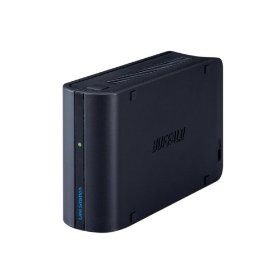
bls First, the hardware.  I have a home server that I use to serve audio and video content throughout the house, to back up our computers and for storage that I don’t need to access remotely.  Because that box has plenty on its plate already, I elected not to use it for my private cloud, even though it has the ability to permit remote access.  Rather I bought a Buffalo Linkstation Mini.  It’s small (5.2 x 1.6 x 3.2 inches ; 1.1 pounds) and fits easily inside the electronics chest in my study (an old chest of drawers with grommets drilled in the back, so I can charge laptops and other devices in drawers and out of the way).

I ran a network cable from the nearest switch (the one that serves my Mac not-so-Mini) to the Linkstation, ran the power cables through the grommet and out to the the power strip I previously installed on the back of the electronics chest.  Less than 15 minutes after opening the box, the Linkstation was installed and ready to go.

Next, the software.  The Buffalo installation disk is reasonably straight forward.  It identified my Linkstation on the network right away and installed the NASNavigator 2 software, that allows you to manage the Linkstation via your computer.  Like with a router, most of the Linkstation setup is done via your web browser (always change the default password right away with routers, wireless access points and web accessible drives).  If you’ve ever set up a router, this process will be a breeze.  Even if you haven’t, the process is pretty simple and the manual is helpful if you need some hand holding.

You name your Linkserver, set the date and time, assign it to an existing Windows workgroup if you want (though it will be visible on most networks even if you leave the default workgroup name).  You create folders to share via this same web based application.  It’s not hard to do, but it’s not as easy as it would be if you could set up shared folders via Windows Explorer.  You can also switch between a RAID 1 or RAID 2 setup, but no action in this regard is necessary unless you want to switch arrays.

Setting up web access consists of selecting the folders you created as described above and selecting the desired level of access: none; users who have accounts you set up via the setup application; or anyone.  You can (and should) also set access levels- generally read only- for publicly shared folders.

To complete the web access setup, you pick a name for your web accessible space, which is then accessible via a Buffalo owned and administered remote access domain and create a key to give to those who you want to allow access to your “non-everyone” folders.  If you have a firewall or a router, you need to configure it to permit access.  The Buffalo application will attempt to automatically configure your firewall/router, but this did not work for me.  Having some experience setting up routers, I was able to manually configure my router pretty quickly.  This would be a major pain for someone without this experience but it is unavoidable.  Anyone who has ever set up a Slingbox has already been through this process.

All in all, the software is about as simple as can reasonably be expected.  It worked, but it could be more elegant.

Finally, my first impressions.

Once you test your settings and happily get the all clear sign, accessing your private cloud is as easy as pointing your browser at the web address Buffalo creates for you, and filling in the shared space name and your name and password.  The Buffalo web access application works reasonably well, though it is not as appealing as the interfaces for some of the commercial online storage services.  I greatly prefer the Box.Net interface, for example.  On the other hand, once you access the shared folders, when you click on a file you are presented with options to link to a file or to email a link to the file.  You can also remotely add files to the cloud if you have the requisite permissions.

I wanted the ability to serve some content from my private cloud to this blog and my other web sites.  To accomplish that, I created a new folder, set the sharing level at anyone and the permissions as read only.  Here’s a cloud theme song (buy this excellent Jayhawks record on Amazon), which is temporarily located in that folder to see if it works.  Initial results are mixed.  It looks like the files can be accessed, but it doesn’t seem to play well with Yahoo Media Player (which I use and recommend to allow readers to easily play embedded audio), and buffering times vary.

It’s too early to tell if a private cloud will do the trick for me, but it might.  More on my private cloud later.