Another Horse in the Online Storage Race: divShare

While working on tonight’s Evening Reading post, I came across a story about the recently deceased Eddie Bo.  The story mentioned his song, Check Mr. Popeye and had the song queued up in an embedded player.  From divShare.  The player was compact, with volume control, and seemed reliable and stable.  I was surprised that divShare hadn’t previously come across my radar.

So being a web scientist and all, I felt compelled to take a look at divShare.

The front page says free account users get 5GB of storage and 10GB of monthly bandwidth.  That’s not bad at all.  The sign up form is right there on the front page.

ds1

That’s pretty easy.  Once you sign up, you’re presented with your “dashboard,” from which you can upload and manage your files.

ds2

It’s not the cleanest interface I’ve ever seen, but compared to Photobucket, which I use all the time, it is a work of sheer, unmitigated beauty.  Let’s see if it passes my two-part online storage test.

Test one: does it have a drag and drop uploader?  Why, yes it does.

ds3

Test two: does it allow direct links to files, to make it easier to share them on social networks sites, like Blip.fm, etc.?  No, the free accounts don’t.  But otherwise it has pretty flexible sharing options that almost make up for this deficiency.  As noted above, I particularly like the compact embeddable player.

If you need more storage or bandwidth, divShare’s paid accounts look reasonable and generous.

ds4

And paid accounts have no ads, branded flash players, and direct file links (yeah baby).

All of this looks pretty doggone good.  I’m still going steady with Dropbox (you and I get extra free space if you sign up for Dropbox via that handy link), but I have to admit, divShare is making my eyes wander a little.

I’m going to use divShare a little over the next few weeks and see how it goes, but on first impression- I’m impressed.

Related posts at Newsome.Org:
The State of Online Storage
ZumoDrive vs Dropbox
Bringing the Cloud to the People: What Does Google Know that Yahoo Doesn’t?
Tech for Grownups: My Online Toolbox (Part 1)
Creating a Private Cloud
Choosing Dropbox

Evening Reading: 3/31/09

Google Charity Department: So Google is thinking about putting Yahoo and Live Search buttons on its home page, huh?  Some folks think that’s charitable.  Maybe, but I tend to think it’s an attempt at a knock-out punch via comparison.  It doesn’t look like Yahoo is very appreciative of the grift.

Milhouse DepartmentEddie Bo, a legendary New Orleans musician, has died at 79.  I love his 1962 hit Check Mr. Popeye.

Southside Johnny and the Asbury Jukes also did an excellent cover of that song.

Privacy is Dead:  A couple of people are all jazzed up because Google is going to add Google Analytics to Gmail.  I could sit here for a thousand years and not come up with even one reason why anyone should want Google Analytics embedded in their email application.  We are becoming a nation of chimpanzees while Google plays the Jane Goodall role- for profit.

And Twitter is Thirsty:  Be careful or Twitter may appropriate your meager supply of Google Juice.

Ark in the Andes Department:  Maybe that wasn’t Noah’s Ark we saw.  Maybe it was the Galactica.  If you don’t like science fiction, you’re boring.  If you aren’t boring, you need to subscribe to io9.  Great blog.

Good Bill/Bad Bill Department:  It’s a slippery slope with a fine line, but if there’s a way to severely punish online bullies without catching message boards and other content platforms in the net, I am all for it.  Send a couple of anonymous assholes to jail for a decade or two and maybe everybody will stone up and act like grownups.  Unfortunately, I don’t see a way to create an accurate net.

Revenge of the Nerds Department:  You know that guy you call a Goose?  Well he may kick you ass.  Or your dog’s ass.  Those Canadians are always looking for a fight.

Death by Wikipedia:  Microsoft is going to shutter Encarta.  I remember buying Encarta on a DVD back in the day.  Crazy how far we’ve come.

Bad Things Are Made of This:  Since most people online are lying about who they are anyway, Omegle lets you chat with a stranger with complete anonymity.  Here’s the exciting transcript from my one and only Omegle chat:

You: Hello
Stranger: I SEE WE MEET AGAIN
You: Yes, my name is Fred.
Stranger: me too!
You: Ethyl is my wife, have you seen her?
Stranger: yeh shes in my garden
Stranger: under it
You: with Ricky, no doubt. . .
Stranger: sorry

That was almost as fun as trying to talk to Steve Gillmor on Twitter.

Classic TV Department:  Someone at MTV has lost his mind.  They are actually going to show. . . music videos.

Extreme Coolness:  One of the many reasons I love vintage science fiction is because of the cool covers (seriously).  Harry Borgman, who drew some of them, is blogging.  I want a poster of the cover of Andre Norton’s Daybreak – 2250 A.D. cover.  It was the first science fiction book I read, and it’s still one of my favorites.

First Look: Skype is Available @ iTunes

The much awaited Skype iPhone app is now available via iTunes.  I just installed it, so let’s take it for a spin.

Download and installation was a breeze.

Note that the Skype app requires a wi-fi connection.  I’m at home, where one is available.

Here’s the sign in screen.

skype1

Sign in was easy, leading to the All Contacts screen or this Online Contacts screen.

skype2

Can’t call Mike, since he’s in the midst of audio hassles.  But a Skype Test Call worked perfectly.  I could hear well and my voice was loud and clear.

Here’s my profile page, complete with a recent photograph and my slogan.  Maybe I’ll get my Skype-out number back so I can call land lines.  More importantly, my kids are going to be all over me to put Skype on their iPod Touches to turn them into semiPhones.

skype3

One expected buzz kill is that the lack of background processing means you have to sign back in to the Skype app every time you leave Skype to do anything else- like email the screen caps above.

But it is still very cool to have a Skype created, Skype looking app on my iPhone.

So far, so awesome.

Hunch: So Many Decisions

Hunch.com_logo

I signed up for Hunch today.  Hunch, which is currently in beta, is a decision-making tool, built by its users.  Hunch was developed by Flickr co-founder Caterina Fake, who describes the site thusly:

Hunch is a decision-making site, customized for you. Which means Hunch gets to know you, then asks you 10 questions about a topic (usually fewer!), and provides a result — a Hunch, if you will. It gives you results it wouldn’t give other people.

I’ve never been a proponent of mind-mapping or other thought-assistive applications, but I do consult various online resources to assist me with some decisions.  For example, I regularly consult the customer reviews at Amazon when considering books, records or electronics.  So I’m going to give Hunch a chance to earn its way into my online toolbox.

To get the most out of Hunch, you have to use it enough to allow the algorithm to map your preferences, etc.  This will take some time, but in the meantime, here’s how the Hunch process works.  Let’s start with one of the most popular questions.

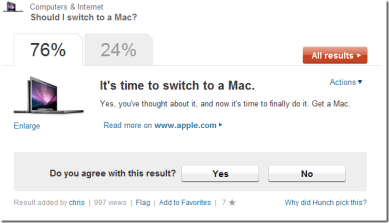
Should I switch to a Mac?

Question 1:  Does your job make you use Microsoft Outlook for email?  Yep.
Question 2:  Are you willing to spend more than $1000 for a new computer?  Yes.
Question 3:  Are you going to use this computer primarily for advanced, 3D gaming?  No.
Question 4:  Are you in the design, advertising, music, or video production business?  Sometimes for music, but mostly No.
Question 5:  Are you ok using the web-based version of Outlook?  Yes, plus there’s my beloved iPhone.
Question 6:  Do you make heavy use of Microsoft Excel?  No.
Question 7:  How much do you need to use Visio?  I don’t even know what that is, so it’s “not a factor.”
Question 8:  Do you want to go “under the hood”, change components yourself, to make your own personalized machine?  You bet I do.
Question 9:  Are you looking for a portable computer?  For purposes of this question, no.
Question 10:  Who do you prefer, Bill Gates or Steve Jobs.  Actually, I prefer Elizabeth Mitchell.  So “not a factor.”

Looks like Dave and Earl are going to be happy. . .

hunch1

Based on conventional wisdom about Macs, I can’t argue too much with that.  I’m not going to switch, but I totally get the argument that I should.

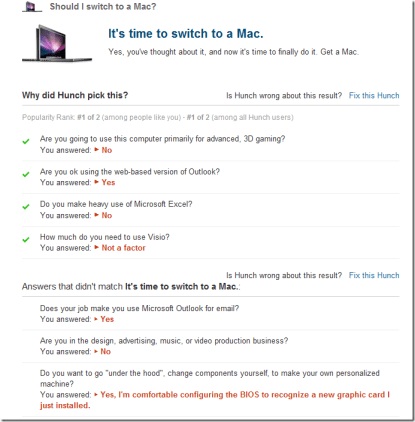
Clicking the “Why did Hunch pick this” link leads to a less than fulfilling list of the answers that supported the switch and the ones that didn’t.

hunch2

It’s too early to tell, but the process is interesting, and thought-provoking.  The thought process will likely prove to one of Hunch’s biggest benefits- perhaps more so than the final answer.

OK, let’s try a more open ended question.

Which book author should I read?

Only 2 questions: fiction or nonfiction and sub-genre.  I choose fiction, and then science fiction.  The first suggestion was Cormac McCarthy.  Well, he just happens to be my favorite author.  Given there were only 2 questions, that has to be a coincidence.  If somehow not, it’s 90% impressive and 10% disturbing.  The second suggestion was Gabriel Garcia Marquez.  I tried thrice to read One Hundred Years of Solitude, and thrice I concluded digging ditches was an easier way to spend my time.  The third choice was Stanislaw Lem.  I’ve not read his books, but I know of them and some of them look interesting.  The “wild card” suggestion was James M. McPherson.  Don’t know of him, so no way to tell.

There are options within Hunch to create a topic.  I don’t know if I’ll ever do that, but if Wikipedia is any indication, there will be plenty of people who will.

Again, it’s too early to tell, but for now, Hunch is on my radar.

Photos: Tents in Town

Raina was the chair of a fundraising event this weekend to raise money for our local parks.  At “Tents in Town” families bought campsites at one of our local parks and camped out.  There was food, music, friends and tents.  It was cold- perfect camping weather.  Everyone had a great time, and I took some pictures.


Cassidy and Evie chatting at the campsite


Evie, Cassidy, Rachael and Delaney


Cassidy on top of the fort at the nearby playground

How (Not) to Win Musicians and Influence Songwriters

catoutofbagIf you’d told me three hours ago that I’d ever write a post defending in any way the sorry state of affairs in the music industry or criticizing someone’s idea of how to reform it, I’d have laughed in your face.  Literally.

But I guess you never know. . .

I saw a link on Twitter to this post, in which a partner at a venture capital firm waxes philosophical about the music industry.  You know it’s a serious post because it uses the word “paradigm” in the title and nine more times in the post itself.  Now that we’ve conquered Earth Hour, maybe we could plan Paradigm Day?

Fancy words aside, the author (in a nod to Cher and both Madonnas he goes by the mononomial Albert on his blog, but being a completist with a mouse, I know his full name to be Albert Wenger) makes a couple of good points.  He also makes a really, really bad point, but we’ll get to that in a moment.

There is no disputing the fact the the more immediate and direct distribution channel provided by the internet has the music industry (and the newspaper industry, among others) all twisted up.  And while I don’t know about profitable, I agree that many of the smaller, more creative music services are probably unlawful, at least under the current pre-shift paradigm (I feel smarter, having just typed that word).  All of this means, of course, that something has to change.  Either the technology has to change or be restricted to conform to the old ways of selling music (very unlikely, having been unsuccessfully tried) or the laws and licensing practices have to change to adapt to the technology (the industry isn’t happy about it, but this is already happening).

I have long said that the cat is out of the bag, and that all the lawsuits in the world against grannies and dead people are not going to get the cat to jump back in the bag.  I have also said that I think shutting down these new music services is bad for artists and songwriters.  Recall that I am a songwriter who gets an occasional check from BMI, so unlike 95% of the people who chime in on this issue, I actually have a little skin in the game.

Having said that, there is nothing appealing to me about the three “experimental” services that Albert mentions.  For one thing, artists can always make their music available, via their web site, MySpace or any of a countless number of other online services.  The difficulty is getting enough buzz to make people listen to it.  And, of course, paying those who help create it.  Secondly, I have no desire whatsoever to get “scenes which play differently each time based on your interaction with them via external sounds, touching and moving the [iPhone].”  I just want to queue up a record and listen to it, using technology that makes that more portable and convenient.

Dressing up the experience with smoke and mirrors like faux interactivity will neither placate the empty bag holding record labels nor improve the experience of the listener, who just wants to hear the music.

The reason a lot of music should be accessible over the internet, via some of these new music services, is simply because it helps generate a buzz that will cause people to want to hear more music by the artist.  Which increases sales at Amazon or iTunes, and attendance at concerts.  No one is going to use MixTape.me as a substitute for a music collection, but lots of people may add songs to their collection they hear at MixTape.me.  Give away some goods to sell more.  That’s the ticket.  And if you need to add some Web 2.0 flavor, pay a percentage of the ad sales in lieu of royalties.

The best way to tell someone what they don’t want to hear is to just put it out there, without beating around the bush.  Albert uses that most hated four letter word.  You know, the one that begins with an f:

I believe these experiments point to the future of online music which will be a paradigm shift in why music is distributed (and how it is licensed) and how we consume music, in which a lot of music will be free and will be experienced interactively!

Again, the only interaction I want it to click the play button, but I don’t quarrel with the concept that people should and will be able to hear lots of music without paying for the privilege of hearing it.

Then, the train falls horribly off the tracks.  Recall that Albert is a partner at a venture capital firm, which assumedly means he invests in new products to make. . . money.  Cash, dollars.  Probably millions of them.

With that in mind, this little gem:

Of course one immediate question about such a new paradigm is how artists will make money.  I think it would be a grave mistake to be caught up in that question.  For starters, it seems to me that over the course of history very little of what we now think of as great music was produced specifically because the people making it were concerned about making the music a commercial success (I was reminded of that this morning listening to “Breakfast with the Beatles”).  Here too is a parallel with “The Invention of Air” – Priestly and many other scientists were and are not motivated by making a lot of money.  On top of that we may finally be entering an age of post-materialism.

Where to start?

For one, it’s epically ironic that a venture capitalist is preaching to starving artists and songwriters about entering an age of post-materialism.

I guess what he’s saying is that if you focus on the music, the money will take care of itself.  Of course, musicians have been doing that for centuries, and it hasn’t worked so far.

Second, if you don’t convince a critical mass of artists and songwriters that the monetization of their art will put food on their table and money in their savings account, there will be no good art to monetize.  Is Albert suggesting that people make music at nights and on weekends, after working at a real job?  There are many reasonably successful musicians and recording artists who have to work at real jobs to support their music under the existing system, which at least gives a nod towards getting them paid.  It is, at least, naive to ask these people, many of whom have already been sold down the river by the music industry, to trust a bunch of developers and venture capitalists to take care of them.

And, finally, to say that much art was made for the love of art and not for money is so completely beside the point and devaluing that it’s hard to respond logically.  Other than the alarming number of made for TV acts, just about every musician begins with a calling to the music, not just to get paid.  What starts out as a form of self-expression sometimes turns into a career.  To say that artists who become successful should not worry about getting paid is like saying that some chef who used to make brownies with her mom for fun should let diners eat at her five star restaurant for free.  It also says a lot about the value placed on the music, as opposed to the web applications and capital that promise to turn that music in
to money.  To value the store more than the good sold is backwards and dangerous.

Look, blog posts don’t have to be footnoted dissertations.  And Albert has some good points hidden beneath the smart talk (that’s a reference to one of my favorite movies).  But to say we shouldn’t worry about how the artists get paid is not the way to start the ol’ paradigm a shiftin’.

In Search of: iPhone Blogging App

I have officially given up on iBlogger. It just doesn’t play well with Blogger-published blogs. So I am trying BlogPress

Unlike Live Writer, which is wonderful to use, but very difficult to configure with remotely hosted Blogger blogs, BlogPress was easy to configure.  But the joy ends there. Part of the post disappears when you move back and forth from the "Write" screen. You can get it back, but it’s a huge pain.

And I see no way to add links (the links in this post were done separately via Live Writer).  Links are the big challenge for mobile blogging apps.  Theoretically, you can add photos.  But the one I tried to add below via the Picasa integration didn’t work.  Again, I had to fix it later.  I also had to fix some formatting issues.

Here’s some white board art Cassidy and Delaney did at my office last week. I wish Photobucket and Flickr were integrated photo storage options.

I also wish someone would make a decent blogging app for the iPhone.

Frustrating. . .

For Tunes the Bell Tolls?

The other day, after generally praising both MixTape.me and Blip.fm, I closed with a hope that both could stay in business, notwithstanding the RIAA’s assault on streaming music sites.  As it turns out, my concerns may have been even more immediate than I realized.

Marshall Kirkpatrick reports today that Seeqpod, the search engine used by MixTape.me and other sites, will soon start charging developers for access to its data.  This does not bode well for music discovery sites, some of which are really fun to use.  In fact, after looking further at MixTape.me, I had decided to do mix tape posts as a semi-regular feature at Newsome.Org.  If the loss of free access to Seeqpod’s data puts these sites out of business, I won’t get that chance.

Which is bad for listeners, and bad for the musicians whose music would have featured.  Both MixTape.me and Blip.fm have Amazon associate links beside each song, which is probably the best business plan in Web 2.0.  Rather than toss random ads for stuff we don’t want on the page and cross their fingers, these sites present the immediate opportunity to buy something that, by definition, the user is interested it.  This is targeted advertising done the right way, as opposed to the intrusive approach favored by Google.

And let’s be serious for a moment.  Nobody, and I mean nobody, is going to use these song mixes as an alternative to a fully accessible music library- that can be taken with them on CD-Rs, iPods, etc.  And anyone who is going to go to epic trouble to record these streams could do the same thing at any number of “approved” music sites.  Or they could do it old school off the radio.

It hurts the artists.

When friends come to my house, it is very common for me to play a few of my favorite songs for them.  Often, one or more of them will then buy the record for themselves.  Heck, I bet I’ve sold 20 copies of Avett Brothers records this way.  Any right thinking musician would be happy that people are playing his or her music for friends, generating a buzz and record sales.  I see very little industry downside here, and no downside for the artists.

But in typical fashion, the empty bag obsessed RIAA is going to continue to lob bombs at these sites, in the hope that one day the cat will miraculously jump back into the bag.  It ain’t going to happen.

Rather that try to turn the music off, the music industry should issue a list of best (e.g., required) practices, to encourage these sites to hide the song location to prevent downloads, etc., and let the music play.

In honor of that, and because who knows if I’ll have another chance, I wanted to make a little mix for your listening pleasure, but it was very hard to access MixTape.me, and when I got there, few of the songs I found were available.  I wonder if that’s a beta problem or a bigger problem?

In any event, enjoy.

Biz Stone and Transparent Opaqueness

On the heels of the recent brouhaha over Twitter’s Suggested User list, Biz Stone, one of Twitter’s founders, tries to give the appearance of clearing things up for us.

First, let’s briefly recap recent events.

sourgrapesDave Winer cried about a bunch of nobodies getting on the list in lieu of him and all his friends who feel entitled to be at the top of any internet-related list.  Rogers Cadenhead put another hilarious, mostly unrelated, beat down on Dave.  I was amused by the differences between Dave’s manifest point and his barely if at all concealed latent point.  I also mentioned that I don’t like the Suggested Users list because it is just another example of the harmful gatekeeping that virtually destroyed the blogging movement.

So let’s examine Biz’s post.

He noticed that a lot of users sign up, but don’t follow anyoneWell, Biz follows a whopping 182 people, out of 256,987 followers.  So maybe he needed some ideas?  And he’s not alone.  Many people, particularly those who already had a relatively high profile in the blogosphere before joining Twitter, follow very few people.  It’s also easy as following down (pun intended) to find people to follow on Twitter, by searching by keywords, finding “follow me” links on blogs and other websites or viewing the public timeline.  Now getting people to follow you back, well that can be a tougher chore.

So let me begin by saying that I don’t buy for one second the argument that this list was designed to help the newbie find some Twitter buddies.  This absurd argument is the foundation on which the defense of the Suggested User list is based.

Let’s continue.

Some dude at PBS asked for transparency.  Well, he may have asked for it. . . .  But, hey, those PBS people are plenty smart.  I can’t imagine what the explanation would be if someone from Spike TV had asked.

So how do they pick the list?  Well, it’s like the staff of a bookstore recommending books.  OK, but why couldn’t the Twitter staff actually roam the Twitter aisles and make some #FollowFriday recommendations?  182.  One hundred and eighty two.

And, of course, “there’s more to it than that.”

It seems their Chief Scientist (that’s a cool job title; almost as cool as Plaxo Privacy Officer) wrote a program that scans active Twitter accounts for. . . “a bunch of key ingredients,” such as:

1. How much of your Profile is filled out.  Well, there’s your time zone, a “one line bio,” a home page URL, your location and a picture.  Call me silly, but I’m not seeing a lot of distinguishing criteria to be mined there.  I’m going to call this one a head fake.

2. Certain indications that the account is interesting to others in some respects.  This, obviously, means number of followers and possibly number of ReTweets.  So we are going to once again confuse popularity with intelligence and influence.  The more followers you have, the more sycophantic ReTweets you’re going to get.  So we’re back to number of followers.  Sorry, but I just don’t think that’s a valid criteria of value.  And it’s certainly not evolutionary.  I would have expected Twitter to come up with something better than that.

3. A few other signals.  Now, that’s transparency if ever I’ve seen it.

Once this list is generated, Biz and some other Twitter people look at it to determine which users are list-worthy.  Biz mentions a couple of things they consider.  “Is the account a good introduction to Twittering for a new user?”   OK, that’s a good one.  “Does the person or organization running the account have a fairly wide or mainstream appeal?”  See, we’re right back to popularity again.

It all comes down to popularity.

Twitter is not paid to include people on this list.  Thank goodness.  That would open another can of worms.

And it works beautifully.  After that question raising, if not exactly eye-opening, explanation, Biz concludes that this little system “makes Twitter more relevant and valuable to users.”  Um, OK.  I’m thinking it’s really valuable to those on the list.  It may be valuable to Twitter.  The newbie?  Not so much.

A Beautiful Math.  But we shouldn’t worry about people on the list getting a follower windfall.  Because while “Suggested Users are getting more followers because they are suggested. . . that doesn’t mean everyone else is getting fewer followers.”  Actually, statistically it probably does.  But I’m not lobbying to be on the list.  I am questioning the legitimacy and value of the list.

So what do you do to get on the list?  Why, fill out your profile, silly.  Or be Oprah.

Evening Reading: 3/25/09

MK and T:  I like this post by Marshall Kirkpatrick about Twitter.  We’ll have to see what the secret special features are, but I don’t think I’d pay for my Twitter account.  And I’m not alone, as nothing leads Marshall’s how much would you pay poll with 57% of the votes.  Combined, nothing and less than $5/month have 81%.  Having said that, Marshall makes a compelling case for Twitter’s value.  Twitter has largely replaced my Delicious “popular” feed for purposes of scanning for new post material.  I only have one mild criticism of Marshall’s post.  I hate the phrase “thought leaders,” because implied in that phrase is a decision as to who the thought leaders are, and we all know that on Twitter, like the blogosphere, popular is often confused with smart.  Jason Calacanis is popular.  Seth Finkelstein is smart.  But, sadly, you know who has more influence in the blogosphere.  Here’s a good rule of thumb one of my professors drilled into my head: any time there is a group to be created, the most important question is who decides who is in it.

Bad Counting Department:  PC World has a list of the Top 5 NAS devices, that contains 10 devices.  Bad counting notwithstanding, it’s a good list for those looking to create a private cloud.  I’d move the HP MediaSmart server from number 2 to number 1.

One Down, One to Go:  Google Docs has added a much needed find and replace feature.  That’s great, but if Google wants any significant business traction, it simply must figure out a way to allow tracked changes.  This is an indisputable fact.

Good MemoriesWolfenstein 3D is out for the iPhone.  I remember countless hours playing that game back in the day.  I want Civilization for the iPhone.  Any chance?

Standing 8 Count Department:  The Drama 2.0 Show lands a hook to the jaw to Mike Arrington and TechCrunch.  I think Mike often defeats his own purpose by acting like a petulant baby, but I still read TechCrunch, simply because it covers stories that interest me.  If Mike’s unwillingness to mange his personal brand hurts TechCrunch’s bottom line, maybe he will realize that you can be lucky, successful and humble.  I’ve never understood why so many of these former-nerds who manage to achieve a high profile in the blogosphere (the blogosphere, for heavens sake) start acting like they think rock stars act.

Kill the People- Just Save the Puppies:  Extremist groups also defeat their own purpose by alienating the undecided- the very demographic they should be trying to appropriate.  When this PETA does one nutty thing after another, like protesting the fact that dogs get killed in a video war game, this PETA is the result.  Philosophically, I am sympathetic to animal rights, but idiotic moves like that make me want to eat a tasty cheeseburger.  Or a dog.  Here, Lucky Dog.  It’s time for dinner.

Worried About the Beaver:  Here are 6 Things You Didn’t Know About the Leave It to Beaver.

Personal Fouls:  If you have tens of thousands of followers and I am unable to engage you in relevant conversation, I will eventually un-follow you.  If you have a few hundred, I will immediately un-follow you.  My Pink Floyd policy required me to remove several people from my list today.