
The Politics of Working

workplace myths

Guy Kawasaki asked Penelope Trunk, the author of a book on career advancement, for her 9 biggest myths of the workplace.  I’ve spent a lot of time in the workplace, a lot of it hiring and managing people.  Here’s the list, with my thoughts (and these are only my personal thoughts).

1. You’ll be happier if you have a job you like.

There’s logic (and condescension) to the garbage man in love story, but this is not a myth.  Being a pessimist can ruin any job, but the fact is that those who do what they do only for the paycheck are generally going to be less effective and less happy.  I’m not saying you have to love it so much, you’d do it for free.  But, within the context of a job, it really helps to like what you do.

2. Job-hopping will hurt you.

I think most folks have 2 maybe 3 hops.  After that, it becomes a red flag on a resume- as does missing years in the timeline (which often hide more jumping).  So it’s a matter of degree.

3. The glass ceiling still exists.

I don’t know if the glass ceiling in the traditional sense still exists or not.  But I completely agree that lots of people are stepping off the ladder and looking for life balance.  But there will always be a segment of the population who is scrambling up as fast as they can.  The important thing is to figure out where your personal sweet spot is and work towards that.  It may be to make the most money possible, or it may not.  I hope it’s not.

4. Office politics is about backstabbing.

Interestingly (at least to me), I agree that this is largely a myth.  What backstabbing remains is much more subtle, but the ones who do it are generally found out and controlled.  If you have good and attentive managers, it’s not much of a problem.

5. Do good work, and you’ll do fine.

I agree with this, but not the toot your own horn every chance you get part.  You have to do good work, period.  Then, you have to try to get others to toot your horn for you.  If I tell you I’m good, it means nothing.  If others tell you that, it means a lot.  People don’t like self promoters because people don’t like to be sold.  They like to make their own decisions.

6. You need a good resume.

This is not a myth- at least as far as content goes.  Sure, blind resumes don’t get you the job.  But once you’ve left the interview, a good resume helps you beat out the competition.  By good, I mean content.  I agree that the form and font and whatnot don’t matter.  I wouldn’t pay some so-called expert a quarter to write my resume.

7 People with good networks are good at networking.

I totally agree that this is a myth.  People who are sincere and likeable are the best at networking.  Because to them, it’s not networking- it’s living.  Nothing turns me off faster than someone who wants to get to know me mostly to leverage off that relationship for personal gain.

8. Work hard and good things will come.

I agree that this is a myth.  Hard work is a requirement, but there’s a lot more to it.  Having said that, it’s not this: “Make sure you’re not the hardest worker. Take a long lunch. Get all your work done early. Grand thinking requires space, flexibility and time. So let people see you staring at the wall. They’ll know you’re a person with big ideas and taking time to think makes you more valuable.”  Because if you do that, people won’t think you’re a person with big ideas, they’ll think you’re a slacker.  Period.

9 Create the shiny brand of you!

This sounds like a clip from some Powerpoint presentation, but I agree with this passage: “Offer your true, good-natured self to other people and you’ll have a great network. Those who stand out as leaders have a notable authenticity that enables them to make genuinely meaningful connections with a wide range of people.”

I think people tend to over analyze job advancement.  It’s really simple.  Be smart.  Be honest.  Be kind.  Work hard.  Live good.  Manage priorities.  Find your balance.

And as Webb Wilder says, wear glasses if you need ’em.
Technorati tags: ,

Evening Reading: 5/23/07

Looks like Google is, in fact, going to buy FeedBurner.  That makes me sad.  Google is trying to corner the market on information.  Like when someone shoots the moon in Hearts, it may be too late to do anything about it when people realize it and start to care.

Now cola has gone open source.

Kodak is getting out of the “low end” digital camera business.  Hmmm.

My home state gets serious about beer.  When I lived there we were happy to get our hands on PBRs and Falstaff.  I even had a taste of moonshine a time or two.  Anyone drinking those high falutin’ beers would have been beat up summarily.

The Civil War in 4 minutes.  This is a great video- watch it before they take it down. (via Kevin Briody)

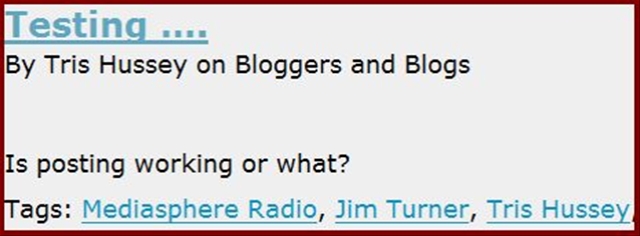
Tris Hussey asked the $64,000 question, and then deleted it.  Here’s a clip from my reader.

Scott Karp is a blogging buddy, but when I see both “disruptive” and “disintermediated” in the first 13 words of a post, it’s time to mark it read and move on. 

My funny line of the day, from a TechCrunch story on some scheduled Second Life downtime: “Second Life entrepreneurs are particularly unhappy with the downtime, after all, if you’re trying to make a living from Second Life this downtime affects the bottom line.”  That’s what I tell my wife when she makes me and the kids stop playing whiffle ball and come inside for dinner.  “Honey, I’m going to get rich playing whiffle ball one day….”

Blonde 2.0 on brand building via social media. 

Technorati tags:

Alms for the Poor or Bring Out Your Grateful Dead

willblogforfoodC|Net reports that the music industry is offering “small” webcasters the option of paying “below market” royalty rates on the songs they play, keeping the required royalty rates essentially the same as they are under a 2002 law called the Small Webcaster Settlement Act.

It’s not known what the cutoff for “small” would be, but the SaveNetRadio coalition argues logically that almost all webcasters should be considered small by broadcast standards.  Once they get more popular, however, they might very well grow themselves out of business under the proposed plan.

While I’d love the ability to stream some MP3’s from Newsome.Org, the bigger issue is not helping bloggers put a few streaming MP3’s online, it’s ensuring the viability of the places most of us go to get new music- the Pandoras and Rhapsodys of the world.

As Techdirt points out, this is likely an attempt to distract the growing number of politicians who have been looking at this very important issue.

While I’m happy to see the music industry negotiate a little, there’s a lot more work to do before we’re done.

Technorati tags: ,

Evening Reading: 5/22/07

Randy Morin is 100% correct.  Those on the outside looking in could easily change the game by linking to each other.  For me, it’s a matter of recreating the blogosphere or leaving it altogether.  Once we get a collective voice, the blogging elite will let us in the club, and we can all blog together.  It’s not about pulling the A-Listers down, it’s about pulling ourselves up.  Scott Kingery agrees.

Google declares Google Office victory.  Maybe, if victory means being used by non-corporate cheapskates.  I don’t know a single person who uses Google Apps in lieu of Office or Works.  Not one.

Karl Martino makes some good points about online news, and expects to be ignored.  See item 1 above.

Darren Rowse, who I consider an un-A-Lister even though he never answered my question, has a good post on growing a blog.

Random blogs I like: Ben Metcalfe, Brad Kellett, Craig Newmark, Greg Hughes, Jeremy Zawodny, Kevin Briody, Ric Hayman, Richard Querin, Steven Streight and Zoli Erdos.

Amazing rumble in the jungle between lions, crocodiles and buffalo.  (via Rob Gale)

Robert Scoble says he’s in a blogging malaise.  That’s sort of like those celebrities who complain about all the fans asking them for autographs and whatnot.  Robert should be thankful for his blogging fame (which he deserves and earned through hard work).  So I’m not going to shed too many tears for him.

Seth makes a good point in the comments to my unblogosphere post.

On that note, I have lately forgotten to implement my new policy, so thanks to Seth, Barbidoll31, Mike, TDavid, Richard, Louis, OmegaMom, EthanSusan, Holly, DeeJay and Kelly for commenting on my recent posts.  Please keep ’em coming!

Technorati tags:

Neither is the Blogosphere

Dave Winer points out that some conferences he recently attended were not unconferences.  He says “people don’t seem ready yet to accept that knowledge is distributed through the room.”

I agree that the structure of an unconference is a better way to learn about a lot of stuff.  But I sort of feel the way Dave felt at those conferences every time I fire up my feed reader.

If we want to promote unconferences, first we need to promote an unblogosphere.

Technorati tags: ,

Partial Feeds + Banner Ads in Each Post = Bye Bye

I’ve noticed that some people are starting to combine partial feeds with a big ad banner at the end of each partial post in said feed.  I will unsubscribe to any feeds that do that.  Bye bye to two long time reads, Blog Herald and PC Doctor.

If this becomes the norm, it will spell the end of my blog reading.

UPDATE: Adrian (the PC Doctor) emailed me and said the banner ads at the end of every feed post was a technical glitch.  I have resubscribed.  Thanks to Adrian for emailing to clear that up.

Technorati tags: ,

YouTube Killer…Arrgg I Say

So The Pirate Bay is going to launch a YouTube Killer.

That’s sort of like a company called “Bank Robbers” launching a Bank of America Killer.  “The Pirate Bay” translated into any language means “Please Sue Me, I Dare You, You Pansy.”

I mean, come on.  I think that’s a hilarious name, and part of me is pulling for them just because I bet they like Monty Python too.  But there’s a little more to slaying YouTube than a waiving a funny name and a middle finger at big media.

Ask Yahoo how they did slaying eBay.

The only way anyone is going to put a material dent in YouTube’s stranglehold on the streaming video market is by putting up a bunch of copyrighted stuff and somehow making it stick.  Granted, The Pirate Bay (arrgg, matey) is at the front of that line, having grown out of the Swedish anti-copyright organization.

But as AllOfMP3.com found out, an offshore address is no panacea for legal troubles.

The Pirate Bay has been on the run from the get go, with allegations that U.S. political pressure forced Swedish police to raid them once already.  I certainly don’t think that’s the highest and best use of U.S. foreign relations, and while I’ve never used The Pirate Bay, I can see why people pull for them.

But popularity is one thing.  YouTube, well that’s something else.

Either way, it should be fun to watch.

Arrgg!

Technorati tags: ,

Googleball: A False Underdog Story

underdogI continue to be amazed at Google’s ability to effectively play the underdog card.  Somehow Google is able to look and quack like Mr. Drysdale and yet get treated like Jed Clampett, pre shooting at some food.

I don’t know if it’s brilliant marketing, Microsoft hate or some combination of the two.  But it seems to be working.

Google has a market cap of $146,000,000,000.00.  That’s $146 billion.  An insane figure for a company that basically has no tangible product to sell.  A company whose revenue stream is closer to media than tech.  A company whose stock price is $470 and whose trailing P/E ratio is above 40.

How does Google pull it off?

Maybe it’s the collective “I can’t believe this is happening to me” effect.

Google went public on August 19, 2004 at $85, via a dutch auction.  I bid 60 something dollars, fully expecting not to get any, but thinking wrongly that anything higher was too much.  Those who bought just 100 shares at $8,500 at the IPO now have stock worth $47,000.  A $25,500 investment is now worth $141,000.  If I had bid higher and gotten a few hundred shares, I probably wouldn’t write anything relating to Google but thank you notes.

Somehow, Google is able to play the little ‘ol me card while simultaneously nipping at the heels of the Fortune 50.  Here are the U.S. companies with a larger market cap than Google: ExxonMobil, GE, Microsoft, Citigroup, AT&T, Bank of America, P&G, Wal-Mart, Pfizer, American International Group, J&J, JP Morgan Chase, Chevron, Berkshire Hathaway, IBM, Cisco and Altria.  Pretty nice company.

Or maybe Google just knows how to throw a pep rally.

Today Donna Bogatin writes about Google’s coach-like fear of the opponent.

Microsoft (DISCLAIMER: I am a Microsoft shareholder) has set its sights on Google’s sacred online ad dollar, buying digital marketing (read advertising) company aQuantive, Inc for $6B.  Plus, Microsoft has lots of money and employees.  And Bill Gates.

Google says it’s worried.  You can almost hear the clanging of locker room chairs as its employees gather round to listen.

“Win one for the Brin-er!”

Meanwhile, in the other locker room, Donna quotes Steve Ballmer, Microsoft’s Gates Lite, talking about how Google puts its pants on one leg at a time:

I don’t really know that anyone has proven that a random collection of people doing their own thing actually creates value.

Maybe not, and Google has certainly had a hard time trying to capture lightning in a bottle the second time.  But Microsoft has products to sell, a ton of cash and application dominance (those who say Office is dead don’t spend much time in corporate offices).

Yet it still trails Google and Yahoo in the race for online dominance.  All that cash and all that structure still hasn’t created decent looking web destinations.  Give Google a computer tariff on virtually every computer sold, and I suspect Google would crush Microsoft and Yahoo.

But the online media game is an away game for Microsoft.

Part of it is that applications and media and online search are different animals.  Dominance in one does not easily translate to the others.  Part of it is scheduling.  While Google and Microsoft dilute their energy by fighting over every possible revenue steam and their bank accounts in the startup rush of ’07, will opportunities arise for a dark horse?  Yahoo perhaps?

I don’t know.  But I do know that playing the underdog role has served Google well.

Even when the lines say it’s not the underdog.

Technorati tags: , ,

Farewell Windows Live OneCare, Hello Kaspersky

My dislike of the once great Norton Antivirus has been well documented.  I have lately been on a quest for a simple, effective, non-intrusive antivirus program that doesn’t slow my computer to a crawl or try to operate it for me.

I don’t need a program to tune up my computer.  I don’t need a hundred pop-up alerts every time I log on.  Unless the black plague is running rampant on my hard drive, I don’t want to see anything related to my antivirus program.

When I ditched Norton, I tried the absurdly named Windows Live OneCare.  At first, I liked it, but that was the Norton effect.  After Norton, anything feels wonderful.  Over time, however, I came to realize that Windows Live OneCare was slowly taking over my computer.  Again, I don’t want a frickin’ computer tune up.  Not now.  Not ever.

So last night, I uninstalled Windows Live OneCare.  And resumed my search for the holy grail of antivirus programs.

Next up is Kaspersky Antivirus 6.0.  I’ve read good things about it.  So let’s install it and see what’s what.

It was easy to purchase.  Paypal payments are accepted, which is a plus for me.  The download file is around 19 megabytes.  Installation took a couple of minutes and seemed crisp and efficient.  By the time it was done, I had received an email with my license key.  Everything was activated and up and running within minutes.  So far, so good.

Time to restart my computer.

I noticed no delay in my boot up.  This is not telling, however, as FileBack PC, a great back up application, takes forever to load (note to FileBack developers- please figure out how to make the program load silently in the background, without stalling the PC).

Kaspersky ran a start up scan, which took a couple of minutes.  It was pretty unintrusive and didn’t stall my PC.  A full scan took 11 hours (I have a lot of files and an external backup drive, so most stuff was scanned twice).  The application ran relatively unobtrusively in the background.  It reported and neutralized several infected emails, mostly trojans, that Windows Live OneCare did not find.  In fairness, that may be because for the past few weeks I have been waging a computer turf war with Windows Live OneCare, hammering the “x” every time it launched an assault against my computer turf.

One thing I like about Kaspersky is that when you tell it to stop, it stops.  No pop-ups or warnings.

It’s too early to tell if Kaspersky is my holy grail.

So far, I’m optimistic.  Time will tell.

Evening Reading: 5/18/07

Dave Wallace has some good ideas for blog promotion.

Tutorial Blog has a list of free Photoshop plugins.  roScripts has some nifty Photoshop resources.

Download Squad on my blogging buddy, Guy Kawasaki‘s Truemors.  Guess what: “[J]ust a few hours after the site went live, it was filled with spam.”  I told you so.

More Moore.  Earl’s son Aaron is blogging with him.  That is very cool.  Here’s Aaron’s post on Unsanity’s Shapeshifter: “Back in the days before I ever thought I would be using a Mac as my only computer, I did everything I could to make Windows something different.”  I’m a Windows guy, but I totally get that.

Am I the only one who is overwhelmed by the number of posts at Engadget?  I can’t help but think a ton of those posts get blown off or skimmed due to the huge volume.

I am depressed by the thought of Google buying Feedburner.

Hugh MacLeod has 15 new blogcard designs available.  Hey Hugh, I’ll pay you $50 out of my promotion budget for a Newsome.Org card.  It doesn’t even have to be flattering.

Kevin Tofel has pictures of the Dell Tablet PC.

Technorati tags: