Apple Faces a Revolution at the Crossroads

It will be interesting to see if the rising number of denunciations and protests over Apple’s banning of Google Voice apps will have any effect.  During last night’s podcast, I said I thought Apple was an extremely arrogant company and asked my podcast mates if they could think of an example where Apple reversed a decision due to popular outcry.  We couldn’t think of any good examples.

Meanwhile, the protests continue.

Today, Mike Arrington quit the iPhone, expressly as a result of the Google Voice debacle.  I applaud Mike for doing that.  I don’t often- or even usually- agree with him, so if he and I are on the same side of an issue, we must be right.  Stated simply, it’s foolish and unnecessary for Apple to side against its customers and Google.  If people are forced to choose between Apple and Google, Apple may be surprised at how many puppies run to the other side of the room.

And there’s more at stake here than meets the eye.  While the App Store/Google Voice thing is important on its own, I believe it is a barometer for Apple’s future.

Do the right thing, and everyone falls immediately back in love with all things Apple.  Stay the inconsistent and illogical course and this issue could be the beginning of the end of Apple’s golden era.  You can’t call yourself a hero and act like a villain.  You can’t be the people’s choice if you don’t choose the people.

One interesting subplot to all this:  Google wins either way.  Think about it.

Harry McCracken believes Apple may come around.  I hope he’s right, but I’m not so sure.  The price cut Harry mentions was a nice, but isolated gesture.  I suspect Apple views the wall it has erected around the App Store as more sacred- and more profitable- than what amounted to a glorified coupon (recall that the credit Apple handed out was good for future, marked up, purchases).  To reverse course now on the Google Voice decision- even though it would be the smart and just move- would set the stage for more second guessing of Apple’s erratic app approval/rejection process.  And we know that the one thing that Apple loves almost as much as money is control.

The most amazing thing about this whole app approval brouhaha is how easy it could be fixed.  All Apple has to do is three simple things:

1. Be at least semi-transparent.  Tell people what is going on.  In life and business, a little explanation goes a long way.

2. Tell the truth.  Don’t speak in riddles or half-truths.  Don’t let ATT take the blame if the blame is not theirs and toss them in the grease if it is.  And don’t hide behind the duplicate functionality canard.  If you simply want to control the experience to the detriment of customers, Google or whomever else, just have the stones to say so.

3. Be consistent.  Inconsistency is the great motivator of unrest.  Apple has been the model of inconsistency as far as the App Store goes.

That’s how to make it better.  But it could also get worse.

Lately we have been seeing more and more signs that Apple is struggling with the jailbreaking thing.  First came the warning that jailbreaking could result in terrorism.  Now we read an official support article warning folks about the risks they assume by choosing the apps they want to install, rather than letting Apple decide for them.  I wonder if the great irony that it is precisely Apple’s iron grip on the app approval process that is driving people to jailbreak their iPhones is lost on Apple?

So for now Apple tries to educate us away from jailbreaking.  What’s next, when that doesn’t work?  Will Apple start disabling jailbroken iPhones?  Or perhaps take a page from the record industry’s book of bad strategy and try to litigate the cat back into the bag?

As you can see, this issue is bigger than just our desire to have Google Voice apps on our iPhones.  Apple and its customers have come to a crossroad, and we need to at least try to point Apple toward the right path.  We need to continue to express our concerns, displeasure, questions, etc.

We have looked out for Apple, now Apple needs to look out for us- by siding with the legitimate desires of the customers who made Apple what it is today.

And who will make it what it will be tomorrow.

How I Read the ATT Comment on Google Voice

Here’s how I read the latest on Apple and/or ATT’s absurd and utterly annoying rejection of Google Voice apps.

The ATT statement doesn’t say that ATT- or the requirements of ATT’s agreement with Apple- is not the reason why Google Voice apps have been banned.  It simply says that ATT does not manage the App Store and is not part of the approval process.  There are four ways to interpret this:

1. That Apple decided on its own to ban the Google Voice apps for some inexplicable Apple reason, which seems to be what ATT would like us to conclude.  This could be accurate, given that other phones on the ATT network have Google Voice apps.  If so, the torchy mob should immediately descend on Apple’s castle and demand a straight forward explanation.  Don’t buy the duplicative feature canard.  All kinds of duplicative apps are allowed.  It’s only the one that would most improve the iPhone experience that is not.

2. That the agreement between Apple and ATT requires, either directly or indirectly, that apps that might take money out of ATT’s pocket be excluded.  This would be consistent with the wi-fi-only Skype limitation.  The rub here is that we’d be talking about SMS charges only, and there are tons of apps- Beejive for example- that already allow you to send free text messages.

3. That Apple decided to ban the Google Voice apps because it knows that ATT’s network is crappy and fears that any significant additional load will grind things to a halt.  This could also explain the Skype limitation, and the crippled SlingPlayer (though nothing can explain Sling’s ridiculous $30 app money-grab).

4. That Apple decided to ban the Google Voice apps because it gets a share of the money that ATT makes, and Apple wants to squeeze an extra dollar out of the faithful.  I would find this the most irritating.

It may just be that ATT sees the writing on the wall as far and the iPhone exclusive gravy train goes and is tired of getting kicked around every time someone has a bad iPhone experience.  Maybe ATT decided to try its hand at posturing by press release, and is feeling out Apple in the first round with these vague and non-inflammatory jabs.

We may never know the real story.

What we do know is that we want our Google Voice app, and our Google Latitude app, and all kinds of other apps that have not and may not see the light of day.  The more we run into these walls of nonsense, the more likely we are to go rogue and jailbreak our iPhones.  I’ve never seriously considered doing that.

Until now.

One Bad Apple Does Spoil the Whole Bunch of Apps

So I write a happy, hopeful post about how Apple is going to save the tablet space and maybe even break Amazon’s stranglehold on the e-book market.  Then I walk all aglow out to the garage for my nightly treadmill run and The Wire watching, certain that the tech world was a wonderful place.

A couple of hours later I come back, all sweaty and tired and sad about the beat down that Bunny Colvin took at the end of Season 3, and read that Apple is removing Google Voice apps from the App Store.

Are you shitting me?  People have made careers out of crapping on Microsoft for making people spend 10 minutes downloading and installing a third party browser.  Where is the outrage here?

Look, I too have worried about Google taking over the world, and all of our data with it.  Shoot, it was just the other day that I finally capitulated to Google, and admitted that eventually it will contain my entire life.  That was after I fell in heavy like with Google Voice, but before I realized how cool and useful Google Latitude (another app that Apple has apparently squashed for no legitimate reason) can be.

Either Apple has lost its collective mind or it is once again doing ATT’s dirty work.  I’m guessing it’s the latter.

Here’s the thing, Apple.  It’s not ATT or any other carrier that put the iPhone where it is.  It’s the loyal, evangelical, tech-loving customers, many of whom really want to use Google Voice, Google Latitude and all kinds of other apps that ATT- the same ATT that can’t get it together enough to accommodate MMS and tethering- might not like.  Oh, and the developers, who write the apps that give Apple such a commanding lead in the apps race.

If ATT’s network can’t handle the demand of the greatest mobile phone ever made, then why in the world did Apple give ATT the exclusive for so long?  And doesn’t that agreement require ATT to have some level of network capacity?  Maybe I’m missing something, but this seems backwards to me.  If ATT can’t (or won’t) play ball, then let the other carriers in the game so there can be network sharing.  And if it’s not ATT, then I hope someone at ATT says so, so the torchy mob can run howling back to Apple’s door.

This is messed up.

I don’t care that Apple and/or ATT nixed the SlingPlayer app.  Sling’s ridiculous $30 app price makes me pull against them, and I have a Slingbox.  I don’t care all that much that I can only use the Skype app via wi-fi.

But Google?  Not only can you not survive on the internet without giving Google its propers, but even Google, who is bent on internet domination, gives almost all of its stuff away.  Google ought to start charging ATT every time an ATT customer uses Google’s network, and see how that works out.

Apple needs to immediately reverse course on this, and accept not only the third party Google Voice apps, but also Google’s own Voice and Latitude apps.

One caveat: I am assuming that Google isn’t going along with this nonsense or suppressing its objections in some harebrained scheme to give Android devices some perceived advantage. Outside of that, I think there should be a general uprising until Apple comes to its senses and, if necessary, tells ATT what’s what.

In sum, this is stupid and needs to be fixed.

Now.

Phones Down, Tablets to Go

While much of the Apple tablet coverage is, at this point, speculation and rumor, I think it’s reasonable to believe that Apple will release a tablet or tablet-like device.  And I think it’s a good bet that when it does, the Apple tablet will revolutionize the tablet space the way the iPhone forever changed the mobile phone universe.

In other words, the only train wreck I predict is a traffic jam created by the train loads of people lining up outside the Apple stores to buy one.  Or two or three.  I can envision- and embrace- a world where the Apple tablet simultaneously turns the tablet, music and Kindle markets on their respective heads.  I’m particularly hoping Apple can find a way to knock the Kindle off the top of the mountain, and bring choice, price sanity and color into the game.  The hard part will be getting the publishers onboard, but if anyone can do it, Apple can.

For $800 or so, I will buy one the day they are available.  To the extent I can replace both my tablet, my over-priced 1984-stealing Kindle and maybe a music player or two with a single device, I’ll be happy.  Integrated wireless broadband is a must.  To the extent Apple does the only sane thing and avoids tying me to a single wireless carrier, I’ll be really happy.  To the extent I can do all of that for something less- maybe $500- I might buy one for my kids.
But there are a few hills to climb on the journey from strategy to implementation.

First, Apple has to decide which side of the fence the OS will land on- iPhone or Mac.  It’s odd, but the Mac has become the weak-point in Apple’s line up.  I can’t imagine ever using a mobile phone other than an iPhone.  Apple TV is an elegant, fun and much under-marketed device that could easily replace a more traditional television service (for one monthly DirecTV payment, I could buy all 5 seasons of The Wire for my Apple TV).  While I use my Mac occasionally, the fact is that it doesn’t do a lot of stuff as well, or cheaply, as my PC.  The cloud will help, but not enough.  I hope the Apple tablet experience is more iPhone-like and less Mac-like.

This would mean that either iPhone apps will need to work on the Apple tablet, or Apple will have to make it harder for developers, by asking or requiring them to develop for separate platforms.  I’m betting- and hoping- for the former.  There’s very little I need done that can’t be done on an iPhone.  Only the screen size holds me back.

Second, Apple needs to walk the music walk and create a good sound.  I don’t think you can do that with integrated speakers on a small device, so that means Apple will need to develop and either include or offer good, affordable external speakers.  And a remote control.  iPodish docking devices would be another option, but I want the tablet to be the device- not support the device, so I want good external speakers.

Finally (and here comes my sermon again), Apple needs to completely trash the current iTunes application and build a good one from scratch.  iTunes is both the control panel and traffic cop for Apple’s audio video content.  And it sucks.  Completely and utterly.  Even the stripped down Apple TV interface is better than iTunes.  I realize this isn’t going to happen- especially if the “this year” rumors are true regarding the tablet.  But iTunes needs to go, and the sooner the better.

If they play their cards even halfway right, Apple can own the tablet space.  There are some issues to address, but I’m not going to bet against Apple.

Not again.

Hacking a (Mini) Mac

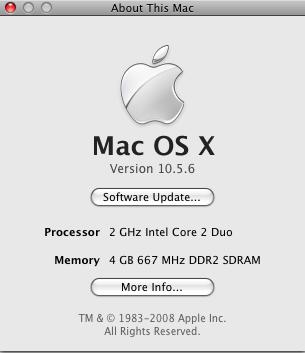
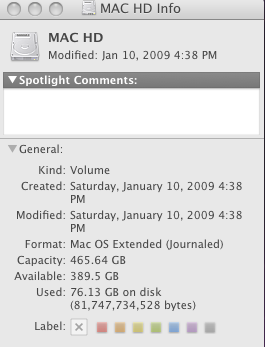
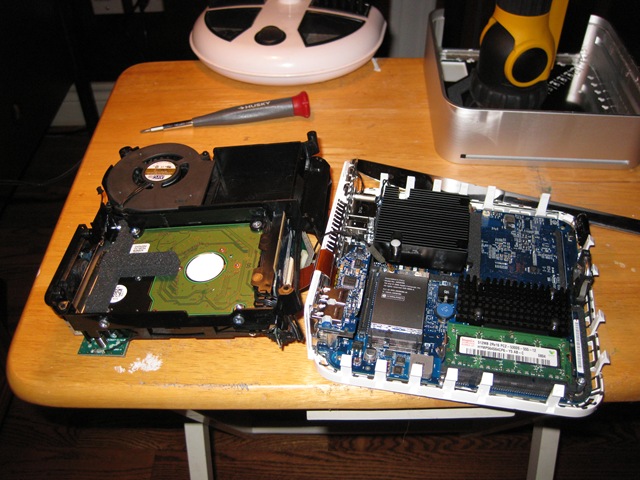
macopenedNow that I have taken that important first step and added a Mac Mini to my home office computer array, the only logical next step was to open it up, take a look at the insides and add stuff to it.  Here’s the story of how I upgraded my RAM to 4-GB and my hard drive to 465-GB.  Because of the small size of the machine, it was harder than upgrading a desktop, but no harder than upgrading a laptop.  And there are lots of tutorials on the web to guide you through the process.

First, I shopped around for new hardware.  I ended up getting two 2-GB memory modules and a 500-GB hard drive from OWC.  The items were shipped immediately and sitting in my office within a couple of days.

I decided to add the RAM first.  Methodshop has an excellent walk-through of this process.  Of course, I didn’t back up anything.  I decided to play marbles for keeps and just grabbed a putty knife and started prying the case apart.  As noted in the walk-through, this first step is probably the hardest part of the exercise.  Once you get the hang of it, it gets much easier, but at first that Mac Mini looks about as hard to get into as Fort Knox.  Once you get the case open, follow the steps as described in the Methodshop walk-through and a few minutes later, you have an upgraded Mac Mini.  The only part I couldn’t get done was to reinsert all 4 corner screws.  The back left one proved to be impossible, so my Mac Mini is secured by only 3 corner screws.  I hope it doesn’t feel inadequate.

atm Adding the RAM was easy- and easier than I expected.  Now for the new hard drive.

Applefritter has a good walk-through of both the RAM and hard drive upgrade process.  OWC sells upgrade bundles along with its hard hdinfo drives, which include an external SATA enclosure and software to clone your existing hard drive to the new one.  Cloning my existing hard drive to the new hard drive was easy- and I didn’t read any instructions.  I just installed the application, put my new hard drive in the enclosure, attached it to my Mac Mini, opened the application and looked for the right settings (clone).

After cloning the hard drive, I followed the steps as described in the Applefritter walk-through.  It went relatively smoothly, with a couple of complications.  When unfolding the case to access the hard drive, the audio cable to the DVD drive came loose (see the last picture in the Applefritter walk-through).  It’s easy to reattach, but it would be a huge drag to fully reassemble the machine, only to find later that the DVD drive wasn’t working.  I also accidently pulled the cable that attaches the airport antenna off of the connector on the internal airport card.  It can be reattached easily if you know where to attach it.  I also found that you need to pull the T-shaped foam rubber off of the old hard drive and attach it to the new one.  You can see this foam rubber attachment in the eighth picture in the Applefritter walk-through.

All in all, these upgrades were quick and easy.  And at the end of the day, my little Mac Mini isn’t quite as mini anymore.

Technorati Tags:

Blogging from a (Mini) Mac

Well, I’m not rich or convinced enough to go all-in with something super-expensive, but I was curious enough to dip my toes in the Mac-water with a Mac Mini. I bought one a couple of weeks ago, hooked it up to one of the two monitors in my study and have been using it, along with my PC, ever since. At first, I was under-whelmed, but the more I use it, the more I like it. I already prefer it for converting my home movies for my media server. Getting it to play well with my reasonably extensive home network was a bit of a challenge, but except for a couple of still-invisible devices, I managed to get there.

The early results are that I get the Mac thing, at least to some extent.

It’s hard to tell if I will gravitate more to the right side of my setup- where the Mac resides, but at a minimum I’ll keep the Mac around for the things it clearly does better than a PC. If I win the lottery, I’ll buy a tricked out Mac Pro and run both OS’s via Parallels or some other software.

I can tell you absolutely that there is no Mac-equivalent to Windows Live Writer for writing and managing blog posts. I’m using Ecto at the moment, and, with apologies to the Mac nation, it’s not even in the ballpark. It feels like going back to Internet Explorer after years of Firefox plug-in heaven.

UPDATE: I really don’t like Ecto. This post originally posted to an old, abandoned blog I still haven’t deleted. Granted, I’m sure I could figure out how to post it to this blog, but how wasn’t immediately evident, as it is in Live Writer. I reposted it via the Blogger dashboard.

I also hoped that iTunes would be faster on a Mac. It’s not- the Windows and Mac experience seem identical. It still amazes me how inflexible, slow and generally crappy the iTunes application is, given how elegant the Apple hardware is.

But there’s still something that feels different and oddly better about using the Mac. Plus, Earl and my other Mac buddies will be proud of me for taking the first step.

Making the iPhone Engine Run Smoothly

iphone1

One of the other reasons I waited so long to get an iPhone is the fact that it cannot, yet, serve as a tethered wireless broadband modem for my laptop.  For an extra $15 a month, my recent Blackberries could link up via Bluetooth with my laptop or Samsung UMPC and serve as a broadband modem.  This was handy in airports and in hotels that offered no or ridiculously expensive internet access.  In fact, as long as my phone was in the room or car, my other devices would link up automatically and have instant reasonably fast access.  For two weeks after Hurricane Ike, I ran my home network off of my Blackberry.  It was slow, but the jump from none to slow is more significant than the one from slow to fast.

The iPhone doesn’t tether, yet.  Apparently, there was a third party app that allowed tethering, but Apple squashed it.  Sure, I could jailbreak my phone and find a way to tether.  But the iPhone is about seamless convenience and constant jailbreaking would be seamful and inconvenient.

But I think it’s OK.

The reality is that there is very little I need to do in airports and on the road generally that I can’t do directly via the iPhone.  Sure, I can’t easily create or materially edit documents, but I don’t do that in airports and in transit anyway.  I do that in my hotel room or between speeches at a conference- in places that almost always have internet access.  Plus, while I haven’t tried it yet, iPhone users can access ATT’s wi-fi hotspots at no additional charge.

And there may be other issues at work here.  I suspect that Apple’s agreement with ATT prohibits tethering.  Both as a way to conserve bandwidth and to force customers to buy ATT’s existing wireless cards or the rumored account add-on that may add the ability to tether- at an additional cost.  Add free tethering without a bigger pipe (or additional money to build one) and the demand on the bandwidth will increase materially, likely lessening the experience for existing- and future- iPhoners.  Keeping the bandwidth-hogging geeks from linking up all their gear to their iPhones is, at least for the moment, the governor that makes the iPhone engine run smoothly.

I’d rather do it this way than end up throttled or charged more for someone’s idea of excessive bandwidth use.  The iPhone has clearly crossed the mainstream into the non-geek population.  Many iPhone users are happy to make calls, text their friends and check the weather every now and then, none of which is bandwidth intensive.  If I can ride along with the herd and do what I need directly via the iPhone, with no limits or additional charges, that’s great.  If it turns out I can’t live without tethering and I have the opportunity to add (and pay for) that feature, that’s good too.

Technorati Tags:

Dr. iPhone or: How I Learned to Stop Blackberring and Love the App Store

As one of the rats in the great corporate email race dominated by Microsoft Exchange Servers and Blackberry Enterprise Servers, I have used a Blackberry for many years.  From the first little pager-looking 850 to the Pearl 8130, and several points in between.  While thumb-typing away on my Blackberry, I have suffered from recurring bouts of iPhone lust, having seen my wife and many of our friends fall in love with their iPhones.  For a long time, however, my concerns over the handling of corporate email kept me glued to the Blackberry alter.

Until last week.  Here’s how Verizon tried to hose me and led me to the most eloquent device I have ever used.

verizon

I am sold on the touch screen concept, and was eagerly awaiting the arrival of the great iPhone slayer- the Blackberry Storm.  I stopped by the local Verizon store just before 9:00 a.m. on November 21- the day the Storm was released.  The store wasn’t open yet, but there were a dozen or so people inside.  A Verizon employee quickly unlocked the door for me.  She asked if I had an appointment, noting that the other people in the store had booked an appointment in advance.  When I told her I didn’t have an appointment, but was a Verizon customer who wanted to upgrade to a Storm, she happily exclaimed that “we can get you in and out of here in no time,” and directed me to the customer service window.  There were two Verizon employees helping customers at the window, and I was second in line.  30 minutes later I was still second in line.  One of the employees at the window told me Verizon’s computers were overwhelmed and it was taking a long time to process the upgrades.  No problem- that was to be expected on the morning of the release.  The first problem occurred a few minutes later when another line dweller told me Verizon was sold out of Storm handsets and that I was waiting in line to order one that would be mailed to me.  A Verizon employee confirmed that and told me I could order the phone faster over the internet.  So I left the store, went to the office and logged into my Verizon account.

Here’s where things started to fall into place.

iphoneMuch to my surprise, my quoted price was not $200, as widely advertised, but $500.  I called customer service and was told that my contract was too recent to permit an upgrade and that I would, in fact, have to pay $500 if I wanted a Storm.  I didn’t like this, but contracts are contracts, so I asked how much it would cost to terminate my contract early (by about a year and a half).  $125 was the answer.  So, I asked, “you’ll sell this phone to a stranger for $200, but an existing customer has to pay $500?”  I was told that was the case.  Again, not good news, but I understand the math so far.  I had one more question: “But if I wanted to, I could pay $125 to terminate my contract today, come back tomorrow and pay $200, thereby achieving an actual price of $325?” I could tell the phone rep was uncomfortable, but ultimately she agreed that I could do that.  “But you won’t sell me the phone for $325 without having to go through all of that?”  She said she couldn’t.  The cost was understandable, even if a little frustrating, but the unnecessary hoops were more than I could handle.  So a wonderful thing happened.

I canceled my Verizon account, drove to the local ATT store, bought a 16G 3G iPhone and had my number ported over.  At the end of the day, I have a much better phone at a lower cost.  $125 is a lot of money, but amortized over the remaining 18 or so months of my Verizon contract, I’m more than happy to pay an extra $7 a month for the iPhone experience.

I am a technophile and somewhat of a gadget freak.  I have used lots of gadgets.  The iPhone is quite simply the most well-designed and useful device I have ever used.  Plus, it’s a load of fun!

The phone comes with just about everything you need, right out of the box.  But the real fun begins when you explore the App Store.  So far, I have added the following apps, which give me a device that does just about anything I might ever need it to do.

AOL Radio: an amazing selection of great sounding music stations.
Pandora Radio: the best music on the net.
AroundMe: uses GPS to find local restaurants and other points of interest.
Mobile Fotos: my favorite app- a must for Flickr users.
Camera Bag: auto-edits iPhone photos
Google Mobile Apps: brings all of Google’s apps to an iPhone interface.
iTalk Recorder: record voice notes.
Note2Self: record voice notes and email them.
Remember the Milk: the best to-do list and reminder service.
Sportacular: quick sports schedules and scores.

(You can search for these great apps and others from within the iTunes store.  Many of them are free and all of them are cheap.)

Those of you who are on corporate email platforms will wonder how I feel about the iPhone/Microsoft Exchange implementation.  I think it works perfectly.  The emails are much easier to read and flicking is much easier than scrolling with that irritating wheel (which was very hard to do with my Pearl).  When I delete an email on my computer or my iPhone, it is automatically deleted on the other device.  I didn’t have my Blackberry configured that way, but after a few days, this approach seems more logical to me.

When I experimented with my wife’s iPhone, I found typing to be difficult, often hitting the wrong letter (particularly P when I was aiming for O).  But after a little practice, you find that your typing improves and you rarely hit the wrong letter.  My friend Marvin says it’s a confidence thing- I think that’s a good description.  I find myself typing faster on the iPhone than I did on the Blackberry.

I wish the camera had a flash, and you do have to recharge the iPhone more often than the Blackberry- because the iPhone is so fun to use, you use it more (and there are solutions to that problem).  But those are minor issues that are more than outweighed by the many additional benefits of the iPhone.

I’m sold.  Thanks Verizon!

Technorati Tags:

Why the iPhone Won’t Go Corporate

Update late 2012:  Wow, how wrong was I…

I was momentarily very happy today when I came across a story in my feeds saying the iPhone was going corporate. And then I read the post and immediately realized it was not going to happen.

All the rates and plans and promotions and parades and proclamations in the world are not going to bring the iPhone to corporate America until it has the ability to pull email from Microsoft Exchange Servers and BlackBerry Enterprise Servers. Why? Because almost all of the big companies in America use one or both.

One of my partners stood in line to buy an iPhone the day it was released. I remember when he showed it to us at lunch the next day. All of us were jealous. All of us wanted one. As the initial coolness factor faded in favor of the I need to get my work email factor, however, he found it burdensome to carry an iPhone and a Blackberry. He ended up getting rid of the iPhone and going back to the boring, feature challenged, but work-email compatible Blackberry.

Someone will say, “but you can get your work email over the web with an iPhone.” That person has never worked in a corporate environment where immediate and effective access to your email and other data is critical to your effectiveness. In sum, that just doesn’t work.

I would buy my way out of my Verizon contract and buy an iPhone today if it could pull my office email. So would a lot of other people I know. But it won’t, so we don’t.

Meanwhile, I got a letter from Verizon’s customer retention department this week, offering me a Blackberry Pearl 8130 for $50. No contract extension required. I just called them, and they are sending it to me via Federal Express. It’s no iPhone, but it’s a start.

Technorati Tags:

More on iPods

Dave Winer’s arguments against AppleTV are very similar to mine against the iPod. Why does Apple get a pass when it tries to control our audio, and now video, experience? Everything about the iPod is designed to force you to use iTunes as a gateway to your music. And to sell some downloads, of course. If Microsoft did something like this, all the Apple heads would scream bloody murder.

I’m not saying Microsoft wouldn’t have done it if it had the chance. I’m just saying.

On a similar note, why does Google get a pass when it tries to control our entire internet experience?

Back to iPods: Michael Walsh points me to his Digital Rights Manifesto, which I generally agree with, except that I will not accept any form of embedded DRM. Now that I can get DRM-free downloads from Amazon, I am buying much more music than I was in the less immediate CD format.

Michael also pointed me to this very timely comic.

Speaking of what goes around comes back around, get ready for the next big thing: wireless TV!

Technorati Tags: ,