
[Sadly, the content of this post was lost on the way from our self-hosted WordPress site to WordPress.Com. If we can find it, we’ll put it back later.]
Category: Tech
Three Simple Things Twitter Should Do to Improve the User Experience
 As everyone who reads this blog knows, I run hot and cold on Twitter. On the one hand, I just don’t get what’s so magical about trying to have a conversation in a what amounts to a public chat room often inhabited by a horde of spammers. MLM’ers and self-promoters. I didn’t like chat rooms in the nineties, and I don’t see the appeal now. On the other hand, a lot of my friends really love Twitter, and I have been wrong before (about Facebook, among other things).
So I keep trying to figure out how to use and enjoy Twitter. During this process, I came up with three simple things that would greatly improve the Twitter user experience. Without further adieu, here are three things that Twitter should do right now, today, that would help me and a lot of other people use and enjoy Twitter more.
1. Escalate the Spam Battle
I can’t give you numbers, but I am confident that a large number of the people who follow me in any given day or week are doing so only in the hopes that I’ll follow them back so they can turn around and send me some sort of spam. MLM crap, outright scams, you name it. I am equally confident this is the case for other people as well.
Twitter should fight the spam fight for us, or at least give us better tools to fight it ourselves.
Sure, you can send a spam report off into the ether. I have reported a number of users for spam. Maybe some action has been taken on some of them, but you can’t prove that by me. Twitter should value the quality of its network- not just the quantity- and take a stand against spam. I can’t remember the last time I saw a story about Twitter’s efforts to reduce the spam that runs rampant on its network.
But make no mistake. There are ways to fight spam.
One of the most effective ways would be to take a page from the message board book and appoint a class of community “moderators” (call them whatever you want) who volunteer to monitor the network for bad behavior and who are empowered to take action against it. Sure, you have to clearly define what is grounds for action, and you have to err on the side of allowing content, but I can tell you from experience that it can be done. Cheaply and effectively.
Why hasn’t Twitter done this, or something similar? The cynic in me says the developers are too busy reading their own press. But maybe I’m wrong about that too.
I hope so.
2. Allow Embedded Media
This is something Pownce did years ago, and Facebook and Google Buzz do now. You don’t have to host the files. You just need a way for people to link content and allow others to hear or see it in line, right there on Twitter.
Some will want to play the copyright card, but if you aren’t hosting the content, I see that argument as a canard.
And even if someone who matters at Twitter thinks this is a bad idea, I don’t think Twitter has a choice. Why? Because other services are doing it. Twitter has all the mindshare right now, but as we’re seeing with all the Buzz hoopla this week, things can change.
Spam might kill Twitter. The failure to stay feature competitive would, for sure.
3. Better Subscription Management
I try to keep up with my inbound and outbound Twitter follows, and in this regard let me give a mighty shout out to and recommendation of Topify. If you don’t use it, you should. In fact, Twitter should buy Topify and make it part of the core Twitter code. It’s that good.
Even with Topify, it’s inexplicably difficult to manage your Twitter follows and followers. There’s no way to mass unfollow people, for example. There are some services that try (or used to try) to provide this sort of thing (Your Twitter Karma, for example), but Twitter doesn’t like them, and has taken the position that some of them violate Twitter’s terms of service.
Here’s the problem with that. Why is it OK for spammers to follow 999 people a day, unfollow them and then spam them, but there’s no way for a user to generate a list of people they follow and choose (e.g., by uncecking a box) which ones to unfollow? Stated another way, why doesn’t Twitter allow us to manage our subscriptions any way we want?
Sure, you can unfollow people via the list of people you follow (click on the “following” link below your photo), but the list doesn’t easily tell you if the person follows you. You can figure it out by clicking the Actions button and looking to see if you have the ability to DM the person (yes, they follow you; no, they don’t). But why does it have to be this hard?
Last night, I decided to browse my follows and remove obvious spammers and most of the people I follow who aren’t major media writers and don’t follow me back (you know, my Pink Floyd policy). This should have taken 60 seconds, but it took forever, because I had to find this list via FriendOrFollow, and then unfollow people one at a time.
Note: my Pink Floyd policy is not absolute. There are plenty of people I find interesting enough to follow, regardless of whether they follow me.
Another problem: there are a ton of people who follow me, that I don’t follow back. My general Twitter approach is to follow back anyone who follows me who (a) has more than a few posts, and (b) isn’t an obvious spammer or MLM’er (Topify makes this pretty easy by including recent posts in the new follow email notice). But, again, I come and go with Twitter, and I get behind. There are tons of people who follow me that I’d like to follow back. But I don’t have time to visit each person’s profile and decide whether to follow or not.
Twitter makes this a little easier by showing whether you you follow your followers (the “followers” link below your photo). This is clearly designed to encourage following and to discourage unfollowing. Why?
You should be able to slice and dice your follows, any way you want.
Users should have access to a page with profile information and a box that can be checked or unchecked to follow or unfollow people. Candidly, I can’t conceive of why there isn’t something like this already.
That’s it. Three simple things that would vastly improve the Twitter experience. For me, and for everyone else.
Has Google Reader Entered the Fast Lane?
And how you can benefit from it.
I noticed earlier today that, in a great improvement from days (and days) gone by, posts were showing up a lot more often in my Google Reader. I marked it up to some hiccup in the pipeline.
Then I saw a post by Alex Wilhelm over at the Next Web speculating, with at least something approximating confirmation, that Google has widened the pipe, perhaps via PubSubHubBub.
Life in the Fast(er) Lane
If this is true, or even close to true, it is great, awesome news. For one thing, I use Google Reader all the time, and my one complaint has been that it sometimes seems to be taking a leisurely drive, when I want an on-ramp to the information superhighway.
(numerous new items have populated my Google Reader in the time it took me to type that bad metaphor)
Enabling Your Blog
If you want to make your blog PubSubHubBub-ready, there are two ways to do that.
If you use Feedburner, enable PingShot:
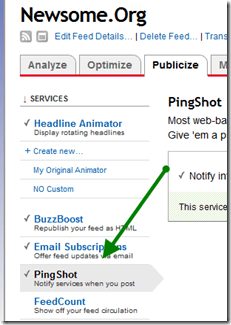
If you use WordPress, grab a plugin.
Google Reader is truly my number one tool where online content is concerned. I’m happy it has been speed-enhanced, however it was done. And I’m happy Google is still improving it. It would be a shame if Google lost focus on Google Reader.
I still miss Google Notebook. But that’s a story for another day. Right now, I’ve got a ton of new posts to read. And more every minute.
How to Share Your Google Calendar
I’ve done a few hard things. Learned code. Built a computer from parts. Finished a Rubik’s Cube. Learned how to navigate around Facebook (sort of). You get the picture.
But nothing prepared me for the chore that was configuring my Google Calendar to allow my secretary to see and add appointments.
So I thought I’d so a step by step to save someone a little agony.
I use Google Apps for my email and calendar, so there are a couple of extra steps that may not be required for regular Google Calendar users.
Step 1: Configure Sharing Rights (Google Apps Only)
This is where a lot of Google Apps users get tripped up.
To share your calendar with people outside your domain (in my case, those without @newsome.org email addresses), you must enable sharing with people outside your domain, within Google Apps. From your Google Apps Dashboard, click on Calendar and then set the “Sharing options” for users "Outside this domain" to "Share all information, and outsiders can change calendars." If you don’t do this, the person you are trying to share your calendar with will, at most, only be able to see if you are free or busy- no details and no ability to add items to your calendar.

Step 2: Wait a While (Google Apps Only)
Once you configure your Google Apps as described in Step 1, it takes a little while (maybe an hour) for your revised sharing settings to take effect. This can be very frustrating to those who don’t know about this delay.
So be patient. Go grab some lunch.
Step 3: Make Sure the Person Has a Google Account
In order to log-in and see your calendar, the person you want to share your calendar with must have a Google account. This is not the same thing as a Gmail account. Any email address can be used to create a Google account. The sign up page is here.
Step 4: Grant Access via Your Calendar
Now go to your Google calendar. Navigate to Settings>Calendars. Look beside your calendar (the one you want to share, not someone else’s that is being shared with you) and click on "Shared: Edit Settings." Add the person’s email address to the blank under “Share with specific people” and choose "Make changes to events." Click on the "Add Person" button, and the entered email address should appear in the list below, with the correct sharing level.

If it still says "See only free/busy (hide details)," then you need to go back to Steps 1 and 2 above. Probably it’s a matter of the delay described in Step 2.
Step 5: Log-in and Share Away
Then, once the person logs into his or her Google account, he or she will be able to access and add to your calendar.
That’s it. Post any questions in the comments.
Microsoft Store: Moving at the Speed of a Glacier
 My kids are starting to compete for computer time on their shared computer, so I decided to revive the old but still very functional HP Laptop I used to experiment with Ubuntu (verdict: beautiful GUI made useless by a complete inability to configure a wireless card). Since I wiped the hard drive, I needed to do a clean install of Windows. Having somewhat of a current software obsession, I decided to part with $216.49 to buy a Windows 7 Home Premium license.
All of this happened on Saturday, so I thought I’d save some time and buy this license at the online Microsoft Store. Did I say this was Saturday? Three long days ago?
After completing my purchase, I watched my inbox eagerly for my confirmation and Product Key. I watched. And watched. And watched.
Then I decided to go on living my life, and forgot about the whole thing.
Until today, when I got that email, with the confirmation. And the Product Key. That’s 3 days. 72 hours. 4,320 minutes. 259,200 seconds.
Which is about 259,170 seconds longer than it should have taken.

In this real-time world where speed is measured in seconds, isn’t it crazy that an online purchase from Microsoft, of all companies, takes 3 days to complete!?
It would have been faster to have it delivered by pony express. Or on a glacier.
Will Lack of Exchange Support Doom the iPad?
I have been on an emotional roller coaster with my hopes, expectations and plans for the forthcoming Apple iPad. At first, I got swept up in the Steve Jobs as a Mystical Shaman euphoria and thought this device would change the entire landscape of personal computing. Once I came to and let my Apple hangover subside, I decided I was disappointed with some of the notable- and mind-boggling- omissions. Like standard ports, a camera, etc.
 Meanwhile, in my never-ending pursuit of technological efficiency, I continue to struggle with my mobile game plan. Historically, I carry my iPhone everywhere, and put together an impromptu toolbox when I travel. Depending on the location, method of travel, length of stay, etc., I choose between my HP tablet (smaller, but less powerful), my HP laptop (sleek and powerful, but big and heavy) or my HP netbook (which I rarely use, but take on short trips sometimes out of charity). Along with the selected computer, I take my USB wireless broadband card. Since iPhones still can’t tether, I have to pay another $60 a month to ATT for this card. Anyone see a connection there?
This approach works OK, particularly as I migrate more and more to the cloud. But it would be nice to have less equipment, and to use the same devices everywhere. There are still times when I have one device, but need something that is local on the other device.
So I started to wonder if the iPad might just be my mobile game plan in a box. Much of the time, whatever laptop I’m lugging around has more horsepower than I need. Maybe an iPad could replace all of my laptops, reduce my gear load and make me a consistent mobile user. Yeah, that sounds good.
Right?
No, wrong. The iPad is probably going to screw up my plan- and break my heart- due to three major issues. Issues that will be the end of any hope on Apple’s part for corporate acceptance of the iPad.
What Good is It If We Can’t Read Our Email?
While I haven’t seen any final word on this, I am concerned that the iPad won’t support Microsoft Exchange. Most companies use Exchange for their email, which means that, in some techy Groundhog Day twist, the very thing that kept business users from getting iPhones for so long will prevent us from effectively using iPads.
I hope- and Apple better hope- I’m wrong, and the iPad will support Exchange. It’s one thing for non-corporate users, all of whom are going to carry some manner of cell phone, to spring for an ATT-subsidized iPhone. A more expensive, non-subsidized tablet is another thing altogether. The iPad needs the business community, or it will become nothing more than a better Kindle.
A secondary, but important, issue is what will corporate IT departments do to the iPad in the (misguided in my semi-humble opinion) name of security? I had to battle with my company to get an hour password screen lock window on my iPhone (that I paid for). Assuming the iPad does support Exchange, will business users have to hobble their iPads just to read their mail?
I Want to Fracking Tether, and I Want to Do It Soon
It’s beyond absurd that U.S. iPhones still can’t tether- something my Blackberry did 3+ years ago. It is unthinkable to expect those who already pay for an iPhone and a wireless broadband card to pay ATT yet another monthly fee to get 3G on our iPads (should I mention that the lack of a USB port makes it impossible to use said wireless card with an iPad?).
If I can get rid of my wireless card, and apply that cost to a data plan for an iPad, great. But that will require Apple to include a tethering feature on the iPad. And I haven’t heard anything that leads me to believe that’s in the works.
Which leads me to ask: who do they think is going to buy all these iPads they plan on selling? Seriously.
And the Final, Word?
Lastly, the iPad needs to support the viewing and editing of Microsoft Word documents. The business world is based on- and largely hostage to- Word. For meaningful penetration into the corporate world, Word on the iPad is a mandatory requirement.
Maybe Apple will figure this out, maybe it will be Microsoft, or an app developer. But someone better, and soon.
So Will I or Won’t I?
I don’t know. If at least two of these three issues are addressed to my satisfaction, probably. Otherwise, I’ll probably wait for the iPad 2.0.
Or maybe I’ll get a Kindle.
Update 1:
John Welch, via PCWorld, says that, happily, iPads will have Exchange support. According to sources, iPads will have the same Exchange-related features as the iPhone. Kudos to Roberto Bonini for predicting this via Twitter. John seems to be on my side of the iPad as a potential business tool debate, though he shares my concern over the lack of Flash, and my fear that IT directors will overstate the network-related issues.
As we learned today, the Flash thing may be an unsolvable issue, given the Hobson’s choice between no Flash or no battery life. All of this assumes, of course, that Apple is telling the truth.
WP Plugin: WP to Twitter
I’ve been using the Twitter Notify plug-in via Live Writer to post new blog post notifications to Twitter, but there are problems with that approach. It doesn’t work when I post from the WordPress Dashboard, or when I (try) to post with the WordPress iPhone app. So I went looking for a better method, and came up with WP to Twitter.
You can configure WP to Twitter to do just about anything short of tying your shoes. You can configure it to work with several URL shorteners, including Bit.ly. You can configure it to Tweet new posts (good) or edits to posts (with my typo-correcting requirements, bad). You can customize the content and sequence of the Tweet, convert tags to Twitter hashtags and more.
Best of all, it will automatically push new posts to Twitter, regardless of where and how the post is created.
All in all, pretty nifty.
WordPress for iPhone 2
With most of the heavy lifting behind me in my migration to WordPress, I’ve started looking at some more subtle features. I’ll cover plugins later, but I want to try WordPress for iPhone 2.
I can already tell it tries to overcome the aggravating inelegant linking issue that plagues every iPhone app to one extent or the other. It’s easy to create a post, and, once you figure out how to do it (via the Status screen), easy to publish posts.
We are at Tokyohana with our good friends the Brooks, who are visiting from Atlanta.
I took a (blurry iPhone special) picture to add to this post. Wonder if and where it will appear?
Update: Pictures appear at the end of the post, which would be fine except they are huge (I resized it from my desktop). If this is how it works, the photo addition feature is useless.
The company is great, the food is excellent, and the app is very good. It does about as much as can be done to make it less than torture to create a link.
I bet this will rock on an iPad!
Now back to friends and food.

Update 2: I was unable to post over 3G, but it seemed to work via wifi. I hope that’s a network glitch and not an app limitation.
More on Blogger Custom Domain Publishing
I’ve been spending a lot of time working on Newsome.Org’s move to WordPress, which is going remarkably well (more on that later). But today I want to look a little deeper into the process and benefits of publishing your blog via a Blogger Custom Domain.
 First, a recap. Recall that Blogger has announced that it will discontinue publishing via FTP on March 26, 2010. This caused a general panic here at Newsome.Org, followed by a somewhat more thoughtful election to move Newsome.Org to WordPress and my music publishing company (Errbear Music) to a Blogger Custom Domain. As I noted before, the process was generally very easy. Here’s the step-by-step walk-through of the process.
Here are some updates.
Adding Post Pages
When I was publishing to Errbear Music via FTP, I was hosting the blog files in a directory on my Newsome.Org server, and using a page in that directory (errbear.html) as the blog’s front page. I then parked the errbear.com domain on that page, meaning that when someone directed their browser to errbear.com, he or she was forwarded to the errbear.html page. It looked reasonably seamless. The problem became that all of the post pages and other ancillary pages were located at Newsome.Org, and had a Newsome.Org URL. Once I set up my Custom Domain, I wanted to have all of the post pages and ancillary pages located within that domain. This happened automatically for the post pages, but could not happen automatically for the various ancillary pages located in that directory. The majority of those ancillary pages were the very important lyrics and streaming mp3 pages for my songs. This required me to create a new post page, containing the lyrics and a streaming mp3, for each of my songs. It wasn’t a soul-crushing task, using Live Writer and the time saving Text Template plugin, but it did take some time.
I want to be clear about something, to avoid confusion. The pages I am talking about were not previous blog posts. They were html files on my server that I linked to from the sidebar and in blog posts. For those who wonder how things got that way- my Errbear Music pages pre-dated by years the advent of blogging and blogging software. Those pages existed when I moved to a blogging platform.
A couple of pointers for anyone who has to do this:
1. Blogger allows you to mass edit labels. This is a huge time-saver. I decided about 2/3 of the way into the process to create genre-based labels. It would have been soul-crushing to go back and add labels to each post page manually.
2. There is a limit to the number of posts you can make each day to a Blogger blog. I don’t know the number, but it’s large. I ran into the “too many posts” error a couple of times when adding the post pages. Wait a day and you can get back to uploading pages.
I would note that I decided to leave the mp3 song files on the Newsome.Org server. The size of that song library and all the links out there (via a lot of the music search engines) led me to conclude that those files should be left where they are.
Templates are Themes
I wasn’t all that crazy about the default selection of templates. Initially, I hacked up one of the default selections and made it work. There are, however, a lot of good templates out there, you just have to look for them. I started with the Natural Health theme, and went from there. I think that template is as pretty as any WordPress themes I have seen.
It’s easy to upload a template via your Blogger Dashboard. Simply find a template you like and then:
1. Download the template to your computer. If the template is contained in a zip file, extracted the XML template file.
2. Log in to your Blogger Dashboard and go to Template> Edit HTML.
3. Back up your old template in case you decide to use it again. Simply click on the “download full template” link and save the file to your hard drive, or just copy and paste the html to Notepad.
4. Look for the section near the top where you can browse for your XML template.
5. Enter the location of your template and click “upload”.
6. The html of your new template will now appear in the box below. You can preview your new template or save it and start using it right away.
Hacking the Template
Much of what you want to change can be done via the Layout editor within your blog settings. Blogger has a “Gadget” approach, very similar to WordPress’s “Widgets.” While there isn’t the developer community behind Blogger Gadgets like there is for WordPress plugins and Widgets, I am confident that you can do just about anything layout or content wise on a Blogger template that you can do in a WordPress theme.
At the end of the day, I found the manipulation of Blogger templates to be a little less powerful and a little easier than WordPress themes. It’s not the kiddie pool, by any means, but there is a rope to help you keep from drowning.
One tip:
While you can do a lot via the Layout editor, you’ll need to (and can) edit the html for some tweaks. For example, until I went in and hacked the template code, my email subscription form was subscribing people to the email feed of the template developer. For what it’s worth, I have been using Feedblitz for my email feed for years, but moved back to Feedburner for both my blogs today. (If you don’t know what a Feedreader is and want to subscribe to Newsome.Org via email, see the link in the left column on this page.)
At the end of the day, moving to a Blogger Custom Domain is very easy, and Blogger provides the tools to create just about anything you could want. I’ll do a feature by feature comparison of Blogger and WordPress soon, but in the meantime, I can say that publishing to a Blogger Custom Domain is a fine, feature-rich option for your blog.
As always, I’ll try to answer any questions posed in the comments.
The WordPress Process, Part 6
The WordPress Process is a series of posts at Newsome.Org, documenting my forced march from the comfort of Blogger to the uncharted territories of WordPress. Parts 1 & 2 are here, Part 3 is here, Part 4 is here, and Part 5 is here.
 At long last, we have arrived at the Promised Land. Newsome.Org is up and running on WordPress. Most (I have identified one casualty so far, and there may be a few more) of my 1600+ posts made the trip, and we have preserved the permalinks (more on that below). While I was able to get WordPress installed, hack-up a theme and generally get the system operational, the hardest and most important step is the importation of old blog posts and the preservation of your existing inbound links.
In that regard, there are two important things those moving established blogs from FTP published Blogger to WordPress need to consider.
It’s Easy to Do it Wrong
I imported my old posts in a way that I thought would preserve all of my permalinks. It looked like it worked, and I started going back through old posts and adding Categories and Tags. But, of course, my approach didn’t preserve the links correctly, so we had to start the importation process over.
By we, I mean Aaron Brazell, of Technosailor, who I hired to help me with the importation and permalink preservation part. Aaron is extremely knowledgeable (and by that I mean Jedi-like) with respect to all things WordPress. In fact, he literally wrote the book (WordPress Bible; purchase at Amazon). I bought and am reading Aaron’s book, and highly recommend him for those in need of a WordPress guru. Aaron was able to fix my mess correctly and preserve the permalinks. As punishment, I got to start over on the Categories and Tags job. After a month or so, we are going to change the permalink structure to the default WordPress form and do 301 redirects to forward old-style links to the new WordPress-style pages. I’ll write about that in a future installment of this series.
Use Care When Hacking
While I crashed and burned when I tried to handle the post importation and permalink work by myself, I am pretty good with html, css and most scripts. I got my theme installed easily, and once I explored a bit I felt pretty comfortable hacking the various files to change the look and layout of my pages.
The problem with this, as with any coding, is that it’s always all good, until it ain’t. I got too confident, stopped saving incremental back-ups and promptly trashed my header (the part at the top where the Newsome.Org logo and photo banner are located). A little help from my friend Steven Hodson and some surgery by Aaron got things back up and running. The moral is to use caution when hacking your WordPress files and to always make a back up before you change anything.
Comments
I was able to get get Disqus comment and reaction numbers to show on the main WordPress pages, with some great help from the Disqus team. One helpful tip, and something I stupidly failed to notice: if your comment numbers aren’t displaying properly, go to Settings>DISQUS>Advanced Options in your WordPress Dashboard and check this box:

I could have saved me and the Disqus guys some time if I had seen that earlier. Disqus is a pretty amazing service. If you don’t use it, you should. For sure.
The Punchlist
So what’s left to do? Here are a few things I know of.
1. Finalize the permalinks, and make sure the old links are properly redirected, and then coordinate my URL structure with Google Webmaster Tools. I learned my lesson, and will let Aaron advise me on this.
2. Identify any posts that didn’t get imported and, if I can’t live without them, add them manually. I only know of one so far, so hopefully this will be a small job.
3. I noticed that some applicable posts that got imported do not show up in the appropriate monthly archives. I’ll consult with Aaron and see what can be done about that.
4. Decide whether to install the All in One SEO Pack. Again, I’ll consult with Aaron on this.
5. Consider what additional plugins I want to install. Part 7 of this series will cover plugins, so we’ll address current and future plugins then. In the meantime, good plugin suggestions are encouraged via the comments.
6. Delete the old FTP Blogger-created directories on my server. But only when Aaron tells me it’s OK. I have to resist my techy inclination to jump first and worry about the parachute later.
7. Delete the old Newsome.Org Blogger blog, which currently resides at Blogspot, as part of the post importation process.
That’s where we are so far.
Any other tips from veteran WordPress users?
 Newsome.Org