
Plaxo Wars: The Commenters Strike Back

I came across a very interesting discussion via a post and link on Mathew Ingram’s blog about Plaxo, the ubiquitous sender of emails offering you the chance to update your contact information. These are usually sent by someone I barely know, if I know them at all.

It all started (as best I can tell) when Charles O’Donnell, who works with Fred Wilson (a smart guy I like a lot) at Union Square Ventures, sent out one of those Plaxo emails and then blogged about it. Charles’ point was that he gets people to respond to his Plaxo update requests by adding humor to the request. Although I will probably never respond to another Plaxo update request (I confess to having done so a few times in the past), a funny request would raise the chance of a response from say 0% to maybe 0.2%. So my take is that I’m not going to reply, but it doesn’t twist me off to get a request from someone who I know or who knows me.

Then Michael Arrington posts a negative comment about Plaxo in a comment to Charles’ post, makes a corresponding post on TechCrunch and all hell breaks loose.

First of all, even though I am no Plaxo fan, I think Mike was a little too hard on Charles. But a spirited debate is always interesting and sometime informative and a spirited debate ensued in the comments to Mike’s post.

Charles’ day went from bad to worse when Stacy Martin, Plaxo Privacy Officer (Plaxo Privacy Officer should go into the job name hall of fame on the first ballot), joined the discussion. First she and Mike engaged in a little semi-constructive banter, then she turned on Charles and said that he violated Plaxo’s terms of service. Somehow, I have a hard time buying that it’s up to Charles to make sure Plaxo doesn’t allow Charles to spam Mike. Even if Charles were a spammer instead of a (probably former now) Plaxo user, Plaxo should never let the foxes guard the hen house.

Steve McFarland, as quoted in Mathew’s post, summed it all up thusly:

Plaxo, is like that senior citizen in the middle lane of the highway going 40 or the teenager that waltzes right past you to the front of the line at the coffee shop – they’ll never understand what it is they’re doing that’s so damn annoying because they. just. can’t.

Mathew points to another spirited debate involving Mike, Stacy and others, about Plaxo in the comments to a post Scoble made months ago about getting a tour of the Plaxo facilities. As an aside, Scoble says most of the Plaxo team shares a single room, but he did not say whether they call it the boiler room or not.

These are not the only examples of Plaxo frustration. Many others have posted rants about Plaxo.

Tags: ,

Will Bloggers Gather for Gather?

gatherThe Boston Globe has an article today about a newish web site called Gather that says it wants to be the eBay for online writers. The idea seems to be that Gather will host your blog for free, sell ads to the presumably thousands of advertisers who want to get next to all your great content and then share with you the ad revenue generated by those ads.

This is going to fly like a lead balloon for about a hundred reasons. Here are the ones I can think of off the top of my head:

1) There are about a million other web sites out there right now that will host your blog for free. As I’ve said many times before, there generally needs to be an evolutionary advance to get people to change from the technology they are using and know how to use to one they don’t. Will this be evolutionary? Clearly the spin is that it’s the revenue share that makes it so.

2) But lots of blogs have ads. So I see the sharing more as the blogger sharing with Gather as opposed to the other way around. Yes, I share revenue at ACCBoards.Com with my network partner, but my partner does all of the ad-related work: selling, placing, collecting, etc. If I wanted to put ads on my blog, I’d just sign up for an Adsense account.

3) Ah, but Gather is going to sell ads directly. This seems a little odd until you realize it has to. Otherwise, there’s nothing different about their structure and every other blog with ads out there (other than the fact they get a share of your ad revenue).

I suppose this may be a new spin on the blog network, chase the almighty dollar and try to get rich by writing an online journal thing that I find so optimistically naive. I suppose if you throw in a good marketing staff who can sell ads directly, there might be an argument to be made. But other than the fact some smart people are involved with Gather, I don’t get it- not even a little bit. In fact, Gather looks much more like another try at an About.Com than a true blogging platform. The thing is, the web is full of About.Coms and About.Com wannabes. And then, of course, there’s the About.Com-killer, Wikipedia.

I was one of the editors at Suite101.Com, an early About.Com competitor, many years ago. And while I enjoyed it for a while, I never made a dime and the stock options turned out to be upside down. Ultimately, I decided the right to control my content and the presentation thereof outweighed the potential to get a check for tens of dollars once in a while. That was a long time ago, before the move to the edge and before Wikipedia.

Here’s another troubling thing I noticed on the About Gather page (the bold edits are my commentary):

It just seems fair that we share our advertising revenue with you [[[well, actually it would be my revenue since it would be generated by my content]]] based on the quality and popularity of the content you contribute on Gather [[[this sounds like a secret formula that results in a lot of discretion on Gather’s part; I would be very interested in seeing, for example, how “quality” is determined.]]]. We will also share some of our revenue with you if you choose to use the site actively, exploring content that others write, searching on Gather and on the web [[[so they are going to hold out the payment carrot to get me to use the site and drive up the ad revenue a little; smart, but it makes it sound more like a frequent flyer club than a content partnership]]], and inviting your friends, family, and colleagues to use the site [[[as a general rule my friends and family like it when I suggest they do something for reasons other than the fact I get paid to do it; I don’t want to turn my family dinner into an infomercial]]]. We will pay occasional users in points that you will be able to use to purchase goods and services from Gather partners in a few months [[[I get these wonderful opportunities with my credit card bills already; for only $14 shipping and handling, I can buy a $20 transistor radio for $12]]] . We will pay frequent users, who write great content consistently, in cash if they choose. [[[again, “great” is in the eye of the revenue holder]]]

I will be very interested to see how well Gather gathers.

More discussion on Gather at:

Changing Way

Micro Persuasion
instaBLOKE
Jason Calacanis

iPod Killer on the Loose?

yahoomusic

Tom Foremski over at ZDNet asks if Yahoo Music could become the iPod killer. He digs the way Yahoo Music lets you access a ton of music from all of your computers.

Like Tom, I grew weary of administering my CD collection years ago. I ripped all of my CDs to my music server back in the late nineties. Actually I did it twice. First just the “good songs” when hard drive space actually cost something and later all of the songs once it didn’t. And while my music server works great when I’m at home, it’s certainly true that I can’t (easily) access my music from the road (I can get song files using FolderShare if I really need to, but getting a file or two is not the same thing as having access to my entire library).

Tom likes the way Yahoo Music lets you explore for new music via its recommendation engine. Yeah, that’s pretty cool and all, but here’s a suggestion for Tom: go try Pandora. Fill in just one band you really like and you’ll discover more good new music than you thought existed. I have over 25,000 songs (all paid for; none stolen) on my music server and within 3 minutes of firing up Pandora I was hearing great music from artists I’d never heard of.

Tom also likes Yahoo Music because it’s not the dying on the vine, ad-infested over the air radio. I certainly agree with that. Between Pandora, MusicMatch (my service of choice, which is owned by Yahoo) and XM, I haven’t listened to a second of over the air radio in years.

I’ve never owned an iPod and I’ve never used iTunes. Both seem too proprietary for my open source tastes.

I guess my thing is that you have to do both. If you have an older and/or extensive music collection, the services are simply not going to have all of your music in their online libraries. Plus, I like to load my legally acquired, DRM-free MP3s onto CD-Rs or DVD-Rs to take on the road, and I’m just not willing to capitulate to the DRM extortions of the record label cartel. But I do like to listen to ad free radio and to access at least some music I enjoy on the road. So I have a networked music server at home and a MusicMatch subscription for the road.

That’s my recipe for musical happiness.

Podzinger – Making Podcasts Searchable

podzinger

Podzinger, a new service that may revolutionize the way we search for podcasts of interest, launched this week.

It uses the same voice recognition technology used by the CIA, but instead of finding bad guys, it helps find good podcasts. By turning speech into searchable text, Podzinger will allow users to perform deeper searches and view results by relevance, much the way Google does for web searches. Once you find a promising podcast, you can listen to it from the search results page or subscribe to the RSS feed.

What the big deal?

Here’s the big deal according to the Podzinger FAQ:

Most podcast search sites provide directories of podcasts by subject, category, or they search only the metadata provided by the creator of the podcast. Podzinger takes search a step further by searching the spoken words inside the podcast in order to find more specific and relevant results. The text-based search results include snippets from the audio to help you figure out if the result is relevant. You can even click on the words to listen to the audio from that point.

But what about music?

Note that the blurb above talks about “spoken words.” I will be curious to see how the search AI distinguishes between speech and the vocals in music tracks. If there’s some way to extract the spoken parts between songs, it would pick up artist names, song titles, etc. That would be truly revolutionary.

Podzinger will be ad-supported, so there’s no charge to use to service. I’ve already submitted my RanchoCasts to Podzinger and will report again once they are available via Podzinger.

Here’s some more discussion on Podzinger from:

TechCrunch
Marketing VOX
Harry Chen

ScobleFeeds A-Z: The M’s

This is part thirteen of my A-Z review of Scoble‘s feeds. The rules and criteria are here.

There’s a lot of good stuff in this group, so we have our first three-way tie:

Maryamie (RSS Feed)

Manufactured Environments (RSS Feed)

Marc’s Voice (RSS Feed)

Maryamie
is Scoble’s better half, and she may even be the better blogger as well. She blogs on a varied range of topics from why you should date geeks to movies (she and I would not be good movie buddies because she didn’t like Million Dollar Baby and can tolerate light hearted comedies) to tech to politics. I like well rounded blogs from genuine people and this is a great example of that. After reading her blog for a few days, I think Scoble might have married over his head about as much as I did.

Manufactured Environments is a blog that has a lot of music stuff and a lot of tech stuff. Those are my two favorite topics, so it’s an easy add to this list.

Marc’s Voice a/k/a Broadband Mechanics is Marc Canter’s blog. He is one of the founders of the move to the edge movement I talk about so often. His blog has good web 2.0 stuff as well as a lot of other interesting topics. If you want one blog to read to keep current on all web developments, this would be it.

Honorable Mention:

Memeorandum
(RSS Feed) (ineligible because I read it daily, even though for some reason my posts stopped showing up in the discussion links and that makes me sad)

Micro Persuasion
(RSS Feed) (ineligible because I already read it)

Technorati Tags:
, ,

Return of the Gatekeeper?

postedBusiness Week has an interesting, if troubling, article today, wondering if big media such as Walt Disney, News Corp., NBC Universal and The New York Times might decide to fire a shot across Google’s bow and created a closed search database for their content in an effort to preserve their place as gatekeepers. I can imagine why big media might think about doing just that, but here’s why it won’t work.
The whole move to the edge movement is about knocking down these walls and removing the gatekeeper altogether. I don’t think the hordes of developers and users who are embracing this move to the edge would react positively to an attempt to build another wall as the outer wall is being knocked down. I think the end result would be that the content secured behind this new wall would simply lose some of its relevance. The record label cartel has lost a lot of goodwill and probably a lot of customers by suing dead people and grandmothers in a futile attempt to stuff the cat back into the bag. Hopefully someone at these big media companies has been paying attention and will stop this proposed madness before it starts.

Rather than follow the record label cartel off the cliff, these companies should try to swim with the current and figure out another way to protect their business model via partnerships and licensing deals.

Hurting Google is not a sound business strategy if it hurts them too. And it will. If they try to swim upstream, they will drown in a sea of bad karma and blog rants.

Technorati Tags:
,

The Sad Tragic Death of Norton Utilities

Get out your crying towels, because I’m going to tell you a sad story.

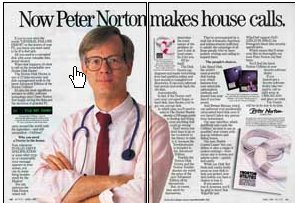
Way back in the days of DOS there was this great suite of programs created by a genius named Peter Norton. They were called Norton Utilities. These programs helped maintain your computer by diagnosing and fixing problems and defragmenting the hard drive. The suite also included a disk editor, which I used all the time. In sum, most computer experts used Norton Utilities all the time back in the day.

nortonad-747951

In 1990 Norton sold his products, including Norton Utilities, to Symantec. Symantec kept the Norton brand and issued new versions of Norton Utilities and released new programs under the well respected Norton name, including Norton Antivirus. I used Norton Utilities up until Windows XP and still use Norton Antivirus. But that’s about to change, for three reasons.

Reason Number One: Conflicts and Resource Hogging

Symantec continues to load too many features into both Norton Utilities and Norton Antivirus that I don’t need and that I don’t want. Both programs have been notorious for years for creating conflicts with other programs and for causing startup and shutdown problems. All of that is irritating, but, given my historical loyalty to the Norton brand, I have thus far overlooked these problems. In the newest version of Norton Antivirus, however, Symantec has added the incredibly annoying Norton Protection Center. This bloatware takes up system tray space and generally seems to be yet another unnecessary resource hog. I don’t want this program, and if I’d known about it before I installed the new version, I would have taken the box back and found another antivirus program. After spending 10 minutes on the net trying unsuccessfully to find out how to remove or disable Norton Protection Center, I gave up and uninstalled Norton Antivirus completely. Simple is better, and with this unwelcome addition, Symantec has finally waddled across the bloatware line.

Reason Number Two: Shameless Upselling

Not only is the Norton Protection Center a blight on my computer in and of itself, it also seems to be nothing more than a thinly disguised ad for other Symantec products. C|Net had this to say about the Norton Protection Center:

[W]ith this year’s debut of the Norton Protection Center, Norton AntiVirus 2006 has lost that uncluttered usability. The Norton Protection Center appears both as a separate icon in the system tray as well as a separate window within the software’s control console. Most of the Protection Center’s functions are useful, such as the alerts it sends if you don’t have the latest virus definitions or haven’t run a system scan in a while and the bar graph in the Status window. However the Protection Center is focused on upselling Symantec’s other products to you rather than providing any new, useful security information. For instance, if you ask to learn more about data recovery, you’re taken directly to the Norton SystemWorks 2006 product page on Symantec’s Web site.

Reason Number Three: Rootkit, Round 2

eWeek reported yesterday that, on the heels of the Sony rootkit fiasco, Symantec has admitted using a rootkit-type feature in Norton SystemWorks that could provide the perfect hiding place for attackers to place malicious files on computers. Symantec, of all people, should know better than this.

It took 15 years, but Symantec has managed to ruin what was once a great set of utilities. I am in the market for a new antivirus program and would love some suggestions in the Comments.

If you want to see more neat old ads like the one above, check out this page.

Why Google Has to Win the Technorati Race

technorati-784323
Lots of talk at TechCrunch, Squash, and The Blog Herald today about the possibility of Yahoo buying Technorati, as I suggested weeks ago and predicted here last month.

If Yahoo combines Technorati with Flickr and Delicious, it will have a commanding and perhaps insurmountable lead in the Web 2.0 race. Which I why I believe you can’t count Google out of this race. If Google buys Technorati, it’s still a two horse race. If I know that, Google knows that.

Look for Google to be the winner in the Technorati race. Why? Because it has no choice.

Technorati Tags:
, ,

iMedia Connection: Content Trends

consumercontentiMedia Connection has a post today about the five trends in consumer generated content from the last year that will have a profound impact on our internet experience in 2006 and beyond. Here are my thoughts on each:

1. Social networking comes of age

I have played around with Yahoo360 a little and have visited a couple of MySpace pages. I’m far too old and uninterested to care about Facebook. On the one hand, I tend to dismiss these pages as cyber-playgrounds for kids and young people. But the numbers indicate that a lot of people are using these sites. I suppose it will be a powerful trend, but I’d be surprised if much of the buzz is generated by the over-25 set. Don’t get me wrong, I’d love some sort of private internet space where I and my close friends and distant family could keep connected. But even if I found it or built it, no one else would use it. I just don’t think there’s enough desire and know-how to make these pages work for the parent and grandparent generations.

2. Wikipedia becomes the number one reference site.

I absolutely believe this. Wikipedia has been my first and nearly exclusive reference site for months. My prediction is that some of the current closed reference sites will become free, ad-supported sites in 2006 in an effort to stay relevant. Might work, but they better hurry.

3. Flickr and tagging take off.

Everyone who knows me knows I am deeply in love with Flickr. It should and will own the photo storage and community market. Tags are just a fancy word for keywords. I use tags on almost all my posts and I believe they will become an almost mandatory part of most web content. That’s a good thing. But keywords aren’t new- they’ve just been repackaged in a sexy package.

4. Blogs, blogs, blogs.

Yes, the move to the edge we’ve talked about is being driven primarily by blogs. This is a good trend that I believe took off in 2005 and will keep rising in 2006 and beyond.

5. Video search goes viral.

Maybe, but does anyone really search the net for videos? If there’s a good one (like the Narnia rap), I’ll find out about it via someone’s blog post. I’m just not sold on video search. If Thomas Hawk (who I predict will give me a link in 2006 if I keep applying blogger lie number 9) is right and Flickr does video, Flickr will own that market as well. Anyone else think Google knows about this and that’s why it’s falling all over itself to get out there first?

Technorati Tags:
,