MixTape.me vs Blip.fm

You have to give credit where credit is due.  These mixtape services are resilient.  In its futile effort to stuff the cat back in the bag, the RIAA keeps shutting them down.  And like weeds, they pop right back up.

The latest mixtape service to cross my radar is MixTape.me.  Let me tell you- I have made a mixtape or two in my day.  I remember sitting by the FM radio for hours with my Maxell cassette tape ready to go.  I’d record the start of every song, and if it was one I didn’t want (as were most of them), I’d just rewind and wait for the next song.  It took forever, but I created some awesome mixes.  My mixtape glory years were from 1982 to 1985, courtesy of Vanderbilt’s WRVU.  I taped Webb Wilder, the Beat Farmers, Raging Fire, Love Tractor, the dBs, you name it.  Later, when I had enough money to actually buy tapes and CDs, I made a few mixtapes for the girls of the moment.  Hey, it could have been worse.  It could have been poetry.  Well, come to think of it, I might have done that too, but let’s not talk about that.

So, given my illustrious mixtape history, I decided to give MixTape.me a spin.

And since I am a fan of Blip.fm, a similar- though not identical- service, I think I’ll compare the two.

MixTape.me

Registration is as easy as it can be.  This is all there is to it.

mixtape1

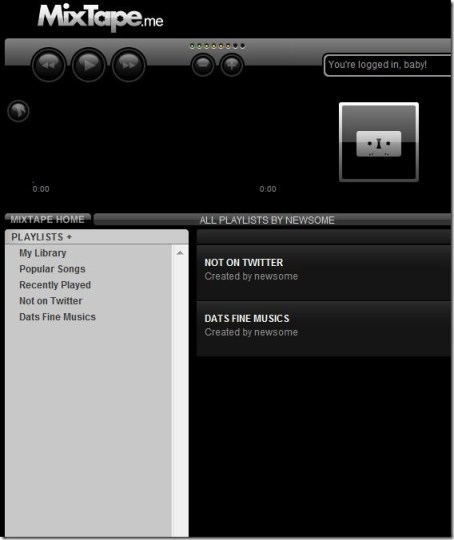
Fill in the blanks, type the captcha (note the refresh and speaker buttons, to help you through the process), and you’re done.  Once you login, you’re presented with a simple black and gray interface.  It’s refreshingly uncluttered.
mixtape2

The gray column includes your library of saved songs, two pre-set playlists: popular songs and recently played songs.  These pre-set playlists show the day’s most popular songs and songs that were recently played by MixTape.me users.  Today’s most popular song was Flashdance.  Flashdance!?  Jeezus.

Below those are your playlists.  You can see that I have created two so far.

To add songs to your library and/or a playlist, you search via a search box at the top right of the screen.

mixtape4

When you get results, you can drag songs into your library or a playlist.

mixtape5

The search process is fast, but I noticed that a lot of songs appearing in the search results are not actually available.  If you click on a song that’s not available, the player will first look for another copy of that song in the database (good) and, if one isn’t available, play the next available song in the list (bad).  Because the next available song is most likely a different song, I don’t like that feature.  Like Blip.fm, you can add the URL of a specific MP3 to add it to your mix.  This feature is not readily apparent, however- click in the +MP3 button at the top right of the song list window (the one just below) to add the URL.

Once you’ve added the songs to your playlist, click on it, and the song list appears.

mixtape3

From this screen, you can rearrange songs, edit the artist and title information, get information about the song or buy the song via a handy link to Amazon.  In a neat design feature, the link leads to the Amazon download page, if one exists, as opposed to the CD page.

MixTape.me has two features that Blip.fm lacks.  You can easily rearrange the order of your songs, and you can add songs to your library to store until you decide to add them to a playlist.  On the other hand, there are not as many songs in the MixTape.me database, but it’s still in beta so more songs will likely be added over time.  I also noted that MixTape uses music search engine SeeqPod.  SeeqPod is being sued by Warner Music, so there is at least some question as to the longevity of at least that part of the search function.  For all I know, Blip.fm may use SeeqPod too.

Once you create your mix, you are undoubtedly anxious to share it with your friends, love interest, dog, etc.  There are two ways to do this.  Via a link (handy for email) and by embedding the playlist on your site.  Here’s one of my playlists (the first song is dedicated to all those cats on Twitter with arrogant Fg/Fs ratios):

Tell me that Jean Knight song doesn’t rock!  People who’ve known me for a long time have told me the fourth song reminds them of me.  That used to irritate me, but the older I get the more I kind of like the thought.  I ain’t asking nobody for nothin’, and all that.

MixTape.me’s embedded player is more functionally and aesthetically pleasing than Blip.fm’s.

Blip.fm

I’ve been a Blip.fm user for a few weeks, and have really enjoyed it.  One of the its best features is neat integration with Twitter, which let’s you automatically post songs to Twitter as you “blip” or add them.  Lots of people blip songs into Twitter regularly.  Of course song blips get in the way of all the rampant self-promotion that has become the main course on Twitter, so some people don’t like it.

Like MixTape.me, Blip.fm makes registration a breeze.

blipfm1

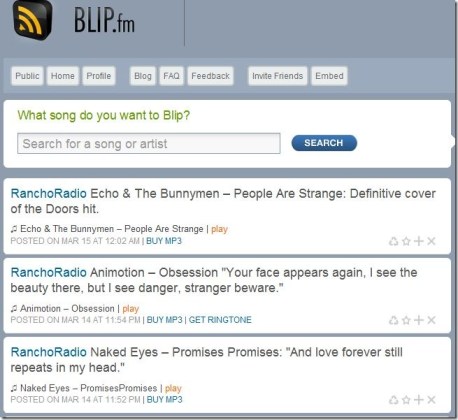
Fill out two blanks, click and presto, you have your very own Blip.fm page to fill with great music.
blipfm2

To add a song, you search for it in the search box.

blipfm3

You can preview the songs, and you should because some of them will be unavailable- though I find the frequency to be less than at MixTape.me.  I find the searching and adding process on Blip.fm to be better that at MixTape.me, but not by a great margin.  There are also more songs to be found in the Blip.fm database, though as noted above, MixTape.me is new and its database will likely grow.

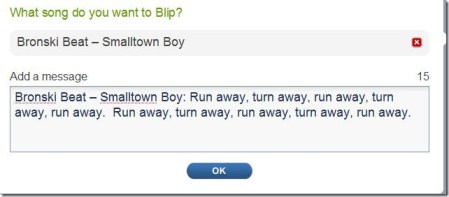
Once you find a song you like, you can “blip” it or add it to your song list, with a witty comment.
blipfm4

Click OK, and the song gets added to your page, to the Blip.fm front page, and, if you so-configure your account, to Twitter.

blipfm5

If you have your account configured to post to Twitter automatically, you can add an exclamation point (!) to the beginning of the message, and that particular song will not be posted to Twitter.

You can also give other Blip.fm users (and receive from them) “props” by clicking a little thumbs up button below a song you particularly like.  Props are calculated and your number of props appears at the right hand side of your Blip.fm page.

As noted above, there is no way to rearrange the songs in your song list, though you can delete songs.  It would also be nice to have a place to hold songs you want to “blip” later- sort of like MixTape.me’s Library.  The sharing features are not as robust on Blip.fm either.  The primary methods of sharing are to share the link for your Blip.fm page and to post your “blips” to Twitter.  There is a third party Facebook app, but it didn’t work for me.  There is a widget you can embed on your site, but the gigantic Blip.fm logo is too much of a space eater.  My inquiry about that went unanswered.  Not a wise practice, particularly when the question comes from someone using and writing about your service.

You can, however, embed individual songs.

That is one sad and beautiful song.

Conclusions

I think both services have a lot to offer.  At the moment, if I could only use one, it would be Blip.fm, because I think the interface is more mature and elegant, but if MixTape.me grows its database and reduces the number of unavailable songs in its search results, its superior arranging and sharing capabilities would give it an edge.

Both are reasonably well designed and fun.  And that’s good for everybody.

Now, if they can just stay in business.

Evening Reading: 3/23/09

Revisiting Alltop:  I finally got around to setting up my custom Alltop page.  I don’t plan to use Alltop for general feed reading-  Google Reader is the best choice for that.  But I think Alltop will be useful for setting up certain content for easy reference.  For example, my first step was to add feeds to help me get better at Photoshop.  These aren’t feeds I want to read every day, but it will be helpful to aggregate them in one place.  Here are three MyAlltop features that should be implemented right away, each of which would vastly improve its usability: the ability to drag your subscriptions around on the page, for better organization; the ability to have multiple MyAlltop pages or tabs, also for better organization; and the ability to add feeds to your page that aren’t already included in Alltop.

Yes, I Was Right:  I was afraid that this was going to happen.  It’s really too bad the blogging establishment completely ignores me, because if you go back and look, I actually get a lot of stuff right.  Well, except for this.  I didn’t get that right.

Apple Love Department:  My DirecTV HR20 recorder died this week, taking a bunch of saved sporting events, all of my and Cassidy’s “monkey movies” (we had all the original movies and the TV series) and several episodes of the Sarah Connor Chronicles, Dollhouse and Supernatural with it.  Via the most wonderful AppleTV, I was able to buy and watch all of the lost network episodes- in HD.  It was fast, easy and the picture and sound were perfect.  If the shows were just a little cheaper, I could envision dumping large chunks of my satellite subscriptions for AppleTV.  That’s pretty amazing.

HBO Irritation Department:  Many people have told me that I would love True Blood.  So I am trying to catch up by recording the reruns, but I missed the first several episodes.  So why in the world has HBO elected not to make episodes available in iTunes?  I simply don’t understand that decision.  Unless they do a marathon, I guess I am hosed.

All Woz all the Time:  I hadn’t thought much about Woz since I read an Apple history book a decade or so ago.  And, other than his clips, I’ve never watched a second of Dancing with the Stars.  But Woz is highly entertaining.  He needs his own TV show.  Seriously.  First, he dances through a fractured foot and a bad knee.  Now he’s pulled a hammy.  He may tighten up, but like Archie Bell and the Drells, he just can’t stop dancing.  At a minimum, I want to see Woz on the next Amazing Race.

iPhone Love Fest:  Looks like we may be getting new iPhones this summer.  I hope they don’t waste effort and space by trying to herd us all into the U-Verse.  It would be a mistake for Apple to let ATT use my pretty as a vehicle to increase U-Verse subscriptions.

Have You Been Served:  I use and highly recommend the HP SmartMedia ServerPower Pack 2 for Windows Home Server, the OS, is now available.

Fear Department:  I just noticed that Signs is on TNT right now.  I think that is one seriously scary movie.  Highly recommended.

No Stupid Names:  Let’s all agree to keep calling it the Sci-Fi Channel, OK?  It looks like the Sci-Fi Channel has some interesting things in store after the sad but beautiful demise of BSG, simply the best science fiction series ever (relegating my beloved Firefly to number 2).  I am particularly interested in the Riverworld series.

Speaking of Endings:  Here’s a post on the movies that influenced BSG.  And the evolution of the ending is a must read.  As is the original ending of Bladerunner.  This is good stuff

Agriculture Department: I need to plant some tomatoes.  I’ve been putting off the resurrection of my garden, post hurricane.  Here’s a great tutorial on growing tomatoes.

Dropbox on a Stick:  I’m on record as a Dropbox fan and user.  Now you can install it on a thumb drive.  Maybe.  That’s great, now go do an iPhone app.

One More Time:  Speaking of Dropbox, if you’re interested in free, easy to use online storage, give Dropbox a try.  If you sign up via that link, both you and I get a little extra free storage for the referral.

Losing on the Field, Old Media Tries to Change the Rules

Everybody agrees that it’s best to win the game on the field.  But for some teams, that plan just doesn’t work out.

Take old media, for example.

For years and years, links have, for lack of a better objective measure, been the de facto measuring stick for online content.  Inbound links have played a major role in search engine results.  More links result in a higher the placement on search result pages.  It’s not a perfect system, but it’s all we have.  And there are no built in advantages that favor one content producer over another.

But now some old media want to change the game.  They think their content should be favored over blog content.  Ignoring for a moment the very important fact that the distinction between blogs and other content platforms has largely disappeared over the past few years, this is one of the most ludicrous things I’ve read in months.

For starters, isn’t it odd that big, resourceful, rich old media is asking for a handicap when playing an online scramble against what old media has long viewed as amateur publications?  Isn’t this like Michael Jordan asking to start with 10 in a game to 21?  Or like the New York Times asking that a high school newspaper be printed with invisible ink?  I mean, come on!

Just because what started out as weblogs and evolved into a new form of media- a form which, interestingly, has been appropriated by lots of old media- is beating some old media publications at their own game is no basis for a rule change.  This smacks of the same logic vacuum evidenced by the record labels when, after realizing they couldn’t monopolize it, they tried to kill digital music distribution.

The fact that old media shot itself in the foot by electing to give away- and thereby devalue- its product is a little sad.  Maybe it would make a nice movie on the Lifetime Channel.  But in no way, shape or form should Google or anyone else rewrite the rules to favor those who don’t want to compete on the merits.

Sure, search results aren’t always perfect.  But anyone who uses Google or any other search engine more than infrequently knows how to instantly zoom past the static and zero in on the best results.  The fact that I and many others look for the Wikipedia link says tons about who does and does not get the web.

But there is a lurking point to be made by old media.

What is slightly less absurd and much more interesting is the effect of republishing or discussing content, even with attribution.  Here’s what I mean by that.  Despite his social media-frenzy-induced abandonment of his blog for the so called social networks, Steve Rubel still has a lot of readers.   I saw the link above in my feed reader this evening, and first read about this issue on Steve’s blog.  Nat Ives wrote the original story at AdvertisingAge.  Through Steve’s link, I ultimately made my way to Nat’s story (see link above).  But many people will probably first see the story at and link to Steve’s post.  If Steve gets more links to his post discussing Nat’s post, who deserves the most Google juice?  If I understand the argument, old media is saying the publication that wrote the original story, in this case AdvertisingAge, should get the most Google juice.

Nice idea in theory.  But there’s no algorithm in the world that can effectively parse where an idea started.  And let’s be real for a moment- the AdvertisingAge piece didn’t create the issue.  It merely reported what was said by other people at other places.  It’s not like every news piece is a novel.

Old media needs to worry about winning on the existing field and by the current rules.  Not trying to create an artificially uneven field and a new set of self-serving rules.

The Short Happy Life of the Infinite Advertising Theory

It was now crunch time and they were all sitting under the soft white glow of their computer monitors pretending that nothing had happened.

Eric Clemons sums up the obvious to many but ignored by some flaw in the Infinite Advertising Theory, the somewhere between a wish and a belief idea that online ads can pay for everything forever:

Pushing a message at a potential customer when it has not been requested and when the consumer is in the midst of something else on the net, will fail as a major revenue source for most internet sites.

Amen, brother.  The word in that sentence that I want to focus on is “most.”  Because that one little word is responsible for the mass denial that propagates the hopelessly broken revenue model that is rampant on the internet.

In any statistical model, there will always be examples on the edges that can be misused to support an invalid argument.  When Wake Forest flames out again in a post season basketball tournament, some overly optimistic fans will cite the fact that one or two other highly ranked teams also flamed out, ignoring the painful fact that other than Wake Forest the list of underachievers changes every year.  This attempt to wrap oneself in the false blanket of statisticulation may make the non-mathematical reader feel better.  But relying on that placebo not only does nothing to fix the problem, the head in the sand passage of time makes the problem bigger and harder to fix.  And it doesn’t make anyone any money.

The fact that the top microscopic percentage of web sites have so much traffic they can make money by tossing ads in a reader’s face and waiting for him to accidently click on them is utterly and completely irrelevant to the validity of the Infinite Advertising Theory.  For every TechCrunch and Mashable, there are thousands of other web sites that may be fooled into thinking that they too can make money via ads.  To base your web site on advertising is like basing your income on the lottery just because you read stories in the paper about people who won millions in the lottery.

All we need to fix this problem is the one thing we don’t have.  A time machine.  All of this happened because of one bad decision.

When it became clear that the web was going to be a giant, less expensive distribution channel, old media, in a land rush brought on by greed and fear, tossed up its content on the web in a mad rush for eyeballs.  The people that ran old media didn’t really understand the web.  They were afraid of it, but they were at least smart enough to realize it couldn’t be ignored.  Everyone else was rushing to stake out a claim on the net and so old media did too.  Everyone confused eyeballs with subscription numbers, and decided that whoever had the most eyeballs would win the game.  In that death race for eyeballs, content producers soon upped the ante by giving their content away.  Even those holdouts who felt that hundreds of years of business theory dictated that giving away your only product is a bad idea were forced by momentum and customer alternatives to capitulate to free.
Surely if everyone is doing it, it must not be a horrible idea, right?  And if we get lots of traffic, we can monetize that traffic, right?

For a while it actually worked.  The perfect storm of a booming economy and the newness of and investor uncertainty about the web allowed people to make money for a time almost solely based on eyeball traffic.  When I founded ACCBoards.Com you got paid by impressions, meaning you got paid based on how many people saw the ad.  It didn’t matter so much that they all ignored the ads, because they were there to read about college sports- not to buy something they weren’t looking for just because someone tossed an annoying ad in their face.

Another problem is that advertising in general is based on the gullibility and suggestibility of the target audience.  The fact is, however, that the online audience, particularly the early adopters, is likely lower than the traditional old media audience on both scales.  Plus, unlike pre-TIVO television, you don’t have the benefit of a captive audience, when leaving is just a mouse-click away (stupid, irritating and ineffective mousetraps notwithstanding).

Eventually, the web matured as a distribution channel, and advertisers and investors had to start looking at scary things like click-throughs, sales figures and attributable revenue.  Which caused the online advertising gravy train to slow down significantly.

So online content producers now find themselves trapped in a paradox of their own creation.  They gave away the only thing they have to sell, in an effort to increase traffic, which costs money to serve, while ad dollars are not as infinite as they thought, but because they gave their product away for so long no one believes it has any value.  How’s that for a mess?

I don’t really see an easy way out of this mess.  But I can tell you one thing:  the fact that a few web sites can make good money via online ads does not mean that yours or mine or some desperate to survive newspaper’s can.

We need a new plan, but first we have to admit the old plan isn’t working.

Eat at Twitter: Preserving the Customer Experience

Twitter is a fun and interesting place.  I haven’t been posting there as much over the past week, as I try to map out its place in my online genome, and my place in its.  But there is no arguing the fact that Twitter has momentum, and a big chunk of the public mindshare.  Like any public place, be it a park, library, beach or restaurant, the question becomes what will Twitter evolve into over the coming months and years.  And how the operators and users will protect- or not-  the experience that led them there in the first place.

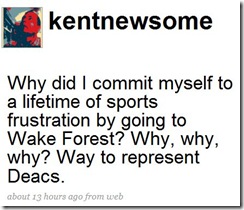
wfucsufail Clearly Twitter has to make money to survive.  There are operational costs, and there’s the occasionally overlooked fact that the people who created Twitter weren’t looking solely to create a new age chat board where we could all debate whether Kara Thrace was or was not an angel (I say she clearly was) or bemoan our college choices.  They started it as a business venture.  To get rich.  Or richer.

That’s the way businesses work.  When a new restaurant opens, we don’t give the owner the key to the city for feeding us.  We know he or she is trying to make a living by creating a place we can go to have fun and eat good food.  The restaurateur is neither entitled to make money nor criticized for trying to do so.  He or she makes money or not, based on the customer experience he or she creates and manages.  It’s the same for online interactive sites like Twitter.  People will try lots of things once or twice, but you have to provide a superior, consistent experience to create a critical mass of loyal and regular customers.

The customer experience becomes the most important and valuable asset.  And one that must be managed carefully.

But what about all the other people who help create and manage the restaurant experience?  The waitstaff and bussers are integral to the experience, and they too are trying to make a living.  But much, if not most, of their pay comes in the form of tips from diners.  How does this analogy translate to Twitter?

One way or another, I think it has to.  Why?  Because there are lots and lots of waiters, waitresses and bussers on Twitter.  How do they get paid?  Are they entitled to get paid?  How is this going to work?  Are they going to improve or destroy the user experience?

I don’t know all the answers, but what I do know is that everyone who hopes to make any money via Twitter should be very concerned with preserving the experience for the users- those rare diner-equivalents who come not to sell, but to eat.  Imagine how fast you’d be out the door if instead of taking your drink order, the waiters at your favorite restaurant immediately began to badger you about tips.  When something like that happens, the user experience turns negative, the word spreads, the restaurant is doomed.  And nobody gets fed or paid.

And it’s not just outright badgering we have to be concerned about.  Very few marketers are as subtle or value-additive as they think they are.

Let’s say it again:  very few marketers are as subtle or value-additive as they think they are.

I worry about all of this, because it seems like 8 out of 10 people who follow me on Twitter are waiters looking for tips: marketer, consultant, PR representative, SEO expert, etc., etc. (and that’s not even counting the outright spammers and get-me-rich quick schemers).  Based on their profiles, all of these people are, at least nominally, on the clock when posting at Twitter.  Sure, they’re taking drink orders and not immediately negotiating for tips.  But if they are on the job, they must expect or at the very least hope for a payoff at some point.  How is that going to happen?  If my little slice is representative, Twitter is overrun with marketers, consultants, PR representatives, SEO experts and other forms of the same animal, all in search of what looks to me like a pretty small tips pool.

Which raises another interesting point.  While I don’t do it online, a significant portion of my job involves building my company’s brand and selling our services to clients.  It’s subtle- like Twitter today- but subtle or not, I’m brand building and, indirectly, selling all the time.  Every print article I write.  Every speech I give, etc.  And one thing that anyone who has ever sold anything knows is this:  it is very hard to sell something to someone who is trying to sell you something at the same time.  Some of the couldn’t sell water bottles in the desert marketers may disagree with this, but anyone who has spent a day in the trenches knows it’s true.

When someone calls me and asks to meet with me, I try to figure out what they’re really after.  Sales calls are like dreams- there is a manifest purpose and a latent purpose.  Sales people sometimes stupidly try to get in front of me by pretending that they want to hire me.  Once we get in a conference room or sit down for lunch, however, it quickly becomes clear that they are trying to sell to us, not the other way around.  We call this getting sold by the buyer.  Usually these people have no need for our services.  And even if they do, they either don’t know it or are so intent on getting through their sales pitch, they wouldn’t hear a word I said.  If I said any words.  I completely disengage when this happens.

So if all these people are flooding onto Twitter trying to sell their services, how are we to we preserve the good restaurant experience, and avoid a giant flea market where everyone is trying futilely to sell to the seller?  And destroying the user experience in the process.

I don’t know, but we better find a way before it’s too late.

Newsome Kids in Print

Bellaire Eaxminer 0309a

Cassidy, Delaney and Luke are on the front page of the printed and online editions of the Bellaire Examiner, our local newspaper.  Raina is the chair of a fund raising event for the local parks.  Here’s the full story.

Cassidy and Delaney are old pros at the paper thing.  They’ve been in papers and magazines numerous times.  In fact, Cassidy’s first media experience was when she was one.  On the cover of Money Magazine, thanks to one of her daddy’s bad investments.

moneyc

Tech for Grownups: My Online Toolbox (Part 1)

OK, so you’re a relative grownup, aren’t trolling the internet looking for chicks or dudes (let me say again how thankful I am that I got through school before Al Gore and Mark Zuckerberg invented the internet), but would like to use the vastness of the web to find, manage and organize data.  And maybe have a little fun in the process.  Here are the tools I use to do that, from the baby step of a web browser, to the giant leap of a central online data repository.  I’m going to do this in two parts, and I think I’ll stay inside the box and start with Part 1.

First Things First, the web browser.

You are almost certainly reading this on a Windows based machine, which means you are probably using Internet Explorer as your web browser.  That’s messed up, but it’s easy to fix.  You need to download and install Firefox.  It’s free, easy and quick.  And your efficiency and coolness factor will get a huge boost.  Why? Because of the many add-ons that are available for Firefox.  Basic installs of Windows Explorer and Firefox are a wash (particularly the newest version of Internet Explorer), but Firefox with the right add-ons is still a superior experience.  There are hundreds of people who use other browsers like Opera and Chrome, and there are teens of people who use something called Flock.  Unless you drive a Smart car, make all your own clothes and grow all your own food, you don’t need to worry about those.

And of course, those on Macs and iPhones use Apple’s Safari.  You can and should get Firefox for a Mac, and we’ll deal with Safari on the iPhone later.

Now, let’s improve the Firefox experience with some of those add-ons.

Here are some of the ones I use.

AdBlock Plus, to remove ads.  This one is a little controversial, since lots of people are trying to make money on the internet and unless you actually have something to sell (most of them don’t) the only legal way to make money on the internet is to put ads all over your page and hope someone accidently clicks on one.  We need to help these people get real jobs by blocking the ads.  Trust me, this is positive social activism.  We’re doing them a favor.

BugMeNot, to anonymously log in to free web sites that insist on making you register.  Many of us use fake names anyway (I was Antigone Tellyeaux (get it?) at the Houston Chronicle site for years; I was William Frawley during the glorious Napster years).  This is also positive social activism by demonstrating that you don’t really need my name and email address to let me read your news stories and accidently click on your ads.  BugMeNot does not provide credentials for paid sites, which is good since we’re all law-abiding grownups.

Foxmarks, to synch bookmarks on all your computers.  I keep separate bookmarks on my work computer, but synch them across my home computers and laptops.  One caveat: Foxmarks is changing into something called Xmarks and will start offering suggested sites to visit.  This sounds to me like a social networking hysteria induced attempt to be something I don’t want, so who knows what the future holds.  But until they screw it up, Foxmarks rocks.

TinyURL Creator, to make web links smaller, so we can use them on social networks and whatnot, which we will get to below and in Part 2.  In the meantime, you need to practice using the words “social networks,” “Facebook” and “Twitter” in every sentence to show everyone how hip you are.  “Hey, Junior, if you don’t change your Facebook status to finishing his homework, I am going to come up there, delete all your social network accounts and then talk about it on Twitter.”  See, it’s easy once you get the hang of it.

Photobucket Uploader, to easily upload photos to your Photobucket account.  Photobucket’s interface is a train wreck, but combined with this add-on it makes grabbing and sharing photos very easy.  I don’t use it to share my personal photos- I use Flickr for that, but Photobucket is great for uploading stuff I want to use on my blog or on one of the social networks.

Evernote Web Clipper, so we can easily add content to Evernote, one of our primary tools, that we’ll get to in a moment (I have mad love for Evernote).

These are just a few of the plug-ins I use.  There are thousands more to choose from.  You can browse and search for them here.  Here are the ones “recommended” by the makers of Firefox (at the moment, I don’t use any of the ones at the top of that list) and here are the most popular ones.  The point is that you can tailor Firefox to your needs via the selective installation of add-ons.

Now you need a war chest to buy the cool stuff you find while surfing around on your tricked-out Firefox.

Paypal is the only way to go here, for a couple of reasons.  Lots and lots of places take Paypal; it’s owned by eBay, which is a huge company that has lots of legal and business incentives to make it safe; and most importantly, you can use it to keep your credit card information off the big scary internet.  I just keep money in my Paypal account to use when I need it.  You can use a credit card or your bank account as a back up source of funds, but either way, Paypal can serve as a buffer between you and all those people trying to steal your money on the internet.  I don’t really believe all that but it’s amazing how many of my real world friends are still terrified by the internet.  I have one friend who will clutch her purse to her chest and tremble if she hears the word internet.

One caveat: If you get an email from Paypal, asking for your password, don’t give it to them.  It’s not Paypal.  Delete that one and move on to t
he
one from the brother’s nephew’s cousin’s former roommate of some dead African president who needs a little help moving some money around.

Now we need to find some places to store, organize and access our data.

For my personal photos, I use Flickr, because I like the interface and the iPhone integration via Mobile Fotos.  Plus, you can determine who can see each photo you upload- everyone, people you designate as friends or only you.  There are other options, like Picasa (owned by Google and integrated with other Google applications), SmugMug and, as noted above, Photobucket.  I think Picasa is a decent alternative for very basic photo sharing and SmugMug has a lot of non-geek traction, but most of the others are either feature or interface challenged.  In other words, they are too hard or not as good.

For online file storage (or the Cloud as the cool people call it), I prefer Dropbox.  You get 2 gigabytes of free storage (that’s a lot if you aren’t a hardcore geek), a good web interface, and the ability to direct link to your files, including music files (here’s why that’s important).  The only criticism I have of Dropbox is that it currently lacks an iPhone app.  Box.Net and ZumoDrive are other similar, but not quite as good, alternatives.

The most wonderful, Evernote.

For note taking and general data archival, I use and highly recommend Evernote.  It has a great desktop application, a decent web interface and a very good iPhone app.  You can add, sort, synch and access your saved data from any computer.  Evernote is so important and so hard to explain without pictures, let’s take a look at how I organize my data in Evernote.

evernote1

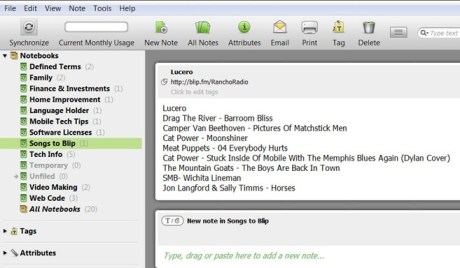
I have Notebooks (think of them as folders) for various types of information.  The one highlighted above is where I list songs I come across on Blip.fm that I may want to later add to my Blip.fm page.  I also have folders for Web Code I use regularly (so I can copy and paste it), Software Licenses, Home Improvement projects, etc.  With the Evernote plug-in (see above) I can easily add information, web clips, etc.  Let’s look at one more example.  Here’s a clip from my Mobile Tech Tips Notebook on how to connect to ATT hotspots via my iPhone.  Through the Evernote iPhone app, I can access this information whenever and wherever I need it.

evernote2

Evernote makes it easy to accumulate, manage and access all sorts of information.  The premium (e.g., not free) version even allows you to add and synch files and documents.  I don’t use Evernote for that yet, but if it ever catches up to Dropbox, it would present a compelling case for one-stop shopping.

That’s enough to get you started.  We’ll cover the rest of the stuff you need soon in Part 2.

If you have questions or other ideas for the perfect online toolbox, let me know in the Comments and I’ll address them in Part 2.

When Did Online Journalism Go Full Enquirer?

When I see people post stupid headlines, like, say, this one:

Facebook Could Kill Google,

it infuriates me and makes me laugh, at the same time.  When did the entire internet go full Enquirer just to cobble together a few extra page views?

Henry Blodget, editor of the semi-ironically named Silicon Alley Insider, wrote under that headline based on some comments by some cat named Ross Sandler (or maybe it was Adam?) of some outfit called RBC (maybe the Bebo one?) about how Facebook is a major traffic source for Google.  How, exactly, this means that Facebook may one day murder Google is not clear.  To give a morsel of credit where a morsel is due, Henry does point out the important little fact that “Facebook does have a big problem relative to Google, which is that it doesn’t have a business model.”  Surely a little thing like a business model won’t keep Facebook from ending the life of a $105B company. 

When you get past the idiotic headline, the point of the story is that Facebook is growing faster than Google.  Of course a seedling is also growing faster than a massively larger ancient redwood, but who wants to get hung up on the math.  Nevertheless, there is some semblance of a point and purpose to the article, all of which is of course secondary to and nullified by the attention grabbing headline.

But everybody knows you never go full Enquirer.  Check it out.  Jason Calacanis, “Mahalo,” look Enquirer, act Enquirer, not Enquirer.  Bulldog obesessed, stupid Twitter offer.  Narcissistic, sho’.  Not Enquirer.  You know Guy Kawasaki, “Alltop.”  Self-promoter, yes.  Enquirer, maybe.  Spam on Twitter. But he charmed the pants off Metacafe and ran a book cover competition.  That ain’t Enquirer.  Robert Scoble, "Video Blogging."  Nerdish, yes.  Enquirer, no.  Henry went full Enquirer, man.  Never go full Enquirer.  You don’t buy that?  Ask all these sites, "Deadpool."  Remember?  Went full Enquirer, went home empty handed. . .