Delaney had her first swim meet of the summer this morning.
She got first in all three events. Delaney works really hard, and it makes me happy to see her enjoy the payoff.

Delaney had her first swim meet of the summer this morning.
She got first in all three events. Delaney works really hard, and it makes me happy to see her enjoy the payoff.

That collective sigh of relief you heard today came from Amazon and Google, happy that they will live to fight another day in the war for the cloud.
When Steve Jobs, the formidable Warden of the West, took the stage at WWDC today, much of the world expected him to land a killing blow to the aspirations of Amazon Cloud Drive and Google Music. It didn’t happen. While interesting, the much anticipated iCloud is not going to march through cyberspace like a host of digital Lannisters and ascend to the aluminum throne.
Not by a long shot. In fact, Instapaper and Dropbox probably suffered more casualties today than any of the others who aspire to rule the cloud.
First of all, iCloud is not a streaming music service, in the way we have come to expect. It’s more like a semi-automated Dropbox that syncs your music between up to 10 devices. That’s great, but it is not a game changer.
Second, it doesn’t, at least as far as I can tell, create a remote backup of your music files in the cloud. That would be pretty hard to do with only 5 GB of space. Maybe you get to almost the same place if you can bulk download your songs, but even that would be Ned Stark to the neither rational nor reliable music industry, and the term and terms of its license agreements with Apple. Stated another way, if I have to choose between the mild hassle of a one time upload of my music library (and the resulting certainty that I have accessible files that I own) and $25 a year for the rest of my life (with only the right to access the songs based on the terms of the iTunes Match agreements), I’ll probably gut it up and upload, so I can keep the money, and the files.
At first blush, I think the music labels may have been clever like a fox in agreeing to this deal. It must be refreshing for them to focus on something other than trying to find the digital cat to stuff back into the obsolete bag. In that regard, I’d be shocked if part of the discussions that led up to Apple’s license with- and payment of big bucks to- the music labels wasn’t some express or implied assurances that the music label cartel will march against the digital lockers of Amazon and Google.
Third, how many people want all of their music converted to AAC format? I have MP3s and don’t know that I want to move to another format just to avoid some uploading time. A better bitrate is nice, but not enough for me to completely change formats. Accordingly, anyone wanting to preserve their non-iTunes music in its current state would have to manage and backup two separate sets of music. Their existing MP3s and the converted AAC files. That is not the sort of cloud convergence I was hoping for.
Fourth, iTunes. Frickin’ iTunes. Even with all the automation promised by iCloud. Even with the ability to sync wirelessly. We still have to live with that blight and bloat called iTunes. If Apple wants to change the world, it should start with iTunes. Never before has a program so badly needed a do-over. It needs to be completely rewritten. It does not need to be the vanguard of Apple’s host- in the cloud or on the digital battlefield.
And finally, time. Amazon Cloud Player (to all) and Google Music (to some) are available right now. Presumably, Spotify is going to finally and officially launch in the United States at some point. Meanwhile, iCloud is coming “in the fall.” The fall, in online time, means a long time from now. You can be assured that Amazon and Google know that winter is coming, and are hard at work trying to expand their lead. It will be very interesting to see how much those services improve between now and the arrival of iCloud.
At the end of the day, consumers are caught between three armies, each with its own advantages and disadvantages.
Amazon has integration with Amazon’s MP3 store. That alone will carry it a long way on the path to fealty. But Amazon’s web player is a little kludgy (though less so than iTunes). On the downside, there is little chance that an Amazon Cloud Player app will find its way onto the App Store.
Google has the most elegant interface. It is the one I use the most, with Spotify looming as a contender, if it every officially launches in the United States (I still think Spotify is pretty cool, but I don’t know if I’ll live long enough to officially use it). But there is no embedded music store, and the process of getting your music into Google’s cloud is not as simple as I’d like.

Apple has iOS and the hardware that runs it, and, more importantly, the keys to the App Store, which is almost dragon-like on the battlefield. I have an iPhone and an iPad, and whatever apps I use are going to have to work on those devices. And, of course, Apple has the Warden of the West, who can sell ice to Eskimos purely on personality. But, again, the feature set of iCloud is pretty underwhelming. And the entire infrastructure is tainted by the mere existence of iTunes.
Generally speaking, competition is good for consumers. That’s probably the case here. However, I can’t help but feel a little disappointed that there will not be, at least any time soon, a one stop cloud for all of my digital content. I was expecting to be blown away today. Instead, it looks like cloud music will require a combination of services, and maybe some work-arounds. Much the way Google Voice requires some work-arounds to dial out. It works, but not as well as you want it to.
So here we sit, Ned Stark like, in the dark, waiting for someone to free us from our digital dungeons. Wondering what’s going on out on the battlefield and worrying that whatever happens probably won’t be what we planned.
Here’s hoping Amazon and Google unite their banners and lay siege to the scourge that is iTunes. It probably won’t happen, but it would make things interesting if it did.

I stayed up way too late last night listening to Sylvie Vartan. She exudes a level of coolness that most American pop stars of the era (early to mid-60s) could only hope for.
How popular was Sylvie in the mid-60s? In 1964 at the Paris Olympia, she appeared as the main attraction on the same bill as the Beatles.
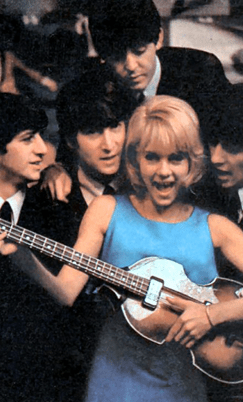
Pretty awesome. Pretty. Awesome.
I was going to comment on this via Twitter, but I couldn’t make my point in 140 characters, without looking like an extremist. And that, I am not. At least not when it comes to content accessibility.
I’m generally on the side of those who argue that most content should be made available, and that filters should occur on the individual level. If content is filtered on the front end (e.g., by the people who control access to content), the choice is taken away from the individual. Philosophically, that bothers me. Plus, I have a much broader view of what is interesting than a lot of my friends. I’m a Simpsons and Southpark fan, whereas many of my fuddy-duddy friends turn their noses up at those shows.

But there are lines, and it looks like Netflix has stumbled over one.
Davis Freeberg reports that Netflix is streaming (e.g., allowing users to watch instantly) the Death Scenes movies.
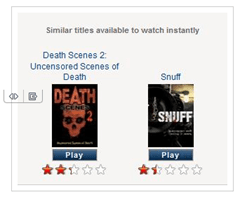
I’ve never seen these movies, and I’m not going to get into any detail about them. But I am aware of them and what they contain. Davis describes them:
For those not familiar with the Death Scenes series, it’s a collection of extremely graphic video clips that show the murder and execution of countless individuals.
Look, I’m not sure why anyone would want to watch this stuff. But that’s not my point. I view this sort of like smoking and barking dogs. I don’t care if it happens, as long as it doesn’t affect me. My issue is that Netflix has these films online and immediately available for any of its users to watch.
Let’s talk about porn. We all know its out there. People feel all kinds of different ways about it. But one thing almost everyone agrees on is that it should not be available to anyone, at any time, at the press of a Play button. Imagine the outrage if Netflix suddenly added hundreds of adult films, with no restrictions. Didn’t some network get in trouble because of Janet Jackson’s one second boob shot? Something else I don’t really want to see.
There is a nuance here, that needs to be explored. When I say that I’m on the side of those who argue that most content should be made available and that I think certain content should be harder to access, I am being consistent, and pragmatic. You generally have to jump though some protective hoops to access the sort of content that is deemed inappropriate for certain viewers. It doesn’t mean you can’t see it. It simply means that others don’t have to inadvertently see it. It’s a reasonable balance.
There is no reason to treat these Death Scenes films any differently. Surely, Netflix knows that kids are among its most passionate users. The Death Scenes movies are inaccurately described as documentaries, and the info pages make them seem like horror films. I can easily see how someone could begin watching these films without knowing what they are getting into. I’d love to know what the Netflix folks were thinking when they made these films so easily accessible. I think I know what a lot of their customers are going to think. They’re going to think about whether Netflix is appropriate for their kids.
Netflix does offer some parental controls.

But there are lots of problems with them. One, the levels are not sufficient. The Death Scenes movies are “Not Rated.” I don’t know that any of the above levels would block them. Maybe checking “R and below” would block them. But what about acceptable movies and documentaries that are also not rated? I don’t want to block a lot of acceptable stuff to avoid a little unacceptable stuff. Plus, any filter you put in place applies to all viewers. I’d be fine prohibiting some members of my household from watching R rated movies, but others would rightfully rebel. I’m not going to change and then re-set filters every time someone wants to watch a movie.
Netflix needs to be more proactive in its programming choices, and more robust in its control options.
Back in college, I was a DJ at one of the local bars. It was a fun gig, and, at least in my selective memory, I had mad skills. Mad skills, I tell ya! I’d love to show my mix skills around the house, but my kids hate my Allman Brothers records about as much as I hated my parents’ lame Vic Damone LPs.
Now, maybe I can find a willing crowd, thanks to Turntable.fm. Turntable.fm lets you create shared listening rooms where you and your friends (or strangers, if you prefer) can take turns queuing up and playing songs. You can search for songs already on the site (I had mixed results doing this, with some songs being incomplete) or you can upload your own. The uploading process is fast and easy and, importantly, MP3 tags are recognized and processed accurately. Once you upload songs, they remain in your playlist until you remove them. There are limitations on how often artists can be played per hour, which indicates that the required licensing is in place.
I created the Rancho Room, dedicated to less known alt. country, southern rock, country rock, classic rock & whatever else sounds good. Some old-timers will recall the original Rancho Room, a chat room I developed, circa 1995, where we had some hilarious times back in the day. Anyone remember those collaborative stories we wrote?
The best way for social network fledglings to understand Turntable.fm is to imagine a shared, streaming radio station, with a rotating playlist created by the people in the room. I have no chance of getting enough friends in the room at the same time to create any kind of a real-time scene. But what I – and hopefully others- can do is upload some good songs, play them for my own ears when I want to hear them, and maybe some other folks will stop by to listen. If I can get a little traction, maybe some of my friends will create their own playlists and, who knows, if we happen to be listening at the same time, our songs will be meshed into a collaborative playlist.
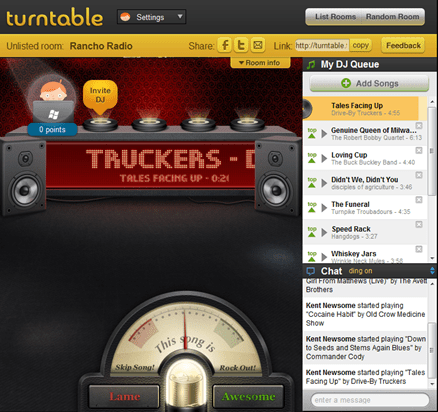
There’s a rating feature for songs, but I haven’t enticed anyone else to create a playlist yet, so I ‘m not sure how it works. Once I get some of you onboard, we’ll try it out.
You can share your DJ status to Facebook or Twitter with a click of a button.
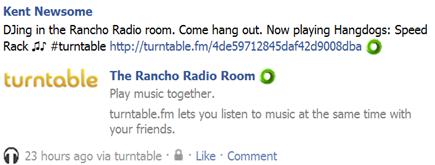
I’ve tried a lot of socially oriented music apps, and some of them are fun. But I haven’t seen any others with as much “fun” potential as Turntable.fm. In a universe of half-baked ideas tossed haphazardly into the social networking space, I think Turntable.fm is really onto something. I like this app. A lot.
At the end of the day, the Turntable.fm experience probably depends on your ability (or lack thereof) to get a core group of users to populate your room. You can probably solve this hurdle by creating a public room. I’m hoping to limit my room to people who enjoy the same sort of music I do, so the Rancho Room is unlisted for now (fear not, you are invited). I know a lot of people who love the same music I do. Can I get them to try the service? That’s a good question. At least there’s no way it will end as badly as my 2005 Flickr experiment did.
One thing I don’t like is that users have to sign up and in before they can visit a room. That seems like an unnecessary hurdle to growth. Sure, people should have to sign up to create a room, and maybe to DJ, but folks should have the ability to visit without signing up. An easy way to handle this would be to allow a limited number of “guest” listeners per room. I also don’t like the degree to which the service is tied to Facebook. If you have a Facebook Friend who uses the service, you’re in. But what if I want to invite a (lower case) friend who isn’t on Facebook? Does that work? I could make this app rock, but these limitations make it harder than it should be.
So. Do you like alt. country, southern rock, country rock and/or classic rock? If so, come on in and take a listen. If you like what I’m trying to do, drop me an email or Facebook message, and I’ll send you a DJ link (I have to have an email address to invite you to DJ, unless we are Facebook Friends).
Here’s my playlist, so far.

As a songwriter, tech blogger and music fan, Turntable.fm lies at the crossroads of my interests. I’m pretty excited about it.
Come on in, and take a listen.
I don’t have many rules, but one of them is that whenever Robert Bobby does a new record, I’ll review it. I can’t overstate how much I like some of his work. Most particularly Genuine Queen of Milwaukee.
10 or so years later, this is still one of my favorite songs. The line “you ought to see her Adam’s apple, man dance” [Robert tells me I had that last word wrong] is one of the best ever put to music.
Enough about that. Just one day after Genuine Queen was among the first songs I added to my Turntable.fm listening room (look for a full review of Turntable.fm tomorrow), I got a review copy of Robert’s brand new record, with The Robert Bobby Trio. A Brief History of Time is available now at CD Baby. You can buy a CD or download MP3s immediately. And you should, because this is a really good record.

A Brief History of Time is not as country-ish as my favorite Robert Bobby songs, but it is full of good Americana and acoustic blues music. It has been described as “a perfect blend of singer-songwriter, folk, Americana & blues! Like John Prine only cheaper!” That’s not a bad description. A Brief History of Time, the title track, sounds like good Prine in his prime.
This record was recorded live in the studio, which gives it a more immediate sound, with some of the energy of a live performance. It’s all about the picking and playing. Bill Nork’s dobro and mandolin tracks are uniformly excellent. Robert’s guitar work is stellar and Robert’s wife, who plays a mean bass, demonstrates that Robert is not the only musician in the family.
Wild About My Loving would have fit right into a Townes Van Zandt & Guy Clark set list. Great guitar and mandolin. The Peace Song doesn’t tread any new ground lyrically, but again the guitar work is stellar. Ain’t No Way, a remake from an earlier record, is a fantastically wistful number.
Rocking My Baby Back Home picks up the tempo a little, with an acoustic rockabilly vibe. My favorite song on the record is Hearts Like Atoms Split, probably because it sounds the most like the older Robert Bobby songs I have listened to for years. When Strangers Start to Cry also has the country sound that I like so much.
I was prepared not to like One Meatball, based on the title, but it got me with a Stray Cats vibe, a good story and, I know I sound like a broken iPod, some excellent guitar work.
At the end of the day, I don’t like this record as much as I like some of Robert’s older stuff, such as Genuine Queen, Lucinda Williams (great tribute song to a great artist whose older work I also prefer) and The Best of All Possible Worlds, but that’s sort of like being critical of the Rolling Stones because every record isn’t Exile on Main Street.
Go buy this record. It’s highly recommended.

The internets are all worked up today over the release of Google’s latest attempt to be meaningful in the social networking arena: Google’s +1 button. It sort of reminds me of the excitement over the soon to be shuttered Google Wave, which was actually an awesome application, and the probably soon to be shuttered Google Buzz, which isn’t.
Being deeply in love with most things Google, most particularly the Chrome browser, I’d love to give +1 a try. Except that I can’t. Once again Google Apps users- yes, some of whom (not me, yet) are paying customers- are left out of the premiere party.
No worries says Google, again- Apps users will soon have the ability to use Google Profiles, and +1. Soon may be a relative thing, however, given that Apps users still can’t use Buzz, over a year later.
Look, I realize this is not a huge deal. But here’s the thing. I would venture that Apps users are among the most loyal Google users. People who would jump right in and do their part to kick-start just about any new Google app. I know that, like a digital vampire, I have turned every Internet Explorer and Firefox user I can find into the walking Chrome.
I don’t understand why Google can’t roll features out to all users- including its most avid- at the same time.
I’d love to write about using +1. Instead, I’m writing about the fact that I can’t use +1. That’s a lose, lose equation.
Anyone want to +1 me up, since I can’t play?
 Newsome.Org