Attention Convention

Dave Rogers has a post on the competition for attention in the blogosphere and the effects thereof.  Stowe Boyd responds.  To quote Kinky Friedman, it looks like we have a tension convention forming.

I tend to favor Stowe’s argument, but there is a little hole in it we need to plug.  Stowe says to Dave “I agree with you about trolls. There are people out there who are the enemies of the future (as Virginia Postrel styled it in her book of the same name), and they need to be outed whenever possible.”  I haven’t read that book, but my question to Stowe, and others, is this:  what defines an “enemy of the future?”  Stated another way, how do we distinguish a troll from someone who merely disagrees.  A troll from a skeptic?  And who gets to decide where those lines are drawn?  Debate and competition are key forces in innovation and efficiency.  I agree that there are those whose goal is not to debate and compete, but to condemn and destroy.  But I think there is potential danger in how we tell them apart.

I am on Stowe’s side of the line where the development of technical innovations, including social applications, is concerned.  Like songwriting, there is absolute beauty in the creation of something that has meaning beyond yourself.  But also like songwriting, when those who want to monetize that creation start calling the shots, there is potential for the artistic process to become corrupt.  Generally in one form or another of the greater fool theory.  If money is to be made, it has to come from somewhere.  It is in some of those situations that I occasionally step back across that line and join the so-called skeptics.

Does that make me a troll?  Of course not, and I’m sure Stowe will agree.  But the line between skeptic and troll is a hard one to draw brightly.  And some will use the troll label as a preemptive strike against a contrary opinion or skepticism that might stand between them and a dollar bill.

That’s where things get a little dicey.  No matter what kind of hat you’re wearing.

Technorati tags: ,

The Sound of Mortar Fire in the Blogosphere

I have some advice for both Dave and Fred.  It won’t matter because I can’t ever get either one of them to talk to me, but here goes.

First, as is often the case in the blogosphere, everyone is so interested in being heard that they forget to listen.  It’s just mortar fire as each party lobs bombs blindly at the other, hoping to get close enough to the target to do a little damage.  And get rich and/or famous in the process.

sourgrapesDave, stop telling us how you invented everything.  Even if you did, people are tired of hearing it.  Don’t keep saying “I’m ready to do the really big ideas.”  Just go do it.  If you want to win an argument about age and innovation, either go invent something new and wonderful or, if that’s not feasible, at least attack the argument in general, not personal, terms.  It’s not about you.  It’s really not.  It’s about everyone over 30.  Your petulance undermines the truths you speak. Truths like this: “In every other creative field people are active into their sixties, seventies or eighties. For some reason in tech we assume people are washed up at 30? Based on what? Marc Andreessen’s experience. Hmm.”  The point is that there are so many people with skin in the game who want to extrapolate all sorts of earth shaking developments out of these little recycled science projects that we read about every day.  That there are so many logical and economic holes in the VC process, particularly as it relates to online stuff, that it’s hard not to fall into one.  That’s the point, not whether you’re getting the reverence you think you deserve.  Oh, and one last thing.  Fred’s post was really not a personal attack on you or anyone else.  So what if he wants to fund youngsters.  Maybe youngsters are the best ones to create things that other youngsters (the current and future target audience) want to use.

Fred, don’t confuse the little high school science projects we call Web 2.0 with true innovation.  According to a National Bureau of Economic Research study on Nobel Prize winners in physics, chemistry, medicine and economics over the past 100 years and on outstanding technological innovations over the same period, 42 percent of innovations were created by people in their 30s, 40 percent occurred when the inventors were in their 40s and 14 percent appeared when the inventors were over 50.  There were no great achievements produced by innovators before the age of 19, and only 7 percent were produced by innovators at or before the age of 26 (Einstein’s age when he performed his prize winning work).  Hanging out in AOL chat rooms, IMing and joining Facebook has about as much to do with becoming an innovator as taking a shower has to do with winning the 100 meter freestyle.  These kids may be creating some cool little projects, but cool does not equate to revolutionary, profitable or necessary.  It’s the brain not the birthday that matters.

Carry on.

Technorati tags: ,

What is Blogging to You?

I wrote a guest post for Diogenes’ excellent series over at Quasi Fictional.

Please give it a read, and offer up your thoughts on what blogging is, or what it should be.  There are lots of great posts on this topic in the series, with more to come.  Come join in the conversation.

And if you don’t subscribe to Quasi Fictional, do it now (feed link).  You’ll be glad you did!

Technorati tags: ,

More on Blogs vs Social Networks

blogssocialnetworks

Jay Neely follows up on our conversation about blogs and social networks and the differences between the two:

What’s the difference between a social network and blogs or a blogging service? One is for your friends, the other is for your audience. The key difference is that one group already knows you (it’s easy to replace “friends” with “coworkers”, “family”, “neighbors”, etc).

As I mentioned the other day, there is logic to that distinction.  But the more I think about it, I don’t believe it’s as clear-cut as that.

Jay says bloggers write for their audience.  Clearly some do, like Guy Kawasaki, the folks at Mashable and other bloggers with one foot remaining in the old media pool.  But lots of other bloggers are writing not merely to have a soapbox, but for the multi-way conversations that are a central part of the blogging experience.  Robert Scoble is the best example of a popular blogger who, it seems to me, approaches blogging from this perspective.  Doc Searls is another.

There are other reasons why Jay’s line of demarcation sometimes breaks down.  Take connecting with old friends, for example.  Very few, if any, of my real world friends even know what Facebook is.  None (to my knowledge) use it.  As a result, I will have a much better chance connecting with people I know by nurturing my web site and waiting for people to Google me.

It’s the same with new friends.  No one will ever accuse me of being shy, but at the same time, I’m not big on chatting online with people I don’t know.  That’s the reason Second Life lost its appeal to me.

On the other hand, I have made a bunch of friends via cross-blog conversations- many of them from other states, countries and continents.  Chip Camden, Earl Moore, Randy Morin, Blonde 2.0, Brad Kellett, Dave Wallace, Ethan Johnson, Frank Gruber, Hugh MacLeod, Nick Carr, Martin Gordon, Mathew Ingram, Susan Getgood, Mike MillerRic Hayman, Richard Querin, Rick Mahn, Seth Finkelstein, Steven Streight, TDavid, Tom Morris and Warner Crocker are just a few of the people I likely would never have become friends with if I had set up camp in Facebook.

Plus, the community that develops via cross-blogging is so much more meaningful than merely adding a few hundred “friends” to the botton of your butt ugly MySpace page.  When I visit MySpace I see very little that looks like a real community.  Mostly, I see a gallery of bad web design.

Granted, the cross-blogging community is distributed, inefficient and sometimes impolite.  But it exists, and without walls.

I think Jay is onto something, and I hope he keeps writing about it.  But at the moment, we’re all standing on the tip of the iceberg.  Below the surface are a lot of other forces at work.

These lines that seem bright and pretty today may disappear completely tomorrow.

Or they may begin to look like walls.

Technorati tags: , ,

Class Notes: Facebook

facebook

I got a lot of great feedback on my Facebook question.

Jay Neely of the Social Strategist says I am focusing on services when I should be focusing on people.  In other words, that in the blogosphere, it’s what you say that matters, whereas with Facebook and the other social networks it’s who you are that matters.  That makes sense to me, though I wish the blogosphere was a little more people-centric than it is.  If you read Jay’s entire post, you’ll see that the gatekeeper business, the community concept and Web 2.0 applications are all driving the evolution of, and distinction between, the blogosphere and the social networking sites.  Here’s my follow up question to Jay (and everyone else): to what extent, if any, do you think this evolution is really being driven by developers who want to make money off of the content created by users on the social networking sites?

Mike Miller says the social network sites are about community, and ease of use.  Community, in the sense that people want to be where their friends are.  Dave Wallace agrees that the ready-made community draws people in because of the pre-existing population and the fact that making connections is technologically and socially easier.  Dave then sums up the essence of a community beautifully, by quoting Adam Fields:

There’s really only one rule for community as far as I’m concerned, and it’s this – in order to call some gathering of people a “community”, it is a requirement that if you’re a member of the community, and one day you stop showing up, people will come looking for you to see where you went.

I built several large communities around message boards back in the nineties, and that definition is perfect.  I have said before that I thought blogs were the new message boards.  Maybe these guys are right, that the distributed nature of blogs makes it too hard.  Maybe Facebook and MySpace are really the new message boards.

Richard Querin, like me a Facebook skeptic, says that Facebook and blogging are separate animals altogether.  He sees Facebook as a way to connect with people you’ve lost touch with- a better version of Classmates.com (but perhaps not as good as Ethan’s Google/blog post approach).  Richard says that, while blogging is a lot harder than opening a Facebook account, it also has more potential- both technologically and socially.  I suppose it depends on what you’re looking for in a service, but if I ever use Facebook, it will be for the reasons Richard outlines- a way to find people I want to reconnect with and then direct them here.

Amy says we’re better off pulling content from the web onto our sites via APIs and widgets than we are “cramming more stuff into somebody else’s big hermetically sealed office building with windows you can’t open.”  She says content is flowing the wrong way.  While I have a greater appreciation for the benefits of Facebook after reading everyone’s responses, I still agree with Amy.  I totally get Facebook for those who don’t have blogs and/or are looking for people, be they old friends or potential new ones.  But if I am going to work my tail off to create content, I’m going to do it here and in comments to blogs I read.

Thanks to everyone for responding.  I’m still in learning mode, so if you have thoughts or other perspectives, please keep ’em coming.

Technorati tags: , ,

Neither is the Blogosphere

Dave Winer points out that some conferences he recently attended were not unconferences.  He says “people don’t seem ready yet to accept that knowledge is distributed through the room.”

I agree that the structure of an unconference is a better way to learn about a lot of stuff.  But I sort of feel the way Dave felt at those conferences every time I fire up my feed reader.

If we want to promote unconferences, first we need to promote an unblogosphere.

Technorati tags: ,

The Earnest Web

Earnest – a serious and intent mental state.
– Merriam-Webster

I’ve noticed a trend lately when reading my feeds.  There are so many bloggers churning out earnest posts about supposedly earnest products and events that the fun quotient in the blogosphere is really taking a hit.  My feeds look like hundreds of little sleep-inducing Wall Street Journals.

It’s boring.  And ironic.  Ironic, because so many people are spending a ton of time and effort to mimic the very thing they claim to be in the process of replacing.  Infinite potential manifesting itself in the digital equivalent of the neighborhood newspapers we did as kids.

Blogging should be so much more than that.  Why should we albatross this new, improved and dynamic medium by using it in such a provincial manner?  How many “me too” posts do people really need to read about the latest Web 2.0 application?  One might be too many.  Hundreds are far too many.  It’s imitation to the point of irrelevancy.

Many, if not most, bloggers have the potential to be so much more than that.  To be more interesting.  To have more fun.  But fun makes the earnest blogger uncomfortable.  This is serious stuff for him, and he believes that serious and fun just aren’t compatible.  It saddens me to see all this brainpower, potential and effort directed at something so…indistinguishable.

And it doesn’t work.

No moat can contain attention.  It flies across the blogosphere at the speed of broadband.  Clicking here and yon with abandon.  And abandonment- of things too common, or too uninteresting.  Or too earnest.

The toll of earnest writing is heavy.  It’s hard to be serious all the time, particularly when you’re not being paid a decent wage to act that way.  After a while, you just give up, the way we did with our little neighborhood newspapers.  The way so many do with their blogs.

The remedy for this is a healthy dose of fun.  And the realization that fun only has three letters.  Fortunes are made on fun every day.  In fact, when you cut through the jargon, most of the stuff bloggers are concerned with are based on fun.  No one ever confused YouTube with Masterpiece Theatre.

If you want to create a new journalism, you can’t do it in the staid image of the old one.

You have to live outside the box.  Let you hair down.  Write something fun or funny.  Let it all hang out.

Otherwise, you’re just another boring newspaper nobody wants to read.  Fun beats smart every time, and in every way.

Technorati tags: ,

Blog Promotion: How Do You Do It?

In my Darren Rowse post the other day I asked what people would do if they had $1,000 to promote their blogs.  I have been thinking about budgeting a little money to promote Newsome.Org to potential new readers.

selfpromotion

TDavid responded with a fantastic and detailed post, full of ideas for anyone looking to spend a little money for more traffic.  It is a must read for anyone trying to build a blog.  Even if you don’t plan to spend money promoting your blog, it’s still a must read, as he includes a number of cost-free promotion ideas.

As TDavid points out, I went on a non-scheduled, unannounced blogging hiatus for several months.  I didn’t intend to.  I just got burned out and one week turned into two, etc.  I went through the same sort of thing Scoble talked about the other day.  A confluence of real world responsibilities and what often seems like a low rate of return on the hard work of blogging put me out of the blogging business for a while.  When I started back (also unplanned), I had lost some of my audience and my Technorati ranking was in free fall.

The point is that blogging is a marathon, not a sprint, for most of us.  This is particularly true when you are geographically remote and unable to plug into a local blogging culture.  Steve Gillmor, who I have met in the real world and consider a pal, tells me geography doesn’t matter in the blogosphere.  I respectfully disagree.  It’s not something you can’t overcome, but I believe if I lived in the Bay Area, I’d become friends with a lot of the guys out there, who would in turn include me in more of their online conversations.

But, like a lot of us, I don’t live out there.  So I have to find another way to promote my blog.  TDavid has some great ideas, many based on his personal history of successfully growing both a blog and other web sites.

TDavid says you need at least 75 posts a month to be in growth mode.  Historically, I would have disagreed with that, but I come from an old media perspective, having written for newspapers and trade journals for years (where a coveted monthly column became burdensome to the point of impossibility).  But having been involved in the blogosphere for a few years, I think he’s probably right.  If not for the content itself, for the content and the embedded links to draw other writers to your site, and to seed the reciprocal links which are, for better or worse, one of the established measuring sticks for blog readership.

TDavid gives some stats that support his more posts the better theory.

Then he proposes an allocation of my $1,000.

He breaks it down into 4 areas: design, widgets, contests and advertising.  Go read his post for details.  Now for my thoughts about each.

Design:  I think I should spend a little money on design, and perhaps a better search approach.  I used to use an internal Perl search engine at Newsome.Org, but I switched to Google a couple of years ago.  I think the first thing I need to do is figure out how to move my content to a WordPress platform- as there are a lot of design possibilities in WordPress that don’t exist via Blogger (my site is locally hosted, but I use Blogger (via Live Writer) to publish content).  Eric Scalf kindly wrote a WordPress template of my basic design for me last year, but I didn’t make the switch because of the frustrating URL problem.

If you are a new blogger, start with WordPress, because it’s sometimes hard to switch once you have a large archive.

Widgets: I have experimented with a number of widgets, and have a few on the site now, including my poor excuse for a tag cloud in which “nbsp,” html for a space, is the most popular “tag.”  You’ve got to love that.  Again, I think I could solve a lot of this if I could switch to WordPress.  Some widgets have a material adverse effect on page load times, so you have to be thoughtful about which ones to add.  After ignoring it for a long time, I have become a fan of the MyBlogLog widget, and find a lot of new blogs via the people who visit Newsome.Org.  I also like the Flickr widget, but it drives very little traffic to my Flickr photos.  I’m still using the GoodBlogs widget, but it’s currently under review, simply because I don’t know how much inbound traffic it generates.  I use the Twitter widget mainly to encourage readers to add me to their Twitter lists.

Steven Streight has a good summary of some available Widgets.

Contests: This is one area that I’ve been thinking about for some time.  I will definitely have a contest or two in the near future.  It seems like a good way to reward current readers and hopefully attract some new ones.

Advertising:  I have also thought about doing some advertising.  TDavid suggests Google Adwords.  I may give it a try, but I have no idea how much bang for your buck you’d get from say, a $250 purchase.  I like his idea about doing a post on the experience to get some added value.

TDavid then provides some effective, cost-free ways to promote your blog.

I used to do trackbacks a lot more than I do now.  I need to start doing them more, because they worked.  I think commenting on other blogs is also a way to get in front of potential new readers.  TDavid has several more good ideas.

This I know: no one is going to read your blog just because you write it.  And the be a good soldier, write hard and wait to be discovered technique is too remote to be a good bet.  We all have to do something to attract readers.

What do you do to promote your blog?

I’ll add links to any posts addressing this topic here, so others can read them too.

Technorati tags: ,

The New Water Coolers

Some folks are revisiting the Twitter vs Blogging thing tonight.

Fred Wilson says we are in the era of conversation.  That saying blogging is journalism and Twitter is not misses the point.  He says we will get our news from blogs and Twitter in the future.  I think that’s true to a point, but not for the reasons Fred talks about.

Tony Hung says that Blogging and Twitter are both journalism.  Part of this is semantics, but I don’t agree.  Not unless graffiti is journalism.

As I have said before, blogs and Twitter and bathroom walls are platforms for the distribution of content.  They are not a new species of content.  The gathering and accurate reporting of news is the lynchpin of journalism, not the medium in which that news is delivered.  There are blogs and print media and maybe even bathroom walls that are journalism.  And there are ones that aren’t.

So I don’t think blogs and Twitter and all those butt-ugly MySpace pages are going to magically turn into a distributed, global Wikipedia maintained and fact-checked by our collective online consciousness.  The platforms don’t make the content any more than the bottle makes the wine.

watercooler

Rather, I think blogs and Twitter are the new water coolers.  The places around which we share all sorts of information.  News, gossip, humor, photos, videos and music.  The bloggers who are fair, accurate and accountable will get more mindshare, just like the best story tellers get more ears at the water cooler.

There will be journalism.

Over time, more and more journalists will move to a blogging platform.  The main obstacle to that migration being the difficulty in taking the subscription (as in pay to read) model along with them.  As this inevitable migration happens, people will claim that blogging is reinventing journalism.

That’s not true.  It’s the journalism, or more accurately the journalists, that will reinvent blogging.

And you need not have a fedora and a old school press pass to apply.

Technorati tags: ,

The Top 5 Reasons Darren Rowse is a Marketing Genius

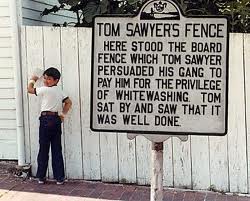
tomsawyerI need to do a Top 5 post so I can get a little link love, and maybe some cash, from Darren Rowse over at Problogger, which for some reason I always read as prob logger.  What better list than the five biggest reasons Darren is the blogosphere’s marketing genius.

So here they are, Letterman style:

5) He founded an emerging church, according to Wikipedia.  I don’t really know what an emerging church is, but it sounds brainy and sorta cool.  As long as he doesn’t start writing science fiction novels and hanging out with Tom Cruise.

4) He also founded a blog network.  I’m not really sure what a blog network is either, but I’ve never belonged to one, so they must have taste and standards.

3) He might be making $1.2M a year from blogging.  That is a pro blogger, by golly.  And even if he doesn’t, he makes at least $120,000.  That’s $108,000 more than Jeff Jarvis (according to the post linked above).  I’m not sure why I find this so funny, but I do.

2) He is the father of multi-level linking via his crafty Group Writing Projects.  He has a lot of juice in the blogosphere, so people crave links from him.  He gives out 2 links each to project participants and gets a zillion links in return, thereby multiplying his juice.  Someone could write a dissertation on the brilliance of this.  And the thing is- it’s a win-win deal.  Anyone can participate.  It’s sort of like the un-blogosphere.

1) I just spent over an hour writing this post, just for a couple of links and a 1 in a zillion chance to win a grand.

While I am poking a little good-natured fun here, let me say for the record that I have been a reader of Problogger for a long time, and Darren strikes me as a good guy.

And a marketing genius.

Bonus question for Darren and everyone else:  If you were a struggling blogger and you had $1,000 to use to increase traffic to your blog, how would you spend it?  Even if I don’t win the contest, I am thinking about budgeting some money to market Newsome.Org.  I’m not going to buy books, or tapes or go to some seminar.  But other than that, anything legal and moral is fair game.

Technorati tags: ,