All These Rumors Surrounding Me

Look at all these rumors
Surrounding me every day
I iust need some time
Some time to get away from
From all these rumors
I can’t take it no more
– Timex Social Club

TechCrunch has a screenshot and some information about my blogging buddy Guy Kawasaki‘s pending Web 2.0 entry- Truemors, which is apparently a rumor reporting bulletin board with Twitter and Digg-like capabilities.

Where to start….

First of all, I suspect they are going to have an epic spam problem.  Sure, they can approve entries, but I bet that’s not their plan.  It would be a ton of work and would delay publication of what they probably hope will be time sensitive scoops.  There will be the traditional spammers, and the disruptors who just want to post absurd things and make trouble.

I also wonder how many people are going to happily populate Guy’s site with juicy content they could post on their own blogs, web sites, etc.

Finally, I wonder how many people are going to choose to get their gossip news at Truemors, as opposed to other news and quasi-news sites?

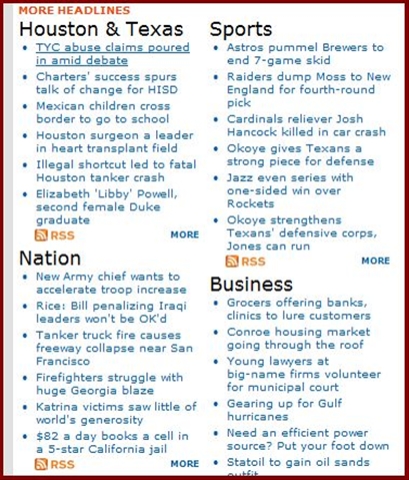
The screen shot shows rumors about Phil Mickelson switching golf instructors, Paris Hilton whining about jail, Scarlett Johansson visiting Austin and the Spurs winning a basketball game.  Not exactly edge of your seat stuff.

Based on the screen shot, it looks to me like a Digg clone more than anything else.

We have to wait for the public launch to see what Truemors is made of.  But based on what little I know right now, I’d have to say the early line is leaning towards a yawner.

Hey Guy, my private beta invite must have gotten lost in the mail.  Want to hook me up?

Thanks to Earl for linking to my last post.

Technorati tags: ,

Morning Reading: 5/5/07

Happy Cinco de Mayo.

Here are 12 U.S. laws every blogger should know.

I think those Geico cavemen commercials are hilarious.  This one is my favorite.  When I heard they were making a sitcom with them, I was excited.  Until now.  Why in the world would they not use the same actors!?

Adam Messinger has a great post on web design and the lack thereof on the new ABCNews.com page.

Gotham Gal has a good review of Wesabe, a personal finance and financial goal tracking application.  I have played around with Wesabe a little bit, and I have to say that it is a very well designed application.  It has a social networking feature that is actually designed to be useful.  In sum, I am pretty impressed with what I’ve seen so far.

Technorati tags: ,

WallStreetmeme?

I have used and referred to Techmeme as the New York Times of the blogosphere since the day I discovered it.  It is one of my first stops when I go to the net for my news.

But Tom Morris has a good point.  Techmeme has evolved from the New York Times of the blogosphere to the Wall Street Journal of the blogosphere.  I don’t read the Wall Street Journal for one simple reason.  It bores me to tears.  In fact, I think the Wall Street Journal is a lot like the opera.  Many people who go there are more interested in what it says about them than what it does for them.  Like neckties and polo shirts.

Tom thinks, and I agree, that layering a media slant (which in the online world is fancy jargon for “come click on my ads”) on top of the larger business focus makes it even less techy and more something else.  Something less interesting.  Some square thing trying to get stuffed into a round hole.  Stuffed by those who try in the name of a potential dollar to turn a content platform into a product.

Maybe that’s the root of the issue.

Maybe the Techmeme algorithm has deduced that all of this Web 2.0 stuff is really just the media business in some new form.  If you have no product to sell, what are you?  If your primary or only revenue source is the sale of ads, what are you?  You’re not science.  You’re not a seller of goods.  You’re media.  You’re the new TV.  A million pages of user generated content broadcasting your AdSense banner over the new air.

Science, as Tom points out, is the glorious process that leads to the stuff people push on and onto Techmeme.  But it’s a process that’s an extra step away from the illusion of money.  The process gets ignored in favor of the product and the frenzy to monetize it.

Monetize it largely by getting us to click on ads next to the content we have created on the platforms developed by some scientist who doesn’t know Mike Arrington from Mike Brady.  Again, it all looks and acts like media.

Sure, there is science on the internet and in the blogosphere.  But it’s not driving the Techmeme train anymore.  If it ever did.

I still enjoy Techmeme, and I continue to believe it is one of the most brilliant creations of the Web 2.0 era, largely because of its efficiency and simplicity.  But I do wish it was more about tech and less about how to make money off of that tech.  The same tech that Web 2.0 generally mandates be given away for free.

But that’s just not the way it is.  Not on Techmeme, not in the blogosphere and, sadly, not in life.

Thanks to Ric, Blonde 2.0 and Earl for commenting on my last post.

Technorati tags: ,

Walking the Line: Digg, Communities & the C Word

You’ve got a way to keep me on your side
You give me cause for love that I can’t hide
For you I know I’d even try to turn the tide
Because you’re mine, I walk the line
-Johnny Cash

Blonde 2.0 has a great summary and discussion of the Digg censorship business.

The challenge for any web community is to give the users who create the content a sense of ownership and investment in the community, without getting sued or letting your community descend into chaos.  Users who populate a community acquire a sense of ownership.  A sense that grows stronger over time.  This is a good thing, as it creates loyalty and nurtures organic growth.  Once a community grows to a certain point, however, a couple of things happen.  One, you start making a little money.

Two, you have to walk a fine line between being too restrictive and too permissive.  A lot of users want a no-rules policy.  A lot of users will leave if chaos and conflict are completely unconstrained.  It’s a fine line, and you simply cannot make everybody happy.  You have to figure out what the largest percentage of your audience wants and then try to maintain it without being autocratic.

On ACCBoards.Com and the other web communities I developed, our mission statement from the first day has been to create a “family friendly” environment.  We did this because we knew that the majority of our target user base would be more comfortable in that environment.  It was about growth more than morals.  Over time, the moderators’ standard became “if a young person shouldn’t read it, you can’t write it.”  We made some people mad.  We made more people happy.  It’s math.

Sports, like technology, is a passionate topic for many.  To address this, we make a distinction between the message and the way the message is delivered.  I have been consistent that almost any opinion is OK as long as it is delivered and defended properly.  No personal attacks, and no extreme language (although we have filters to take care of most of that).  It can be hard to police that standard, because there is a significant sub-group of users who interpret a contrary opinion as an act of aggression.  They cannot separate the message from the writer, and all hell breaks loose.  I almost always side with the contrarian in those cases, and tell the others to stop attacking the opinion and refute the opinion.  I believe that someone who attacks someone for their opinion generally does so because they are psychologically bound to their position and, when they lack the ability to logically refute a contrary opinion, they have a psychological panic attack.  But that’s a topic for another day.

The point is that community leaders have to walk the line, so users feel like peers, not subjects.  I think we’ve done a pretty good job at ACCBoards.Com, as evidenced by the fact that a newish moderator tried to kick me off the site I created the other day, because he didn’t like something I said.  I honored the community by telling him that I’d stop posting for a while, as opposed to reminding him of the history of the site.  The rest of the community largely took my side in the argument.  Self-policing resolved the issue, which is what you want to happen.

Then there’s the intellectual property problem.  I get emails every couple of weeks complaining that some photo is being used without permission, that someone is stealing bandwidth by linking to images or that someone is being mean (those who haven’t talked to a lawyer) or committing libel (those who have).  I generally try to mediate the problem, and most times people are cooperative.  What I try hard not to do is go on the boards and start issuing mandates.  I learned a long time ago that when I do that, I soon have a mutiny on my hands.  Kevin Rose learned that this week.

But (and this is important), if I felt I had to choose between taking something down without discussion or betting the company on a case I might lose (either by losing or by cost attrition), I’d do it.  In a second.  A Digg with no encryption key posted is better than Digg out of business.  An hysterical group of users is never going to conclude that- the combination of anonymity and human nature won’t allow it.  It’s up to the community leaders (read owners) to make that hard decision.

For these reasons, I don’t think people should be so hard on Kevin and the other Digg folks.  Granted, they would likely do things differently if they could start over.  But getting demand letters from big operations with a pile of lawyers behind them is no one’s definition of a good time.  When you’re walking that line, sometimes you wander on one side and sometimes the other.  A nasty letter can blow you off course.  Users have to understand that.

I agree that there’s a lesson to be learned here.  Hopefully, it will be a lesson for owners and users alike.

Thanks to Guy and Jim for commenting on my last post, and to TDavid for linking to it (and getting my back).

Technorati tags: , ,

Narcissism, Honesty and the Technorati Top 100

There’s comin’ down the street
They’re comin’ right down the middle
Look how they keep the beat
Why they’re as blue as the ocean
How the sun shines down
How their feet hardly touch the ground
Jolly [Bloggers] On Parade

-Randy Newman

Guy Kawasaki gives a video interview I saw over at Jeremiah Owyang’s blog.  I had read about this interview, but wasn’t that interested in watching it.  As I have said before, I’d rather interact with other lesser beings than to play the jester in the court of the geek kings, and all that.  But a couple of the quotes from Jeremiah’s post that showed up in my reader got my attention.  Particularly this one:

His goal is to be ranked in Technorati as the top 10, he’s 14 pegs away. Guy says he doesn’t read any other blogs other than his, well he only has about 40 feeds that he reads.

Being largely a math sort of guy, that tells me that Guy wants others to read his blog, but he isn’t interested in reading anyone else’s blog.  That’s just the sort of thing I like to point out and poke fun at, so I watched the video.

Yes, Guy comes off as a little self-centered (more on that below).  But he also makes some good points along the way.  Best of all, he bashed the (other) A-Listers around pretty good.  He says he wants to be the non-asshole A-Lister.  Great sound bite, but the proof is in the pudding.  Read on.

First, he says that blogs that are journals are boring.  He’s wrong about that.  Blogs written by bad writers are boring, whether they’re journals or not.  A good writer can make a journal a hundred times more interesting than yet another nerd writing a me too post about the latest web 2.0 application.

Guy admits he had an “enormous advantage” when he started blogging.  No kidding. I pointed that out after he’d been doing it for a month and a half.  But that’s not the advantage he talks about.  Apparently Guy spammed thousands of people whose email addresses he had collected over the years to announce his blog.  Can you imagine the nine kinds of hell some unknown blogger would suffer if he or she did that?  Guy was a known and respected person in the tech industry, so he can probably get away with it.  Advantage on top of advantage.  It irritates me that that I had neither advantage when I started blogging (and thus continue to push the boulder up blogger’s hill), but that’s largely jealousy talking.  I can’t blame the guy for using his advantages.  At least he’s honest about it.

He is also honest enough to admit that he does care about blog rankings and links.  That’s a breath of fresh air after A-Lister after A-Lister keeps telling the rest of us not to worry about gatekeeping and links and whatnot.  I know Guy will see this post, since he checks his Technorati page “about 50 times a day.”  Will he respond?  Probably not, though he has commented here before.  But that was before he was a made blogger.

Guy then takes the opportunity to smack around the (other) A-Listers who “have this attitude they they are intellectually superior” and who act like it is “an honor to get an email from them.”  He says that maybe the A in A-Lister stands for asshole.  That’s funny.  And it’s also easy to say after all those (other) A-Listers embraced him and made him their equal (or superior).

Interestingly, he says (and this is a Technorati top 25’er talking) that there is no economic payback to blogging.  If a top 25 blogger says this, what does that tell us about blogging as a way to make money?  It tells me that I and others are correct when we say that blogging is not a revenue source in and of itself- it’s merely a more efficient way to distribute information about your true revenue source.  Lots of people caught up in the blogging euphoria don’t get this.

He was asked about links (you know, those things that got him in the Technorati top 25).  He says he won’t trade links with people, which begs the question of giving legitimate links back to others, the way they were previously given to you.  He says if you blogroll someone, you have some moral obligation to ensure that the blog is worthy.  I say maybe, but, again, we’re not giving away MBE‘s here.  Just a link.  I also wonder how Guy felt about links the day he started blogging.  It’s easy not to crave what you have in abundance.

And then they got to the part I was waiting for.  The bit about reading other blogs.  Guy says he doesn’t read any blogs.  Literally.  He says he has some feeds for publications like Science Daily.  No mention of Newsome.Org (that’s the feed URL right there Guy, just to make it easy for you).

Of course he has an alert to notify him every time someone writes about him (as do I and most other bloggers, I’m sure).  He has a “virtual assistant”  (whatever that is) who will sometimes thank those who write about him.  Apparently, he doesn’t realize how much all of this sounds like the A-Listers he slammed earlier in the interview.

So I was right.  He wants us to read him, yet he doesn’t read any of us.  He says he has kids and likes hockey and just doesn’t have the time.  Hey Guy, some of us have kids, like sports, coach sports, write blogs and have full time non-tech related jobs.  Yet we manage to get through our feeds every few days.  I’m not buying the don’t have time thing.  Don’t want to is more like it.

Even though a lot of the interview sounds like narcissism run amok, Guy made some good points.  Somehow, I don’t think he is as self-centered as he comes across.  I hope that’s the case.

I have been a reader of Guy’s blog since the day he started it.  Part of me wants to unsubscribe after watching this interview.  I don’t know what I’m going to do, but I know this: if folks like me stop linking to Guy, he’ll never make the Technorati top 10.

And wouldn’t that be a shame.

All That Glitters is Not Gold – Web Design and the Citizen Journalism Era

citizenjournalismI read, via Steve Rubel, that ABC News has relaunched its web site, with new features that allow citizen journalism.  I think that’s a good thing, but it’s not what I want to talk about at the moment.

Steve notes that most of the comments on the relaunch concern the design of the page, as opposed to the citizen journalism features.  I think that’s because most readers are concerned about finding and being able to read the content they want, while too many web designers are focused on the 37 pieces of flair (many of them ads) that get in the way of that content.  Users don’t want scrolling news tickers and they don’t want fancy, slow loading pages.

Here are just a few of the negative comments users made to the ABC News redesign:

It stinks. Every page is slow-loading, even with cable internet. The look is cramped and cluttered. Browsing through headlines takes forever, due to the necessity to constantly switch pages.

***
Why can’t you just leave it the way it was. So simple, you just opened it up and picked the head line you wanted to read. Now it’s like everybody else, you have to search and decipher everything before you can find what you want.

***
I liked the simplicity of the old design and used it as my home page. Did the designers/developers of this new format get ANY input from users in the 35+ age demographic?

It’s pretty easy to tell what readers want.  It’s harder to explain why web designers refuse to give it to them.  One reason is because the more page views it takes to get to and through a story the more ads get served in the process.  People realize that ads are the price of admission, at least where old media web distribution goes, but there are limits.

Readers will ultimately refuse to click through 5 pages to read one article.  They’ll simply find someplace else where they can get the content with less hassle, or they’ll move to an RSS reader.

There are two other things users want.

One, for the page to display properly on their screen, regardless of monitor size or resolution.  It’s not an 800×600 world any longer.  Some pages that display fine at lower resolutions get jumbled up at higher resolutions, or when you increase the text size in order to read the type.  The ABC News page seem to handle increased text size pretty well.  Morningstar, one of my favorite destinations (DISCLAIMER: I have been a shareholder since the IPO), doesn’t.  Bump your text up several notches and things get jumbled, ads overlap content, things get cut off, etc.  I’m not sure how to address this problem, but it should be addressed, since many users cannot read the micro-text that results from a higher resolution and must increase the text size.

Morningstar is not the only offender here, many other major destinations have the same problem.  ESPN‘s navigation banner becomes virtually unusable if you bump the text size.  I completely quit reading the Houston Chronicle page after recent redesigns rendered the text on the front pages molecular (thank goodness for RSS feeds).  For an example of how to handle large text size the right way, see Wikipedia.

Two, for the pages to be designed in a way that allows you to find what you’re looking for.  I have always thought the CNN page was far too busy- and so I don’t visit it much.   At least the USA Today page looks something like a newspaper, which allows readers to navigate it something like a newspaper.  Google News has the most usable design precisely because it has the least amount of bling.  Techmeme rules the tech-related blogosphere for the same reason.  Tailrank, which for a while was on the verge of bling-overload, seems to be moving back the other way, which is a good thing.  Digg has a relatively simple and easy to navigate interface.

Compare those pages to Fox News, for example.  My head starts hurting before it’s finished loading.  I’m sure the bling imbalance has to do with the sort of media we’re talking about- TV being, sadly, almost entirely based on bling.

But web pages are not TV, and a cleaner, simpler interface is better for users.  And that should be the benchmark for a good web page.  37 pieces of flair was funny in Office Space.  It’s not funny on web pages.

Technorati tags: , ,

Signs of Blog-Addiction

blog

I like SearchRank’s 10 Signs That You May Be a Blog Addict post.  Before I take a look at their 10 signs, I might add one more:

11. You hire a search engine marketing company to try to move your blog up in Google search results.

Now, my thoughts about the original 10.

1. I’m guilty here.  I use Bloglines for my feeds, and if I am at the computer at home, I generally have a Bloglines tab open in Firefox.  I don’t want to miss it when one of my internet pals hits a good lick.  I think it odd too that this deal isn’t getting any run in the blogosphere.  Where’s Techcrunch?  If one of Scoble’s finger nail clippings got sold for 10 cents on eBay, TechCrunch would have a full page story on it.

2. If I told my clients I had a blog, they wouldn’t know what I was talking about.  I have to use the dog ate my homework excuse.  At least a business person can visualize a dog eating homework.  None I know could visualize blogging.

3. I’ve never dreamed about blogging, simply because there aren’t many bloggers who would find their way into my deserted island scenarios.  I’ve dreamed I could fly.  I have dreamed twice, in great detail, that I was a member of the Grateful Dead.  But never about blogging.  Thankfully.

4. I get inspirations for blog posts at all kinds of odd times.  It’s the same way with songs.  Unfortunately, I generally forget both before I get home to write them down.  Maybe that greater than Twitter application Jott can help me with this.

5. There’s more traffic on the stairs when my kids head off to bed than there is in my comments, so I go to where the action is.

6. This is partially true.  I talk very little about this sort of stuff in the real world, so people can definitely get more of my thoughts here than over dinner.  If someone asks me what I’m thinking in the real world, I scream and run away.  That’s one of the reasons I wish I’d started this blog anonymously.  If I could talk about my real world life more freely without the fear of getting fired or slapped, I could tell some great stories.

7. I love our pets.  But people who are seriously pet-obsessed scare me.  People who aren’t little old ladies who are seriously pet-obsessed scare me big time.  Like the Exorcist.

8. I used to watch my Technorati rank.  But unless you’re willing to stay on the treadmill full time, the formula makes it impossible to move up or maintain your place.  It’s too hard.  I gave up.

9. Nope.  We have Twitter for all those things.

10. I enjoy active Twitterers, Eric Rice and Bagadonuts being among my favorites.  I update my Twitter feed maybe once a day, but that’s because my day to day activities are pretty routine.  If I had more fun and more free time, I’d update more.

Technorati tags: ,

Link-Giving: An Alternative for the Rest of Us

linksI have largely stopped thinking and writing about the Gatekeeper thing, for a few reasons.  One, it’s a tired topic.  Two, the return on investment from trying to worm your way into the so-called conversation is too low to be worthwhile.  The return on simply writing good posts and waiting is not that much higher, but it’s higher.  It’s a little like fishing.  I am a good fisherman because I am patient- something most casual fishers are not.  And third, the conversations are often boring anyway.  I just don’t care all that much about what a lot of the so-called A-Listers have to say.  Many of them have turned their blogs and Twitter feeds into nothing more than a living billboard for self-promotion.

But I just can’t resist it when a couple of A-Listers start a conversation about link-baiting.

Jason Calacanis started things off with a partially tongue in cheek and partially straight up post, talking about ways to get a link from him.  I chastised him the other day for not reaching out to mainstream media, so let me give a little credit where due.  This is funny stuff, even if it’s true:

DON’T start the post off flaming me. Start the post off by praising me, talking about how great Engadget or Netscape are, that you love my podcast, or that you thought I was a riot at some panel (you don’t even need to have been at the panel…just technorati my name and “speaking at” and you can fake it).

And this:

DO slam someone I don’t like or have had a beef with. This is a long list, but getting on my side will keep me reading your post and increase my chances of taking your link bait.

Of course, scads of people immediately start linking wildly to Jason’s post, dancing in the fleeting glow of inclusion.

I just about fell off of my chair when Dave Winer posted his rules, including this one for why he might not link to you:

3. Lack of reciprocity. If I observe over time that the linking is one-way, i.e. I link to you but even when I’m on-topic for you, I don’t get a link from you, that will dampen my enthusiasm.

That’s either the best satire I have ever read, or the biggest violation of the Goose and Gander Rule ever.  It doesn’t really matter which, because Dave and Jason talking about getting links is like Bill Gates and Warren Buffett comparing their bank accounts.  It makes them feel good, but has zero relevance for the rest of us.

So what can the rest of us do?  We could fall in line, and fawn over these guys.  We might get a link every six months or so.  Or we could just sit back and watch.

Or we could leave that party and start our own.

I don’t want to spend any effort trying to figure what I need to write to be worthy of a link from some blogostar.  That promotes bad writing, and it doesn’t work.  Linking should not be viewed as currency, and the fact that it is viewed that way by many is the single most screwed up part of blogging.  We’re not handing out MBEs here.  We’re just placing a road sign to another place someone may want to go.

So I’d rather just give links to the people I read, without making them work for it.  Here’s some link-giving to some of the blogs in my reader.  Go check ’em out.

A Consuming Experience
Amy Gahran
Assaf Arkin
Be A Good Dad
Ben Metcalfe
Ben Werdmuller
Bill Liversidge
Blonde 2.0
Brad Kellett
Chip Camden
Christopher Carfi
Claus Valca
Corey Clayton
Craig Newmark
Dave Rogers
Dave Sifry
Dave Taylor
Dave Wallace
Dwight Silverman
Earl Moore
Eric Scalf
Ethan Johnson
Frank Gruber
Frank Paynter
Fraser Kelton
Haydn Shaughnessy
Ian Delaney
Ilker Yoldas
Jackson Miller
Jake Ludington
Jeremy Zawodny
John Watson
Jon Maddox
Karl Martino
Kate Trgovac
Kevin Briody
Kevin Maney
Larry Borsato
Marc Canter
Mark Evans
Martin Gordon
Mathew Ingram
Mike Miller
OmegaMom
Phil Sim
Randy Morin
Rahul Sood
Ric Hayman
Richard Querin
Rick Mahn
Rob Barron
Robert Gale
Ron Jeffries
Scott Karp
Seth Finkelstein
Stephen Hogg
Steve Gillmor
Steve Newson
Steven Streight
Stowe Boyd
Susan Getgood
TDavid
Tom Morris
Tom Reynolds
Warner Crocker
Zoli Erdos

That’s it.  No link or master baiting required.  Just links to people because I read their blogs.

See how easy that was?

Technorati tags:

That Sound You Hear

web20Is the sound of Web 2.0 sucking, at least according to Charlie O’Donnell.  Charlie has a list of 10 reasons why Web 2.0 sucks.  Go read his post for the full list, but here are my 2 favorites.

4. Web 2.0 is a conversational vacuum

No matter how many times people say it’s not, we all know it is.  The effort it takes to engage the so called thought leaders in conversation is second only to podcasting in the Sisyphusian Hall of Fame.  I have always thought, and written, that the semi-closed blogosphere is a function of the cross-motives between those looking for cool and those looking for dollars.  I also think it’s because blogging is a very inefficient way to carry on a conversation- Twitter notwithstanding.

10. MySpace is the most popular social network

No kidding.  If MySpace is the crown jewel of Web 2.0, then the whole movement is doomed.  As I have said many times- MySpace is Geocities II.  It was the playground of kids and amateurs the first time around, and it still is.

A lot about Web 2.0 does suck.  But it doesn’t have to.  It’s all in the perception and the spin.

Most of Web 2.0 has a lot more in common with fun and games than it does with big business.  Social networking, for example, is very distinct from business networking.  I realize this is semantics, but names are often descriptive.  Those who try to put Web 2.0 on the business side of the equation are forgetting the fact that fortunes are made every day on the fun side.  Just look, for example, at the top ten holdings of the Baron Partners fund (one of my favorite mutual funds; DISCLAIMER: I am a shareholder).  For archival purposes, the top 3 holdings right now are gaming companies.

You can make a lot of money being fun and cool.  Sure, people have come to believe that Web 2.0 is supposed to be free.  But it doesn’t have to be.  People will pay for fun- just look at Second Life.

Web 2.0 would suck a lot less if it didn’t have to wear and coat and tie and try to sneak into the big business party.

Technorati tags: