Castpost & a Very Old Video

Castpost is a new service that hosts audio and video files for use with blogs and other web sites. It is in alpha testing now, and is free during testing. Better yet, alpha testers get a free one year subscription once the site goes live. Run, don’t walk, over there and sign up for a free (for now) account.

I just signed up tonight and am beginning to put the site through its paces. I uploaded some very old video I renamed 3 Short Films from the Vault. It’s comprised of two test films I made when preparing to make Bride of Gibster, my first more or less full length film, and the beginning of another film that never got made. The first test film is some animation I was practicing in preparation for a scene in Bride. The animation in the later film was much more detailed and included dialog (I’ll try to post that scene later). It’s amazing (at least to me) what we got done back in 1991, without the use of a computer. The second test film is a bunch of random photos I shot to learn how to film still photos. I was shooting these photos on a TV Tray with the JVC video camera on a tripod pointing straight down. I used this exercise to figure out the lighting, timing and distances. You can easily do something much better and more complex in minutes using Photo Story or any of a hundred other programs today on a computer, but it was a lot harder in 1991. A lot harder.

The last film runs about a minute, but it is my favorite, only because it features my mom and you can hear my sister laughing in the background while I filmed her. My initial plan was to film mom sleeping for an hour or so and then superimpose some silly photos and music that would approximate imaginary dreams she was having, but she woke up. When she figured out that we were trying to film her, she was very careful not to sleep in plain sight anymore.

Here’s that old video from the early 90s, served by Castpost.

Proof Positive

That if enough people blog loudly about an issue, they can make a difference.

Microsoft was rumored to be negotiating to purchase Claria, a company that has been associated with spyware. Everybody from Ed Bott to Dwight Silverman wondered why Miscrosoft would do such a stupid thing.

Today word was leaked that Microsoft is not going to buy Claria. One of the reasons- the adverse PR that would have resulted.

Mark one up for the good guys.

A Great Timesaver

One of the problems with having a web site is that what looks good today looks awful tomorrow, as tastes and technology change. There is nothing more depressing than knowing that you want to change the look of your site, but also knowing that you have hundreds of pages that will have to be changed individually to facilitate the new look. Yes, CSS (which I now use religiously) can help a lot in this regard. But many older pages, including until last month all of mine, either don’t use styles at all or have the styles embedded in the page itself (talk about defeating the purpose).

So when I decided to update the look of Newsome.Org, that was one thing, since it only has about 3 pages to worry about. But when I decided to update the look of the Err Bear Music page, that was another thing altogether. The EBM pages contain a main page, 5 index pages and literally hundreds of song pages, one for each of my songs. It would take days and days and days to reconfigure each page individually- I know this because I have done it twice in the past. This time I decided to see if technology could make it easier, and boy did it.

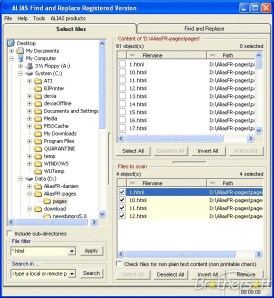
There are a number of search and replace programs that will work with html files. I tried several of them and found Alias Find and Replace to be the best. It made a 30 hour job a 2 hour job, and the only reason it wasn’t a 30 minute job is because I had to figure out what to tell the program to replace to get what I was after.

alias_find_and_replace

The hard part was the individual song pages. Those pages are identical except for the lyrics part in the middle. After a little trial and error, I changed hundreds of my song pages in a few minutes in 3 steps. First I used “Search & Replace Blocks” to remove all of the header tags and embedded styles in favor of a uniform header and a reference to a remote style sheet (which will now allow me to globally make any subsequent changes to all pages merely by modifying the style sheet). Second, I used “Search & Replace Blocks” again to replace everything in each page before the beginning of the lyrics with the new code from my new page template. Third, I again used “Search & Replace Blocks” to replace everything after the lyrics with the new code from my new page template. Worked like a charm.

Alias Find and Replace works with all kinds of files, so it’s not only a time saver for html files, but also any other files where you need to make the same change a lot of times.

It’s a great timesaver and I highly recommend it.

Is That a Train I Hear a Comin'

to take my TIVO away? Or is it Rupert Murdoch. More unfortunate evidence that TIVO is dying on the vine. I like my TIVO, but I know that it is not a long term DVR solution. When Direct TV turned its back on TIVO after allegedly trying unsuccessfully to buy it, the end was beginning. A lot of early adopters like me are going to soon have some very expensive paperweights. The problem is being accelerated by the fact that the current HDTV models do not support MPEG-4, and Direct TV is about to switch to MPEG-4 in order to create more bandwidth for additional HDTV stations.

Like a lot of things (VCRs, tablet computers, etc.) the person who invents something isn’t always the one who capitalizes on it. If Direct TV says subscribers need a Direct TV branded DVR to record HDTV, most subscribers will get one. I don’t know how (or even if) TIVO thinks it can survive without the support of Direct TV, but it can’t.

To make matters worse, TIVO recently hired a contraversial CEO.

Looks like rough waters ahead for TIVO and its (so far) loyal customers.

Podcasting Revisited

Ed Bott agrees with my reservations about Podcasting and the real world.

I actually spent some time last night considering doing a Rancho DeNada podcast, but then I remembered that it would take forever to do it, I couldn’t use any music other than my own without risking the wrath of the priority-challenged RIAA, and even if I did, no one I know has the knowledge, hardware or inclination to listen to it.

Connectivity and the New Internet

connectedAs I’ve been rewriting most of the Rancho DeNada pages, I’ve been thinking about the internet and its evolving role in the American family. I think we’re about to get to the point where the internet moves beyond on online phone book, atlas and catalog and becomes something very useful- a way to stay connected in a hectic world. Here’s why.

When the internet first came into the nation’s consciousness, it was a place to send email, which was new and novel at the time, and a place to explore- like an online text based adventure game. Emails oddly enough replaced more phone calls than letters, since most heavy letter writers (such as everyone in my extended family over 50) didn’t embrace the internet. So what was intended to connect people had the opposite effect. People simply used email rather than the phone. It was fast and cheap, but very impersonal.

Then there was the world wide web. For early users, it was fun just to be on the net looking at a page created by someone far away. I remember late one night back in the mid-nineties I found myself chatting on an IRC program with a fisherman from Japan. It was pretty amazing at the time.

The problem was that content (or more specifically the web pages that displayed it) was very, very hard to create and so expensive to maintain that the big media companies pretty much controlled the distribution of information. The internet was becoming an online newspaper, but there was no reasonable way for the average person to create, maintain and distribute content. It took me hours and hours to create the original version of Rancho DeNada (which would look like my 3 year old’s coloring book by today’s standards), and every update was painstaking. I caught lightning in a bottle when I created ACCBoards.Com back in 1996. At one time we were doing 2 million hits a month. But when the dot.com bust happened and the internet advertising revenue model vanished overnight, I had to affilate with a network just to keep the site online.

Now, things have changed. There are so many applications that allow developers and writers and truck drivers and housewives to create professional looking content and publish it immediately (Blogger being one of the best for non computer types). Lots of families now have year-round, current “Christmas letters” in the form of a web site or family blog. Here is the best example I have seen (I don’t know them- I found their excellent family blog on Feed Map), but there are many others, including, to an extent, this page. One or two families that are connected in some way create a family blog and link to each other. Before you know it, the thing gets legs and there is a little neighborhood of family web sites. It isn’t just limited to families either- photographers, bird watchers and banjo players can do the same thing. Add some photograph serving by flickr to the mix and before you know it, you’ve got something really cool. Fred Wilson has a neat post today about the scalability and leverage of the new internet. Good post by my favorite blogger.

These interconnected pages make it easy to keep in touch with your neighbors as well as people you know in other parts of the world. I grew up in South Carolina and live in Texas. As anyone who knows me will attest, I am a terrible correspondent. I don’t call and I don’t write (and I am not proud of it). But I do update Rancho DeNada, so someone across town or across the country can see what we are up to with the click of a mouse.

And maybe the best thing about it is that these pages make it easy to stay connected on a meaningful level with people you care about. They even inspire people to make phone calls, or plan camping trips or do something else that groups of families can enjoy together. Finally, the web becomes a way to stay connected. That’s what Al Gore created it to do in the first place.

There are some turnkey solutions out there, Yahoo!360 being one I have experimented with. And while those sites are great for someone who hasn’t the time or inclination to build a site from the ground up, they are not flexible enough for a lot of people, myself included. I want a free standing site where my imagination is the limit and I can make every little corner the way I want it to be. But whether you want to build the whole thing or use an existing platform, the choices are there. And most of them are free.

Later this week, I am going to start a survey of Houston blogs and we’ll see some real examples of what I am talking about.

Now if only our friends would create some sites we could link to.
Zip Drives Suck, Period

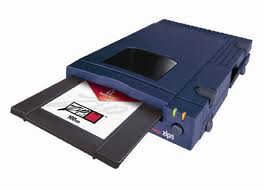
zip drive

I have owned a lot of computers. I have built a lot of computers. Several of them had iomega Zip Drives in them, including the one I am using now (which I built).

At least half of the Zip Drives I have had just stop working at some point, either via the infamous “click of death” or via some mysterious and irritating failure to read any of the disks. Given that the whole idea behind these devices is to back-up data, I’d say that’s a pretty unacceptable failure rate.

The Zip Drive in my current computer suddenly can’t read any disk. And once one of these drives dies, you can no longer eject the disk without using the paper clip trick. If they are going to keep selling these crappy drives to the unsuspecting public, they should at least put a paper clip in the box.

So here’s my computer tip for today: never, ever, no matter what put a Zip Drive (or any iomega product for that matter) in any computer you build or buy. CD and DVD recorders are cheaper and more reliable and flash cards are smaller.

These sorry devices should have been recalled and destroyed years ago.

Leap Year Flashback

nologo2

Thanks to the magic of the WayBack Machine at the Internet Archive, click here to see what Newsome.Org looked like on February 29, 2000. It’s interesting to see that the date code at the top still works and returns today’s date!

Somewhere around here I have an old copy of the first web site we put up back in 1996. It’s pretty frightening by today’s standards, but one of these days I’ll post a picture of it.

Podcasting and the Guy Next Door

The other day I mentioned that I was going to write on Podcasting.

I knew what I thought the limitations were, but I wanted to take some time to consider the benefits. Today, Fred Wilson, a smart and interesting father and venture capitalist, whose Blog I read literally every day, wrote an excellent post about the great potential of Podcasting, and why he thinks it will become a bigger, more mainstream thing. He said it better that I could and he even addressed some of my issues. It’s a good read and actually made me slightly more optimistic about the possibility of mainstream acceptance.

But I still have some concerns. Here are the 5 reasons I believe Podcasting will not be embraced by the masses:

1) It’s simply too hard to create one. I built the computer I am typing on now from scratch, and I wrote almost all of the pages that comprise Newsome.Org. I used to write computer games (in Basic, way back in the late Eighties) and was briefly a game designer for a small software company. In sum, I am the neighborhood computer geek. And I haven’t the slightest idea how to create and distrbute a Podcast. Yes, I could spend a few hours and figure it out. But even if I did…

2) While it is much easier to download and listen to a Podcast (I use iPodder for that, and I expect there are plenty of similar programs), it is more effort than the average person is willing to devote to listening to music/talk, etc. when there are so many other alternatives. I have smart friends who still have trouble sending and receiving email. Podcast listening is simply not something that non-computer geeks are going to learn how to do. I and certainly a few others will certainly go to some effort to access a Podcast that we can’t get elsewhere (such as the excellent Podcasts produced by my friends at Compadre Records), but in general it’s easier to get the same sort of stuff somewhere else. So I figure even if I did create a Podcast, very few people would have the desire and ability (it takes both) to listen to it. And even if they did…

3) Podcasting raises the very same issues you have with sharing other music files: the priority challenged folks at the RIAA (a better site to get the story is this one) will eventually get around to putting most of the independent Podcasters (and perhaps even some of the listeners) out of business. If I can’t download a song from Napster (meaning the original one, not the current sad reincarnation), what makes me think I can download a bunch of songs strung together in a Podcast. So that leaves people like Compadre (who own the rights to the stuff they use), marginally appealing talk shows, and public domain stuff. And even if the big boys get into the business…

4) There will eventually be ads. As I discussed last week, ads are killing traditional radio and real time (as opposed to TIVO‘ed) television. Once people start trying to monetize Podcasts, ads will kill Podcasts too. As an aside, ads are also the biggest buzz kill on independent internet radio stations like Rancho Radio. In fact, if I can’t dream up a way to broadcast Rancho Radio without the ads, I’ll probably take it off the air, again. But even if I could handle the ads…

5) I am over 40 and no one over 40 uses an MP3 player and earbuds as their primary music source. I have serveral MP3 players, but except for the occasional long airplane trip, I never use them. If I walked down the hall at my day job listening to an MP3 player, people would think I had lost my mind (often they do anyway, but for other reasons). Like many people of my generation, I do a large part of my music listening in the car. I like to burn a bunch of MP3’s onto a CD-R and pop it in my CD player. It’s safer and anyone riding with me can hear the music and talk to me at the same time (if I had earbuds in, they could do neither). Yes, I occasionally burn a Podcast onto a CD-R and listen to it in the car, but that’s simply an extra step that the average person will not take.

In theory, Podcasting is a great idea. And I’ll continue to listen to them occasionally. But I will be surprised if Podcasting is ever embraced by the masses. I hope I’m wrong.