The VC Debate: Boom, Bubble and Bust

We were in Galveston at a wedding this weekend, so other than my cautionary post on Saturday morning I missed a good bit of the big VC Debate.

I’ve been catching up on my reading, and here are my thoughts on what some folks are saying:

Mark Evans: Makes a good point that, while there are some bubble signs, we need VCs to shepherd the companies through the monetization process and provide a level of comfort to outside investors. I agree with this as long as the VCs don’t get caught up in the madness of the greater fool theory and rush a bunch of companies to market that have no way to turn their ideas into a profit. This happened far too much leading up to the last dot.com bust. And as an aside, online ad revenue by itself does not a business plan make.

Mathew Ingram: Says that the VCs didn’t create the bubble and that as a practical matter, we can’t simply take the middleman away under our current system. He also says, and I heartily agree, that the smart investors who might otherwise serve as a balance against another bubble in Dave Winer‘s new market proposal didn’t exactly distinguish themselves the last time around. They didn’t, although the people who really got killed last time around were the retail buyers of stocks and mutual funds. Most of the insiders and big players made out like bandits. And while I technically agree that bubbles are built on the demand side, there is a huge machine in place designed to create that demand- both at the IPO and before. So while the VCs are not the creators of the greater fool theory, they certainly profit from it. And a greater fool will do wonders for a bad business plan.

Scoble: Points out that there is more access today via the sort of communication engendered by free conferences, blogs and other new media. I think that’s true but the roads out of all those small meeting rooms still lead to the existing market structure. Things may be better now than then, but the system to turn an idea into a ton of cash is the same as before.

Rick Segal: Good, thoughtful post on the place, purpose and challenges of the VC industry in 2006. I like this quote (other than the fact Kent Newsome isn’t in that listsmallicon-793225).

My working theory is that a Capital firm with Esther Dyson, Mark Evans, Shel Israel, Doc Searls, Robert Scoble, Dave Winer, or some combination, might have value that, along side my money, could bring ideas into the mainstream in a much different fashion with great returns for all.

AS LONG AS the all includes all the retail buyers should the deal go public. Too often those folks get forgotten about.

Anne 2.0: Says that Web 2.0 won’t give the super-sized returns needed to get the attention of traditional VCs. This is the best point yet, and I hope she’s right about this. Because if a bunch of people get in a room and try to engineer some of those returns, the traditional way to get there is to sell to someone else based on projected growth, etc. We are the someone else, as we learned last time around.

Jeremy Wright: Talks about the need for passion in the VC arena. People who build these Web 2.0 applications have passion for the application. The VCs have a passion too, but it’s usually a passion for making money- that’s precisely why they get hired. I agree with Jeremy that you should strive for a passion for both, but too often the two passions can conflict with one another. Much like a musician who is passionate about her music dealing with a record label whose job it is to commercialize and monetize that music.

Phil Sim: Talks about the launch of his start-up, without traditional VC money. More importantly, he talks about the need for a good business plan. I love this quote:

My original business plan didn’t suddenly start to suck because the bubble had popped. I think about what we might have done differently with MediaConnect had we had venture capital and realistically, I think we’d have been far less worried about ensuring everything we did was monetised and our business model was profitable and I’m not convinced we’d have come out the other side. Bootstrapping is a wonderful way to ensure you’re focused on what should really be the core concern of most every business – getting profitable.

Fred Wilson: Recommends this approach:

Be the entrepreneur’s partner. Help him or her. Be there for them. Support them. Counsel them. Share the risk with them. Have fun with them. Laugh and cry with them. And make boatloads of money with them. It’s a time tested formula and it will work forever.

The most important word in that quote is “forever.” It can’t be a slash and burn (the retail stock buyer). There has to be first a real, sustainable product. Then a real, sustainable profit that can be grown over time. Do that, and I’ll buy your stock all day long.

Obviously, there are other ways to make money without going public. I talked a little about that yesterday. But as someone who made a ton of money and then lost a ton of money during the last tech boom, bubble and bust, and as someone who created and developed a product that got into the VC pipeline the last go around, I think we have to proceed thoughtfully and with caution this time around.

The cliff is out there somewhere. Just beyond our view perhaps, but it’s there. If we hold hands, maybe we can help each other from wandering too close.

The NTP Story

The Globe and Mail has a long and interesting article today about NTP, the company that’s in the process of kicking RIM’s tail in court. RIM is the maker of everyone’s favorite email gadget, the Blackberry.

I guess the public relations campaign mentioned in the article worked, because until today I had the impression that NTP was merely a patent troll, trying to extract some easy money from RIM.

This article doesn’t necessarily make me change my mind about the case, but it does remind me that there are two sides to the story.

It’s always next to impossible to get the real story based on what you read or hear on the news. People tell reporters carefully crafted versions of the facts. But it sounds like there may be a little more to this lawsuit than I thought.

Tags: ,

Taking a Page from the CD Book

It seems the TV networks are taking a page from the record label cartel book and raking in almost all of the $1.99 per episode charged to download their shows onto our iPods and computers.

I still want someone to explain to me why there is a big market for downloadable videos, other than the few tech savvy, long distance rail commuters and the guy whose TIVO hiccuped and failed to record last night’s episode of Lost. Seriously, I want to know.

Selling downloadable video is the biggest much ado about nothing since Y2K.

Even if there are teens of teens who actually want to buy these reruns of free TV shows, how much jack does Apple stand to make if Apple’s take for each sale is only 54 cents. Let’s see 10,000 downloads of Lost equals $5400. Net out your costs, and put a few grand in the bank.

Yes, iPods are driving a significant portion of the online content economy. And if you have one of those video iPods I suppose you have to find something to watch on it. But in weeks and months, after the new and the cool fades, how many people are going to regularly buy and download this stuff?

The more I read about this stuff, the less I get it.

Tags: , ,

Let’s Not Forget the Other B Word

Heather Green has a timely article today wondering if we are in the middle of a great boom or heading towards another bust. It’s a great question, and one I have wondered about too as I see Gather getting crazy money and hear rumors of Digg getting bought for $30M.

Back in the nineties, I and many others, bought stock in companies that were going to change the world and make a ton of money in the process. Study the phrase “were going to” in that sentence. We ignored it at the time, but “were going to” is very different from “were.” Back then, nobody expected these companies to make money right away- we were in the middle of a tech revolution that was going to change the way things worked and create tons of revenue for every smart idea. Here’s a list of some companies that proved to us that a smart idea does not ensure profitability, or even survival: Exodus, 360Networks, JDS Uniphase, ICGE, Enron, VerticalNet, Wind River Systems, Portal Software- you get the picture.

The combination of too much money, the greater fool theory, a media frenzy over dot.coms and good old fashioned momentum chasing led millions of people into the tech fray. And millions of people got slaughtered when the gig was up. All because the investing world got too enamored with tech and stopped caring about investing fundamentals.

Are we in danger of the same thing today?

Hopefully not on anything approaching the same scale. But if enough of these startups with good ideas and bad balance sheets catch come of the crazy money out there looking for deals, we could start moving towards the cliff. There are two ways these good idea companies can hit a homerun: get bought by a Yahoo-equivalent (e.g., del.icio.us) or do an IPO and get bought by you and me. The Yahoos can take care of themselves. If we start hearing rumblings that some of these startups are going public, then I think we need to proceed with caution.

There’s something else I wonder about. If everyone is out there trying to hit that $30M homerun, will there be any money left over for a truly useful application or product that has reasonable prospects? In other words, is there money for a company that hits singles and doubles.

Our economy was built on singles and doubles, but these days it looks like everyone is swinging for the fences.

And that makes for bad baseball and bad investing.

FeedLounge: What Am I Missing?

feedloungeI’ve read some good reviews of FeedLounge, the premium (meaning you have to pay for it) RSS feed reader. So the other night I decided to give it a whirl.

I signed up, paid via Paypal (the official and convenient payment service for Web 2.0) and imported my feeds. To say I am underwhelmed would be an understatement.

First of all, the layout is nothing revolutionary. Granted, you can easily switch between 3 different views (3 pane vertical, 3 pane mixed and 2 pane), but there’s nothing particularly novel about the way content displays. You can tag RSS content, which would be great if I could think of a good reason why I would want to. Tagging is like Pink Floyd’s song Money– the first 10,000 times I heard it I thought it was cool. Now I’m sick of it, but it still gets played about every half hour.

But none of that is the real problem. The real problem is that FeedLounge seems slower than freeze dried molasses. By comparison, Bloglines seems like greased lightning. At times, FeedLounge seems to be about as responsive as Bloglines. At other times, it seems much slower. I might pay for a lot faster. The same or slower doesn’t seem all that pay-worthy.

Another problem is the updating formula. Bloglines FAQ says it checks for updated content every hour. I didn’t have my team of mathematicians with me so I couldn’t decipher the FeedLounge FAQ on this point, but it seems that FeedLounge checks for updates somewhere between every half hour (twice as good) to every 48 hours (48 times worse).

Someone please tell me what I’m missing.

My Favorite Records:Eagles – Desperado

This is the another installment in my series of favorite records.

Any of the Eagles’ first five records could make a good argument for this list. Their California influenced country rock sound further defined the genre founded by the Byrds and Dillard and Clark. Great records all, but my clear favorite is 1973’s Desperado.

Desperado is a concept album about old west outlaws, but the songs themselves run the gamit from a country waltz (Saturday Night), to semi-bluegrass (Twenty-one), to acoustic county rock (Tequila Sunrise). But the masterpieces on the record are Bernie Leadon’s Bitter Creek, Don Henley’s title track (which has some of the most beautiful lyrics of any song you’ll ever hear) and the three versions of Doolin’-Dalton.

The record has been mildly criticized by some as being too much Don Henley and too little everyone else. I’m a huge fan of Bernie Leadon’s contributions to the Eagles’ catalog (Train Leaves Here this Morning, from their first record, being perhaps my favorite Eagles song, with Journey of the Sorcerer not far behind), but I can find very little to criticize about this record.

Technorati Tags:
,

What in the World is this Guy Talking About?

gibberishDennis Howlett is howling about how Tech Memeorandum is somehow hosing him and some other guys (literally if you buy his metaphor) by not somehow linking to enough stories “impacting business.” Then he proceeds to dump all over Scoble and Dave Winer over all sorts of perceived injustices.

He posts part of an email from Gabe Rivera, the creator of Memeorandum, that explains how Memeorandum’s algorithm selects what shows up on the page, and even says that Gabe manually added the allegedly excluded site to Memeorandum’s database. Yet somehow Memeorandum is not doing its job because their posts aren’t showing up.

I love Memeorandum. I read it daily. I’m no A-Lister, but my posts show up there regularly. It’s one of the very few places in the Blogosphere where new voices have a chance to be heard.

It’s not perfect. As I have mentioned before, sometimes my posts disappear there for days at a time only (so far at least) to reappear. I wrote Gabe about it a few weeks ago, and I got a similar response to the one posted by Dennis. Sure, I’d love to be assured that all of my applicable posts will show up on the Memeorandum page immediately, but that’s not how it was designed and that’s not the way it works. What we have is still way better than watching the pigs fly by our window while we wait for that link from Om or Mike.

Gabe was brilliant in several ways by leaving the selection process to the algorithm. First, it levels the playing field a little. You still need links, which a lot of the A-Listers won’t give- or at least won’t give to me. But that’s not Gabe’s fault. Additionally, it provides for a good answer when I, Dennis and others make inquiries.

Now about that business stuff. Right now there are 17 main stories on the Memeorandum page. All but 5 of them definitely concern businesses more than the consumer and the other 5 at have at least some relevance for business. Granted, Memeorandum’s not the online edition of the Wall Street Journal (ZZZZZ…), but that’s why so many people like it.

As everyone knows, I think the Blogosphere is somewhat of a closed society. But if we want to start pointing fingers about why that is, Memeorandum is not the place to start.

In Defense of My Yahoo

Brad Feld talks today about what he believes is the coming irrelevance of My Yahoo, and presumably other portals. We talked about this the other day when I provided my initial defense of portals.

Like me, Brad has used his customized My Yahoo page for many years, primarily to track stock prices and news for the public companies he follows. He has decided that his My Yahoo page has become less useful because he no longer checks stock prices several times a day and because he feels like he’s missing newsworthy stories by relying on My Yahoo’s relatively static content.

As I said the other day, I still find My Yahoo very useful.

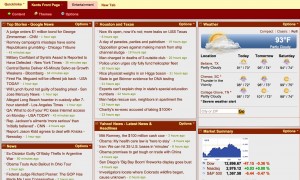
myyahoo1-300x180

I don’t check my stock prices daily either, but I really like having my entire portfolio listed on the left side of My Yahoo page- right below the overall market charts and summaries. I use the headlines, business, sports and tech stories in the middle of the page as a newspaper substitute. And I like the weather and sports scores on the right side. I think you can get more information faster from My Yahoo than you can sifting through a bunch of RSS feeds (having a separate RSS feed for every stock I follow seems highly cumbersome to me). Plus, as Fred Wilson points out, you can easily add and intermix any crucial RSS feeds with the other news feeds on your My Yahoo page.

One thing I very much agree with Brad about is the overwhelming effect of trying to list the news stories for all of your stocks on your main My Yahoo page. It is absolutely overwhelming. I tried it briefly and then decided to move all of my stock news to a separate My Yahoo page- you can have several and navigation back and forth is easy via the drop down menu at the top right of the page. So now I have a second page called “Investing” where I display the stock news stories. That page is still a little overwhelming, so candidly I don’t use it that much. But the information is there when I want it and it keeps my main My Yahoo page uncluttered and more newspaper-like.

As an aside, I use Morningstar for my stock news tracking purposes. You can customize your email alert preferences to get one email per day with links to all news stories about the stocks in your portfolio. I find this to be the perfect solution.

So while I am a big user of RSS feeds, I don’t think they serve the same purpose as My Yahoo or any similar portal. RSS feeds aren’t a good substitute for the morning paper, whereas My Yahoo is. That’s why I’m still a big fan of My Yahoo.

Tags: ,

4 Things

I’ve never done one of these deals, but someone sent me this in an email, so I’ll do it here.

Four jobs I’ve had in my life:

1) Bag Boy
2) Lifeguard
3) Heat Set Machine Operator
4) Lawyer

Four movies I can watch over and over:

1) Spaceballs
2) The Holy Grail
3) Raising Arizona
4) Up in Smoke

Four TV shows I love to watch:

1) Battlestar Galactica
2) The Amazing Race
3) Survivor
4) Lost

Four places I’ve been on vacation:

1) Bahamas
2) Cozumel
3) Santa Fe
4) Kamloops

Four of my favorite dishes:

1) Sushi
2) Poblano Chicken
3) Gumbo
4) Garlic mashed potatoes

Four websites I visit daily:

1) Flickr
2) My Yahoo
3) Bloglines
4) Tech Memeorandum

Four places I would rather be right now:

1) Camping
2) Fishing
3) Ocean Drive
4) Sleeping

Four bloggers I am tagging:

1) Improbulus
2) Richard Querin
3) Dwight Silverman
4) Amy Gahran

Only Their Hairdressers Know for Sure

First Yahoo was going to buy Digg. Now it’s not. Yahoo gave up on search. Wait, no they didn’t.

I feel like I’m at the playground with my kids and all of their friends when someone runs up to me every three minutes and shares a breaking story about who used potty talk and who isn’t sharing his or her toys.

When I speak of bloggers talking at and not to each other, this is what I’m talking about. Someone throws a topic out there and like a nineties dot.com stock everybody buys it immediately. Few people stop to wonder if it’s a good buy or not. Most just start reporting the news and/or telling us what they think about it.

And while I’m on the topic of nineties dot.com stocks, if Yahoo does pay $30M for Digg, I am going to sell all of my tech stocks because another dot.com bust is headed our way.

Cool is good. Digg is cool. Traffic is good. Digg has a lot of traffic. To warrant a $30M price tag, however, lots and lots of revenue needs to be in the pipeline, not on the drawing board. Digg has revenue, but I’d be very surprised if anything close to a $30M price tag isn’t some combination of betting on the come (which lost us all a ton of money back in the nineties) and the greater fool theory (which is the basis of far too much of our markets at this point).

When I see these sites, even great ones like Digg, get mentioned in the same breath as $30M, I wonder what, if anything, we learned from the last dot.com boom and the portfolio killing bust that naturally followed.

Tags: , ,