WordPress for iOS 2.6.4 Released

After I pooped all over the WordPress app the other night, I was pleased to see that an update was released today.

Version 2.6.4 allegedly fixes some bugs.  That’s good

It is now easy enough to insert, if not place, images.  It is still a huge pain to insert links.   My best tip here- use a URL shortener to save some typing.  For those like me who keep forgetting how to do links in the app, type http:  and the form will pop up.

The next thing WordPress should do is allow for a default URL shortener to be set, so all you have to do in the link URL form is type the shortened link code.  That would save a ton of time.

I wrote this post on my iPhone, and it wasn’t a completely horrible experience.  Let’s see how it turns out.

What WordPress should do is opt for a bookmarket equivalent, with a browser-based implementation of the “Press This” app that renders a minimal, but usable, web-based editor.

Just to see if I can do it, here’s a random image.

So how’d it do?

Update:  It did OK.  I like two spaces between sentences, and those didn’t make it.  But other than that and a few small screen related typos, the post came out pretty good.

Microsoft Pushes Confusion to Education

This is what I meant the other night when I said that Microsoft needs a paradigm shift in the way it names and markets products.

The inclusion of SkyDrive- legitimate cloud storage- could give Microsoft a real advantage in the education market (since Google still hasn’t provided any).  But I can’t tell what’s what based on the information and quotes Microsoft released.

One thing I know for sure: there is no reason to have five separate versions of Office 365 for education.

Paul Thurrott tries to clear things up in his post (linked above), but there’s only so much he can do.  What could have generated interest generates only head-scratching and shrugs.

I genuinely believe that Microsoft has some compelling products.  I just can’t tell what they are.

Microsoft needs to greatly simply everything.  Every thing.

How to Create an Awesome Custom Sharing Domain with Bit.ly Pro

OK, get ready for a big helping of awesome.  Here’s how to create a custom sharing domain.  In about 15 minutes.

Step One: Get a Cool Domain

Maybe you already have one you want to use.  If not, pick one out and register it with your preferred registrar.  I use Network Solutions, but any service will do.  I chose newsome.cc.  Get it?  Like copying you on a an email or one of those old timey letters.

Step Two: Get a Bit.ly Pro Account

bitly

I’ve been using Bit.ly as my default and preferred link shortener for a long time.  Their new Pro Accounts, which is required to make this process work, are free, but still in beta.  I signed up on Sunday and got my acceptance email this morning.  Excellent.

Registering for a Pro Account doesn’t affect your previously shared links.  All existing data remains in place.  The Pro Account merely adds features.  Once you have the Pro Account in place, you are presented with a Settings page, where you insert your custom domain name, and receive instructions on configuring your domain.  This is an easy process that consists only of changing your domain’s A-Record.  Make note of the IP address Bit.ly provides.  You’ll need it in a moment.

Step Three: Configure Your Domain

As noted above, I use Network Solutions, but the process should be very similar for all domain registrars.

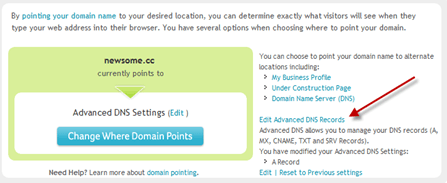
Go to your Account Management page or dashboard, and select the applicable domain (in my case newsome.cc).  Select the link to edit your DNS settings.  At Network Solutions, it is “Edit Advanced DNS Records.”
image

Then the link that allows you to edit the domain’s A-Records.

image

Then replace the “www,” “@ (None),” and “* (All Others)” records with the IP address Bit.ly provided you on the Settings page.

image

The editing form will tell you that it can take hours for the DNS change to take effect.  In my case it happened instantly.  Literally.

Go back you your Bit.ly Settings page and confirm your custom domain by clicking on the button.  Easy peasy.

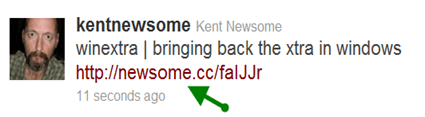
Now, when you shorten a link via Bit.ly (I use the Bit.ly Chrome extension), instead of the bit.ly domain, your shortened links will use your custom domain.
image

Very, very cool.

Step Four: Set Up a Google Reader Send To

Now that we have our custom sharing domain up and running, we need to create a way to share links from within Google Reader.

From Google Reader, go to Settings.  Then Send To.

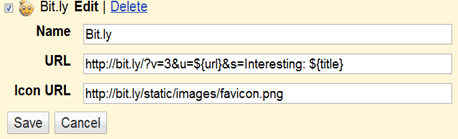
Click on “Create a custom link,” near the bottom of the page.  Fill in the blanks as follows.
image

I put “Interesting” before my shared links.  You can change that to whatever intro you’d like, or delete it altogether.  If you don’t want any intro, the last part would read “&s=${title}”.

Bit.ly Pro rocks.  I love, love, love it.  In a day or so, I’ll tell you about some of its features.  And being a good beta tester, a couple of features I’d like added.

Why not set up a custom sharing domain right now, and test it out by sharing this post!

3 Reasons Why There is Hope for Windows Tablets

ballmerces

I read with interest Paul Thurrott’s post today on the 2011 Consumer Electronics Show (CES), and Microsoft’s underwhelming presence there.

While I completely agree with Paul’s recent theme regarding Microsoft’s dire need to pick up the pace and raise its game, to keep up with new evolution cycle and the rapid migration to the cloud, I don’t know that I agree with Paul about the prospects for Windows tablets.

Paul says:

This year, dozens of companies will ship Windows 7-based tablets and they will all fail. Instead, consumers will continue buying iPads, and they will buy Android-based tablets (and, possibly, the RIM PlayBook), because those products, unlike Windows tablets, have been created specifically for that market.

While it may very well be in spite of- and not thanks to- Microsoft, I think there is a real chance for Windows-based tablets to succeed.

Why?  Three reasons.

Better Content Creation

iPads are great for consuming content.  They are very, very bad for creating content.  Sure, you can read a Word document, but anything more than minor revisions are extremely difficult.  Tracked changes (which are mandatory in corporate America)?  Forget it.  Microsoft keeps hinting that it may one day bring Office to the iPad, and maybe if Microsoft does blow the Windows-based tablet opportunity, it will.  As plan B.  Because I think the fact that it hasn’t yet is very telling: as slow and insular as Microsoft can be, even an old dog knows that Office on a tablet- in any semi-workable form- would be a good selling point.

Consuming is one thing.  But creation is king.

And it’s not just corporate documents.  I knew that I would never be able to manage my flow of Word documents via iPad.  I did think, incorrectly, that I’d be able to blog via one.  To call the WordPress iPad app horrible is a vast understatement.  It’s simply unusable.  Even if they get it fixed, the lack of useful copy and paste and the inability to easily acquire, insert and place photos will always be a frustration.  Live Writer on a tablet?  Sign me up!

The creation hurdle has clearly affected my iPad usage.  I have noticed that the number of days I carry my iPad with me to work has slowly and steadily declined since I bought it.  Now, it’s about one day every two weeks.  That does not sound like a mission-critical device.  Frankly, more than half my iPad usage these days is playing Words With Friends.

Greater Enterprise Acceptance

Like all tech bloggers, I love new technology.  But my company is still running Windows XP and some ancient version of Office.  I’ve only seen one other iPad in my office.  Ever.

A Windows-based tablet, with software that we already have, has a much bigger chance for Enterprise acceptance than the iPad, Steve Jobs and coolness factors notwithstanding.

User Convenience

Again, I’m a tech blogger.  I have Windows computers, Macs, an iPhone, an iPad, several Apple TVs and one (currently highly content deficient) Google TV.  But the large, large majority of people out there in the real world use Windows-based computers.  It would be much easier for a new customer to choose the known- Windows- over the unknown- IOS.  Better does not always trump convenient.

Microsoft clearly needs to be more nimble, and certainly needs a paradigm shift where application naming and marketing are concerned.  But I think the tablet space could be a big win for Windows.

Shoot, I had a Windows based tablet six years ago.

Fujitsu5110

That little tablet can still create content easier than my iPad.  All it needs is a few tweaks here and there: an option to use the stylus or touch; a leaner version of Windows; wireless broadband; a better display.

I’d give it a try.  Wouldn’t you?

Deacon Blues: The First Rule of Deacon Fight Club

The third episode and season finale of Deacon Blues has been released.

In this tense and thrilling episode, a prospective new member inquires about the Deacon Fight Club and its purposes and challenges.

Episode 1 is here.  Episode 2 is here.  There may be future episodes, if WFU continues its downward spiral and the show gets renewed for another season.

Note: All characters and events in this show—even those based on real people—are entirely fictional.  All celebrity voices are impersonated…..poorly.  The following program contains coarse language and due to its content it should not be viewed by anyone.

Obviously, this is satire and humor.  No offense to any person, real or fictional, is intended.

Link for feeds.

Could Slacker Radio Unseat Pandora as the King of Internet Music?

pandoraradio

For the Love of Pandora

I have been a loyal and devoted paid user of Pandora Radio since it was first available back in 2005.  I use it almost every day, in one form or another.  In fact, I may even buy a new truck when it becomes available in-dash, just so I can get my alternative country music fix without having to suffer through the unbearable Mojo Nixon.

While Pandora’s Music Genome has pretty accurately mapped my musical tastes, Pandora is not perfect.  The biggest problem by far is that, thanks no doubt to the idiotic music label cartel, you can only skip 6 songs an hour, even if you’re a paid user.  Even worse, that hour seems to be of playing time, not just of the passage of actual time.  I use Pandora almost every night for the last part of my workout (more on this when I start my “Nerd on the Run” series later this month).  Often, I’ll try to skip a song for the first time that night, only to get the 6 song limitation message- even though it’s been over 20 hours of real time since I last skipped a song.  This is a horrible drawback to an otherwise awesome service.

The Once and Slacker King

Nothing is as good for consumers as choice.  I tried Slacker Radio a couple of years ago.   Even then, it had unlimited skipping for paid users.  I liked Slacker Radio, but I eventually went back to Pandora and stopped using Slacker altogether.

slackerradio 

It looks like that may change.

Today I read that Slacker Radio is about to release an on-demand streaming plan, called Slacker Premium Radio, and a related iPad app.  This app will reportedly give you on-demand access to Slacker’s entire song library and playlists.  This feature will work on the web, and with lots of mobile devices, including  iPhones, iPads, Androids and BlackBerries.

image

With my renewed interest in Slacker Radio, I listened briefly to my classic rock station, Kent’s Vinyl, and The Rancho Room, my alternative country station.  I heard some good stuff, including excellent but obscure songs by Old Crow Medicine Show, Luna and the Scud Mountain Boys.  I also heard some ads, which is a no-go for me.  If I start using Slacker again, I will immediately buy a subscription.  Premium subscriptions currently cost $48 a year.  That’s a little more than Pandora’s $36, but it gives you both unlimited skipping and mobile station caching- the ability to cache your stations for offline play.

Web of Confusion

One thing Slacker badly needs to do better is explain the differences between their current and forthcoming offerings.  It seems there has been some manner of on demand streaming available since late 2008, under the same name: Slacker Radio Premium.  It sounds good, until you read this cautionary note: “Saved songs are based on licenses, not all songs are savable to your Slacker Library or Slacker Portable Radio Players.”

The most important question to ask when you hear the phrase “on-demand streaming” is “of what?”  The biggest issue with these services is their ability to provide access to the major label catalogs.  I assume this new service will be a meaningful expansion of the existing premium service, but we won’t know, well, until they tell us. Notwithstanding the web of confusion currently surrounding Slacker’s new service, I’m definitely interested and on the lookout for details.

Pandora’s Device Advantage

Hopefully this flurry of life by Slacker Radio will spur Pandora to make some significant improvements to its service, including unlimited song skipping.  Pandora is not without weapons in the battle for our ears.  It has a much bigger brand.  More importantly, it has made its way onto just about every online media box or service this side of Apple TV (bad call by Apple that will eventually make me all Boxee all the time).  Every newish TV and DVD player in my entire house will play Pandora.  As will a couple of my audio receivers.  I don’t think I’ve ever seen Slacker Radio on any of them.  To reach the top of the hill, Slacker will need to find its way onto more devices.

I know, for example, that it is much easier to listen to Pandora in my home gym, via my DVD player, than it would be to access Slacker Radio.  When I finish a DVD, it’s a two click process to bring up Pandora.  I would have to get off the treadmill and change all sorts of settings to get to Slacker Radio.

Either way, competition is good for us.  So let’s rock on.

Why Big Media Wants to Kill RSS, and Why We Shouldn't Let It

RSS is dead. Long live RSS!

Another year, another attempt to kill RSS.  Sigh.

That means I must once again bring truth to a cacophony of greed and hysteria, where repetitive games of not-really-farming and being not-really a gangster are valued more than anything other than Facebook, the platform where you not-really play said games.

This discussion cycle seems about as boring as I imagine Farmville to be, but we can’t ignore it.  Because there are armies of media companies, developers and investors out there, with dollar signs in our eyes, who can’t wait to usher RSS off to the deadpool.  For one reason and one reason only: they can’t make as much money if we read their content our way- in Google Reader or the equivalent app of our choice- as they can if they can force us to read it their way- at their site, complete with scads of browser-clogging tracking scripts and ads galore.

Let me say it another way.

Anyone- and I mean anyone- who is concerned with the end user experience should be actively promoting and supporting RSS. Unfortunately, like the very important but much maligned climate control movement, those who favor RSS as a medium for content management are on the wrong side of the ledger.  They are waging war against those who have deeper pockets and much to lose.

I can understand why someone who thinks of our eyeballs only as currency would not want us to manage several hundred web site subscriptions and the related content from a single, convenient, web-based app.  I can understand why big media sites want us to click wildly from page to page and site to site, all in the name of page views and ad serves.  Hell, even Google, who makes mint serving ads on so many web sites, doesn’t have much incentive to promote RSS and its handler, the wonderful Google Reader.

In a recent post, Louis Gray sums up my view of online utopia:

I don’t want more places to play games.  I don’t want more places that I can share photos with an increasing array of effects.  I do want better filters so that the best stuff comes to me, from all networks, without my having to sift through the noise.  That’s important to me, and part of what I am working to do.

That sounds a lot more like Google Reader than it does bouncing around between web sites, Twitter and Facebook.  The only people who have a material interest in promoting RSS is us.  The people, who want to control the manner in which we select and consume content.

Someone reading this is about to say, “but wait, what about Twitter!?  Facebook!  RSS is so last decade!”  To them I say, put down the joint or the deposit slip (depending on which bias has possessed their senses).  Twitter is, at the end of the day, nothing more that legitimized spam.  It’s brilliant.  But that’s what it is.  Big media loves Twitter, because it allows them and their hoodwinked fence painters to relentlessly spam people with the equivalent of partial feeds, which lead the end user back- you guessed it- to the content provider’s web site.  Complete with boggy scripts and ads-a-plenty.

Facebook is great.  For conversing with your friends in far off places, or catching up with the freshman roommate you once hated.  But in no way, shape or form is it the place to catalog, access and consume your news and other web-based content.

Again, only those with skin in the game will try to convince you otherwise.

The people can save RSS.  And we should, because if we don’t, we’re the ones who will suffer.  Not old or new media.  Not Twitter or Facebook.

And certainly not those who see our eyeballs as currency.

Deacon Blues: It’s All in the Name

The second episode of Deacon Blues has been released.

In this action-packed episode, our hero visits the digital lair of the guardian of the karmic vibe.

Episode 1 is here.

Note: All characters and events in this show—even those based on real people—are entirely fictional. All celebrity voices are impersonated…..poorly. The following program contains coarse language and due to its content it should not be viewed by anyone.

Obviously, this is satire and humor.  No offense to any person, real or fictional, is intended.

Link, for feeds.