And in this Corner, Tailrank

trgrab-717847I talk about Memeorandum all the time, and it’s no secret that I love it. I’ve talked about Chuquet and Megite a few times, including about the Newsome.Org personalized version of Megite.

But tonight it’s time to talk about Tailrank, the other major player in the meme tracker game. I’ve had good things to say about Tailrank before, here and here.

It’s a daily read for me, so let’s take a closer look.

Earlier this week I talked to Tailrank founder Kevin Burton about the site and his upcoming plans for it.

The first thing that jumps out at me about Tailrank, and something that differentiates it from other meme trackers, are the screen grabs. I like the little screengrabs beside the lead articles. It gives me a sense of the place where the article comes from and on occasion it leads me back to that site to check out the design and/or see what else the writer has to say.

Kevin told me that the plan is for Tailrank to display a screengrab for most if not all the blogs that get listed. Earlier this week some screengrabs weren’t showing up, but tonight most of the blogs on the front page have a screengrab. Kevin and I didn’t talk about this, but some of the old media sites may not permit screengrabs, so that may be why some sites don’t have them.

I think the screengrabs are a nice touch.

The other thing that jumps out at me is that Tailrank is more broadly focused than some of the other meme trackers and does not have categories- yet.

Kevin tells me that some sort of category feature is coming, and pretty soon.

On the one hand, I like the “everything in one place” aspect of Tailrank because I see things I wouldn’t otherwise see, like this story about Greenland’s melting glaciers. On the other hand, except for when Cheney whacks somebody like he did this week, I am completely uninterested in politics. So I am in favor of some sort of category option.

I would love to see multiple options: all categories, one category or choose your categories. That would be tres cool (I would pick tech, music and whatever else grabs me; I would not pick politics, at least not until Cheney shoots somebody else).

I also asked Kevin if Tailrank had any plans to do any sort of personalization filtering, like Megite is experimenting with now. Kevin told me that when Tailrank launched it had some personalization features- I didn’t know that. No specific details yet about what’s forthcoming in this regard, but I believe Tailrank will come out with something new and innovative in this regard. As Kevin said, “stay tuned.”

The trick as others have pointed out is how to allow personalization without overburdening your servers. People feel differently about the value of and need for meme tracker personalization, but I think it’s a neat, though not mandatory, feature. Particularly if you are trying to build a mindshare. Stated another way, I don’t think Memeorandum needs it, but I think some sort of personalization is a worthwhile feature for those who want to close the gap between themselves and Memeorandum.

The other thing I have wondered about is how Tailrank picks the lead story and the order of the “inbound” stories, particularly on the link pages. Kevin tells me they are reworking the way links are displayed. Expect the links to have more of a threaded look in the future.

I’m glad to hear that, because the one thing I would change about Tailrank (other than getting Newsome.Org posts up there more) is the way the various links are displayed. It seems to me that there could be more information on the link pages. While I like the screengrabs, many of the posts on the link pages don’t have them and that wastes a lot of screen space. Even though I like the screengrabs on the link pages, I would gladly have them appear smaller or perhaps even disappear altogether in exchange for clustered links and more information that would make it easier to jump back and forth from the various linking blogs.

Members who sign in at Tailrank can submit, summarize and tag new stories, to see if they get legs (via tags from other users). If something gets tagged a lot, it moves up to the front page, sort of like Digg. I’m going to tag this story when I get done and see if I get more traction that I did with my Digg experiment (only 2 diggs, including mine). Members can also tag currently listed stories and edit summaries for existing stories (though it’s not clear to me exactly how the summary edit works). I admit that I haven’t really explored this feature much before tonight. I tagged the glacier story with “waterworld,” but I’m not sure why.

While I like the meme tracking functions of Tailrank, I’m not sure I know enough about the tagging and summary editing functions to fully understand how they can help me or other readers. Perhaps a tutorial would help. But these are features the other meme trackers don’t have, so it’s hard to criticize Tailrank for not fully describing them.

All in all, Tailrank is a cool and useful service that’s getting better all the time. It is one of the best places on the web to find interesting content and new blogs to read.

Social Computing and Unbridled Arrogance

Social Computing to Change the World?

Charlene Li posts about a new Forrester report, which is only available to customers, so I have to either pay $299 or talk about it second hand, so I choose second hand.

According to the Executive Summary of the report:

Easy connections brought about by cheap devices, modular content, and shared computing resources are having a profound impact on our global economy and social structure. Individuals increasingly take cues from one another rather than from institutional sources like corporations, media outlets, religions, and political bodies. To thrive in an era of Social Computing, companies must abandon top-down management and communication tactics, weave communities into their products and services, use employees and partners as marketers, and become part of a living fabric of brand loyalists

I guess I’m not so sure about that. If I were going to write a Newsome.Org research report and sell it (probably for around $2.99) the executive summary might say something like this:

All sorts of new web 2.0 and social computing applications (including several thousand online calendars), some hip new wi-fi devices, and too much time on the computer are having a profound impact on the nerd quotient of the typical computer geek.

See, I am a computer geek too. And I’m totally into most of this stuff (well, except for the thousands of online calendars). But I work for a big company who works for and with a ton of other big companies. And other than Blackberries and the occasional corporate blog which substitutes for a press release page, I haven’t seen one indication that big business is aware of, interested in or affected by Web 2.0 or social computing. Heck most of these social computing applications violate corporate internet policies and/or are disabled by corporate firewalls designed to make people work and keep out the next computer virus. Colleges probably care, since a least a material part of their students are into MySpace, Facebook, etc. But I’ve never seen any evidence that the social computing movement affects big business.

So even though big business has rejected Instant Messaging, we expect it to embrace tagging? Fat chance.

I think most of this social computing hype is driven by an odd-couple confederacy comprised of computer nerds like me who can’t wait to get home and read their RSS feeds and the money making machinery that’s trying to monetize these new ideas the same way they monetized the old ideas. The only problem is that not every great idea or technological advance fits snugly into a business plan- at least not when part of that business plan is making money.

Most of this Web 2.0, social computing stuff is cool. But businesses don’t care about cool. They care about making money. So to get embraced by big business, all these applications are going to have to conclusively demonstrate exactly how they will help make more money. Efficiency is important, but it takes a lot of efficiency to get legs in corporate IT departments where most companies aren’t even using Windows XP yet. Using an old version of a word processor isn’t a concern until someone decides the new version will help make more money.

Stated another way, how are blogging and RSS and all the other wonders of social computing going to create more dollars for big business? Blogging is just online marketing to that small percentage of companies who know what a blog is. Maybe blogging is a little better and hipper, but it’s closer to an email vs. Instant Messaging thing than something financially relevant.

Again, I haven’t read the report, so it may have footnotes and data galore proving that I am wrong. But the Executive Summary reads to me like “101 Reasons Why You Should Hire Me to Gaze at My Navel.”

Now I Know Why I Didn’t Get into Harvard

Contrast the Forrester report to Nick Carr’s take today about Web 2.0, which is more than a little about social computing:

I’ve become convinced that we’re building a machine that will, to great and general applause, destroy culture.

This is one of those absurd statements made to generate either attention, discussion, or most likely both. When I read some statement like this in a magazine, I generally throw that magazine in the trash can, yell at the dog and go in search of something meaningful to read, like Field & Stream or Progressive Farmer. Or Mad Magazine.

Nick quotes Andrew Keen, who put down his thesaurus long enough to pop off this little gem:

If you democratize media, then you end up democratizing talent. The unintended consequence of all this democratization, to misquote Web 2.0 apologist Thomas Friedman, is cultural ‘flattening.’

What this means of course is that they are smarter than we are and we should just sit by our computers and wait for them to tell us what’s what.

I tend to agree with Mathew Ingram that this is a load of “load of elitist clap-trap.”

Andrew actually came within striking distance of one good point in his article- the convenient way some have forgotten the lessons of the first dot.com cycle, but his near-point is lost in a flood of pretentiousness that ends with the suggestion that we leave it to smart people like him to “discover, nurture, and reward elite talent.”

It was at this point that I gave up trying to figure out if he really meant this stuff or if it was some sort of over-the-top satire. If it’s satire, it’s boring. If they mean it, it’s boring and irritating.

Forrester just wants to get paid. Those guys want us to leave the heavy thinking to them.

I’m not buying either one.

A Voice of Reason in a Bubble Gone Mad?

I love XM satellite radio. In fact, I haven’t listened to one second of ad-infested over the air radio since the day two years ago when I got XM in my truck.

Unlike all of the new tech companies whose only significant revenue source is advertising, XM actually has something for sale that I and millions of others want to buy. Anyone who reads this page knows that I am evangelically committed to my position that, outside of big media, basing a business plan on ad revenue alone is like building a house of cards in the eye of a hurricane.

But somehow even XM has decided to pretend that the laws of economics don’t apply to it. Otherwise, how in the world could they rationalize giving Oprah Winfrey $55M for a three year gig? At $10 a month, you would need about 460,000 people to sign up for one year just to break even, and that assumes every dollar is profit (which of course it isn’t).

At least one former member of XM’s board of directors seems to get it. Pierce J. Roberts Jr. recently resigned from XM’s board. According to the Reuters story, “Roberts believes the company should rein in its spending and instead focus on reaching positive cash flow even if that means slower subscriber growth.”

Amen, brother. At some point these companies have to figure out how to make a profit. If it costs me $5 to make a hotdog I can only sell for $3, then I need to rethink my business plan, if not my entire business. What is it about these companies that make them immune to these rules?

Want my opinion? Part of it is the greater fool theory that drives far too much of our capital and stock markets. All the machinery that’s in place to serve the start-up, funding, public offerings and stock sale process has too much at stake to tolerate any significant reform movement. And just like the wreck on the side of the road, everyone who finally makes it through that pipeline to where the money is slows down to look (and profit).

Witness this quote from an analyst contained in the Reuters story:

Unless this director knows something that the rest of us don’t, I just find his comments inflammatory in an effort to express his personal anger as opposed to anything that could be materially wrong with how the business is being run.

So now proposing that a company be profitable sooner is not only not required, it’s inflammatory?

Great.

Office Live, Only without Office

I see that Microsoft Office Live has been released into beta today.

officeliveI guess I’ve been asleep at the keyboard, because while I have heard of Office Live, I was completely wrong about what it is. I thought it was online versions of Microsoft Office- you know Word, Excel and all that. Turns out it is a website hosting and development tool for small businesses.

And based on my reading this morning, I’m not the only person who was mistaken about Office Live.

Joe Wilcox at the Microsoft Monitor finally explained what Office Live is. Microsoft Merrimac has not yet weighed in on the issue.

Greg Linden may be on to something when he wonders if the name isn’t really about leveraging Microsoft Office’s mindshare.

Fellow Wagon Trainer Phil Sim thinks it’s about finding a growth area and awaits Google’s parry.

While I agree that small business is a growth area, it blows my mind that so many people are confused about what Office Live is or is not. This was either some bizarre marketing strategy by Microsoft or failure to manage the opening properly. The buzz that the term Office Live generates fades into confusion and disappointment upon closer review.

I’m not a marketing guru, but why not call it Business Live?

All of this unnecessary confusion is too bad, because it looks like Office Live is a pretty neat service, notwithstanding the confusing name.

The news I like even better today is this little nugget I found over at JK‘s. A free hosted Exchange service. Now that’s something a lot of small businesses really need. Why is this not getting more attention?

5 Things 3Bubbles Must Include

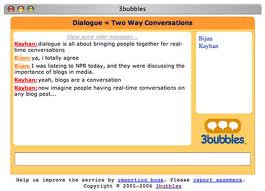
I spent a little time on the 3Bubbles beta chat tonight over at the 3Bubbles Blog. Lots of folks over there, including Scoble and Dave Winer. As I said earlier, I like the technology.

3bubbles

There are some 1400 people trying to get a beta invite, so I’m not going to even try, but having developed some chat rooms on ACCBoards.Com and other very popular sites, and having seen the inevitable disruptive kiddie crew run rampant in the chat tonight, here are 5 things 3Bubbles needs to do to make its application work. Some of this may already be included.

1) Allow the option to require registrations. Drew told me tonight that there will be an image and email verification. They should also make it an option to hold all registrations in a queue until approved by the webmaster. The disrupters will try to reregister with another email address and this will help control that.

2) Create an easy way to ban users, by user name, by email and by IP address. I can guarantee you that if the IP address ban isn’t included, everyone will be sorry. It’s a must have.

3) Allow an option to prohibit registrations from a user defined list of email domains. For years, we prohibited registrations at ACCBoards.Com via the free online email providers. That sounds harsh, but believe me, it was necessary.

4) Allow webmasters to create a list of prohibited words that will show up only as ****** in the chat. This cuts down on link spam and inappropriate language.

5) Allow the webmasters to create moderators with the ability to ban users, but not the ability to change the application settings, etc.

Based on my experience tonight, I think this is a very good application. Not for a one chatroom for every post sort of thing, but for a one chatroom for every blog sort of thing.

But I can tell you from vast experience that the single biggest challenge will be to keep the disrupters at bay. There simply must be a lot of easy to implement tools to keep them out of the chats. Otherwise the good chat content will get lost in the noise, and when that happens, the real chatters get rightly frustrated and move on.

More on 3Bubbles later.

Tags: ,

3Bubbles Beta

3Bubbles, the chat program for blogs that I and other have been talking about recently, has a live chatroom at the 3Bubbles Blog.

I’m over there hanging out with Mike right now. I suspect I’ll get booted once they notice I’m in there.

For some strange reason, my trackball went all goofy when I entered the chat room, but that may be unrelated.

The chat application seems stable and fast. There are about 30 people in the chat at the moment and everything seems smooth. As I said before, I am impressed with the technology, even if I don’t see a business model.

Tags: ,

Question of the Day

Why, when people are spending all kinds of money buying TIVOs and satellite radio purely to avoid ads, is so much of the newish tech-related business we read about based primarily on ad revenue?

I believe that it’s a proven fact that most people who have the know-how and hardware to receive these Web 2.0-related products will go out of their way and come out of their pockets to avoid ads. In fact, I believe most people hate ads and will go to great lengths to avoid them.

Now comes word that some publishing company is going to hawk ad-supported eBooks. Well, actually just one (eBook, that is), according to the article. But if anyone decides this folly just might work, it will go from experiment to movement in the click of a mouse.

Let me say it again: in the medium and long term, relying primarily on ad revenue is simply not a good business plan. Nobody wants to see them and nobody is going to click on them. Even if this nutty business gets legs, the advertisers who are paying with cash and not in kind will quickly realize that the system is flawed.

Another dancer in the conga line of bad ideas.

Technorati Tags: