Why Do a Bunch of Of Other People Have My Same Gmail Address?

Being the  Google Apps loving, Google+ excluded, long-time domain owning cat that I am, I don’t use them much anymore, but I own several regular Gmail email addresses.  I get occasional email at these addresses, mostly from websites where I didn’t want to give my real email address, so I have configured my Google Apps Gmail account to check them regularly.  Emails to those accounts show up in a designated folder in my regular Gmail app.
gmail

A year or so ago, I started getting emails that weren’t intended for me, addressed to one of those old email addresses: knewsome at gmail.  Over time, the amount of email increased.  Now I get several a week.  Most of the time I just delete them, or unsubscribe, if that is an option.  Once I got what appeared to be an important email from a wife to her husband, so I emailed her from another email address and told her that I wasn’t her husband.  I got another one from her the other day.  She wanted him to call her at work, before 6:15.

At this point, I’ve unsubscribed, deleted and, in that one case, emailed, about as much as I can, to no avail.  The emails keep coming.

I can’t get Tim Westergren to give me a straight answer on the Pandora hobbling 6-skips an hour limitation, but I got this today, welcoming some other Knewsome to Pandora:

Thanks so much for joining Pandora! We’re very happy to have you on board, and we look forward to providing you with endless hours of great music listening and discovery.  The Music Genome Project has been a 10-year labor of love, and we hope you’ll enjoy the results.

Yesterday, Google wrote me, not to tell me I can finally use Google+, but to tell someone named Kenneth that his newest Gmail email address, signed up for via the Knewsome account, is ready:

Congratulations on creating your brand new Gmail address,
knewsome1968@gmail.com.  Please keep this email for your records, as it contains an important verification code that you may need should you ever encounter problems or forget your password.

There’s more.  Meredith, Holly and Margaret invited me to the AHHS Class of 2001 10 Year Reunion in Forth Worth, Texas.   Hope it was fun.  I graduated from High School before they were born.

I got an email about a Scholastic Book Order from a third grade teacher in Florida.  Hope those girls got their books.

Someone named Kindal was about to waste his/her money on some software program.  The salesman’s email was so over the top, I couldn’t even tell what he was selling.

Clearly, these are not all the same person, and at least some of them are not spammers or scammers.  It looks like a whole bunch of people are using the knewsome at gmail address like some sort of shared phone line.  I don’t use that address, so I don’t care all that much.

But it is troubling.  And apparently not an isolated event.  These folks are complaining to Google.  As are these.

Has anyone else experienced this sort of thing with their Gmail accounts?

Jukebox, Spotified

Spotify Jukebox

A long time ago in a galaxy far away, music bloggers used to open up their music library, hit random, and list the first 10 or so songs that played.  It was stone age music sharing, only without the ability to, you know, actually hear the music.

I did a bunch of those posts.  Here’s one I did on October 22, 2005.  It was like writing quarter notes on the cave walls of my blog.

It just got a whole lot better.

As anyone who reads my blog, talks to me for more than a minute or wanders into my office knows, I am deeply in love with Spotify.  One of the many reasons why, is because Spotify finally gets music right- and legal- in the social arena.  It’s like a better, faster, legal Napster.

So…

I went back to that old post, and made a Spotify playlist.  Of the 10 songs that randomly played that day, 8 of them are available on Spotify.  And remember, I have a huge and very, very diverse song library.  If Spotify has – or can soon get – anywhere close to 80% of my song library, that will be pretty impressive.

Here’s that playlist, from 2005.  If you have Spotify, the app will open the playlist. (NOTE: when I change the Jukebox playlist, the songs below will change to the current list)

The only songs I couldn’t find on Spotify are What You Want, by The Mertons, and Girl About a Song, by Jonathan Gregg.

I’m going to start making new Jukebox playlists, and sharing them via Spotify.  So get ready for good music.  Oh, and go sign up for Spotify.

Modern Ruins: Splash Downer

As long-time readers know, I am intrigued by modern ruins.

splash

Today, I came across an excellent video by Mike Eisenberg, chronicling the wasteland that used to be the Splash Down Dunes water park in Porter, Indiana.

Watered Down from mike eisenberg on Vimeo.

If you want to see a video of the park in happier times, here you go.

If you know of any good modern ruins video or photo collections, let me know in the comments.

Spotify Wins the Race to My Desktop (and Heart)

Everybody and their dog is talking about Spotify today, which is understandable since it, finally, finally launched in the United States this morning.  I’ll keep this (sort of) short.

image

I have been holding a secret sweepstakes in my head about which much ballyhooed app would find its way to my desktop first.  Google+, which is the talk of the internets, and still, amazingly,  unavailable to Google Apps users, or Spotify, the Holy Grail of music apps.  Spotify won.

I’ve been using Spotify for a few months, and can say unequivocally that it is the best music app I have ever used.  By far.  Now that it’s officially available and I don’t have to worry about some record-label madness derailing my joy, here’s what I know.

One, Spotify is going to completely change the music game, for the better.  I simply cannot believe there is a true music fan that won’t find $5 or $10 a month a screaming bargain for what Spotify offers.  Spotify has already replaced Windows Media Player and the bloated train wreck  that is iTunes as my default music player.

Two, I have cancelled my Slacker Radio account, and may very well cancel my Pandora account.  The 6-skip an hour limitation on Pandora (even the paid accounts) is simply a deal-stopper for me.  The only thing that could ensure that I keep Pandora will be if it gets to my car quickly and cheaply.  I want to dump Sirius XM (and the annoyance that is Mojo Nixon) much more than I want to dump Pandora, so the dashboard is open for Pandora to secure its place in my paid apps lineup.

Three, unlike 99% of the apps out there, Spotify does social right.  The sharing features really add something to the experience.  As soon as I add some alt. country, country rock, classic rock and blues loving friends to my Spotify circle, music discovery will be a significant, and fun, part of the experience.

image

Four, while there are tons and tons of songs in Spotify’s library, there are some holes around the edges.  Particularly as it relates to less mainstream and older music.  One of the first things I did was to try to add all the alt. country songs I thumbed up via Pandora to a Spotify playlist.  I was a little surprised at how many weren’t available.  I hope the library grows like I know the user base will.

Five, as amazing as this may sound, I have not added my huge local music library to Spotify.  I have 26,000 or so (legal, non-shared) songs on my music server.  The thing is, there are probably 15,000 or so of them that I never want to hear again.  I’m afraid things would get too cluttered if I tossed my entire library into my Spotify window.  Rather, I am going to use local files to fill in some of the gaps, and use Spotify’s library as my main one.  This may change, but that’s the current plan.

I’m really stoked about Spotify.  Now, if Google will stop screwing over Google Apps users, my desktop (and heart) will be full of joy.

Dropbox vs Windows Live Mesh: I Can Answer That Question

Paul Thurrott, one of my favorite tech bloggers, asks why someone would use Dropbox over… wait for it… Windows Live Mesh.

image

Let me try to stop laughing long enough to answer that question.

OK, I think I’m OK now.  Here goes.

One, Microsoft does a horrible job of marketing its apps.  It may have the greatest set of apps on earth, but it can’t even figure out what to call them, much less how to effectively communicate to people what they do and why they are awesome.  Seriously, I am a long time Microsoft user and TechNet subscriber, and I don’t even know what Live Mesh (what a stupid, stupid name) is.  I think it’s the (God knows how many times) renamed FolderShare app that Microsoft bought back in 2005.  I actually used FolderShare before it became a casualty to Microsoft’s (lack of a) marketing plan.

Two, Microsoft’s non-core apps tend to be very kludgy.  Dropbox may only be a folder on my computer, but it’s a folder that I can access with a click of an icon, and easily drag items into.  Sharing is as easy as a right click.  As far as I know, there is no way to mount Sky Drive as a folder on my computer, in the absence of Gladinet or some third party work-around.  Even when Microsoft adds features that compare favorably with other offerings, like the ability to sync multiple folders and more space, it generally trips over itself in some way- like the fact that you can’t access Sky Drive via Live Mesh.  Or the fact that you need two separate apps in the first place.  Between the ever-changing (and ridiculous) names and the (real or perceived) learning curve, many people will choose the ease of Dropbox.

Which is sort of too bad, because the battle for the cloud is wide open.

I agree with Ed Bott that the latest Dropbox security breach is a big deal.  I’m a believer in the cloud, but every day I see more and more evidence that the cloud is still being formed, and no one has adequate security in place.  I also agree that scale matters in the cloud.  I would trust Amazon or Microsoft to keep my data safer than Dropbox.  But I’m not willing to spend hours trying to figure out how to mesh (pun intended) Microsoft’s products into a workable solution.  And if I feel that way as a tech blogger and geek, how do you think the typical internet user feels?

The fact is that you install Dropbox and you’re done.  To replicate that with Microsoft either is or seems like (it really doesn’t matter which) the equivalent of a 1000 piece jigsaw puzzle.  It might be beautiful, but few people have the time and patience to tackle it.

I have no doubt that for someone like Ed or Paul, who are very learned in tech in general and Microsoft in particular, the Windows mesh/mess of apps, when placed in the right order, is a fine, and maybe even preferable, solution.

Meanwhile, the rest of us go on living our lives, using Dropbox and hoping that Dropbox gets its security ducks in a row, so we don’t have to go try to figure out what Microsoft’s apps are called that day, and how they work.

The Needless and Inexplicable Flounderization of Google Apps Users

Do you ever feel like there are so many cool and amazing things to do on the net, that you feel overwhelmed?  If so, I have a guaranteed solution for you.  Become a Google Apps user.

image

I ranted a few weeks ago about Google’s unwavering policy to deny Google Apps users the ability to use its newest features.  Lots of people reacted sympathetically and emotionally to that post, so I am clearly not the only Google Apps user who is unhappy about this.  In fact, I suspect that a lot of people are wondering why they elected to put themselves at a comparative disadvantage to the rest of the planet by going all-in with Google.

Now comes the (sort of) much anticipated Google+ Project.  It actually looks great.  One of the good things about being a 15-plus year tech blogger is that I know a lot of other technophiles (e.g., geeks).  It’s a rare thing when I don’t get an early invite to new applications.  I’d dearly love love to try Google+.

But I can’t.

image

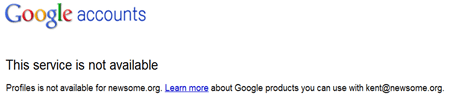
Because like just about everything else Google releases, Google+ requires a Google Profile.  Which Google Apps users still can’t have.

image

It gets even worse.

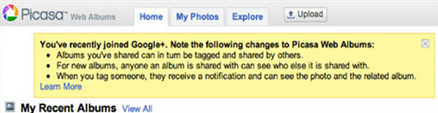
With the release of Google+, Google seems to be opening up more cloud space, in an attempt to attract more loyal Google users.  As Yahoo ignores Flickr to death, it is a good time to start thinking about alternatives.  Google has begun offering almost unlimited space to its loyal Picasa users.  Just not its most loyal users- Google Apps users need not apply.

image

When I asked Google why Google Apps users are getting hosed, they gave me an unsatisfactory but completely accurate answer.

This makes no sense.  At first, I thought it was just a matter of the left hand and the right hand operating separately, and at different speeds.  But if we still can’t even use Google Buzz a year and a half after it was “coming soon,” no one should be holding their breath.

It’s hard to come up with any good reason for Google to continuously leave Apps users out in the cold.

Which leaves only bad reasons.  Apathy?  Cluelessness?  Are they just being mean?  Do they hate us?

Someone will inexplicably try to mount a defense for Google by playing the “Apps are for Enterprise” card.  Fine, then make all the cool stuff an option, for the Google Apps Admins to select or not, as they see fit.  There is simply no way that taking choices away can be spun as good for the customer.  We’re not talking about skydiving here.  We’re talking about using web apps.  The same web apps that Google hopes will be the vanguard for its latest assault on the social web.

Come on, Google.  Stop screwing with your most loyal users.  The Flounderization of Google Apps users is bad business.

Do you love irony and social activism?  Then +1 this post so Google will see that Apps users are getting tired of standing in the back of the line.

In the Game of Clouds, You Win or You Die

image

That collective sigh of relief you heard today came from Amazon and Google, happy that they will live to fight another day in the war for the cloud.

When Steve Jobs, the formidable Warden of the West, took the stage at WWDC today, much of the world expected him to land a killing blow to the aspirations of Amazon Cloud Drive and Google Music.  It didn’t happen.  While interesting, the much anticipated iCloud is not going to march through cyberspace like a host of digital Lannisters and ascend to the aluminum throne.

Not by a long shot.  In fact, Instapaper and Dropbox probably suffered more casualties today than any of the others who aspire to rule the cloud.

First of all, iCloud is not a streaming music service, in the way we have come to expect.  It’s more like a semi-automated Dropbox that syncs your music between up to 10 devices.  That’s great, but it is not a game changer.

Second, it doesn’t, at least as far as I can tell, create a remote backup of your music files in the cloud.  That would be pretty hard to do with only 5 GB of space.  Maybe you get to almost the same place if you can bulk download your songs, but even that would be Ned Stark to the neither rational nor reliable music industry, and the term and terms of its license agreements with Apple.  Stated another way, if I have to choose between the mild hassle of a one time upload of my music library (and the resulting certainty that I have accessible files that I own)  and $25 a year for the rest of my life (with only the right to access the songs based on the terms of the iTunes Match agreements), I’ll probably gut it up and upload, so I can keep the money, and the files.

At first blush, I think the music labels may have been clever like a fox in agreeing to this deal.  It must be refreshing for them to focus on something other than trying to find the digital cat to stuff back into the obsolete bag.  In that regard, I’d be shocked if part of the discussions that led up to Apple’s license with- and payment of big bucks to- the music labels wasn’t some express or implied assurances that the music label cartel will march against the digital lockers of Amazon and Google.

Third, how many people want all of their music converted to AAC format?  I have MP3s and don’t know that I want to move to another format just to avoid some uploading time.  A better bitrate is nice, but not enough for me to completely change formats.  Accordingly, anyone wanting to preserve their non-iTunes music in its current state would have to manage and backup two separate sets of music.  Their existing MP3s and the converted AAC files.  That is not the sort of cloud convergence I was hoping for.

Fourth, iTunes.  Frickin’ iTunes.  Even with all the automation promised by iCloud.  Even with the ability to sync wirelessly.  We still have to live with that blight and bloat called iTunes.  If Apple wants to change the world, it should start with iTunes.  Never before has a program so badly needed a do-over.  It needs to be completely rewritten.  It does not need to be the vanguard of Apple’s host- in the cloud or on the digital battlefield.

And finally, time.  Amazon Cloud Player (to all) and Google Music (to some) are available right now.  Presumably, Spotify is going to finally and officially launch in the United States at some point.  Meanwhile, iCloud is coming “in the fall.”  The fall, in online time, means a long time from now.  You can be assured that Amazon and Google know that winter is coming, and are hard at work trying to expand their lead.  It will be very interesting to see how much those services improve between now and the arrival of iCloud.

At the end of the day, consumers are caught between three armies, each with its own advantages and disadvantages.

Amazon has integration with Amazon’s MP3 store.  That alone will carry it a long way on the path to fealty.  But Amazon’s web player is a little kludgy (though less so than iTunes).  On the downside, there is little chance that an Amazon Cloud Player app will find its way onto the App Store.

Google has the most elegant interface.  It is the one I use the most, with Spotify looming as a contender, if it every officially launches in the United States (I still think Spotify is pretty cool, but I don’t know if I’ll live long enough to officially use it).  But there is no embedded music store, and the process of getting your music into Google’s cloud is not as simple as I’d like.

image

Apple has iOS and the hardware that runs it, and, more importantly,  the keys to the App Store, which is almost dragon-like on the battlefield.  I have an iPhone and an iPad, and whatever apps I use are going to have to work on those devices.  And, of course, Apple has the Warden of the West, who can sell ice to Eskimos purely on personality.  But, again, the feature set of iCloud is pretty underwhelming.  And the entire infrastructure is tainted by the mere existence of iTunes.

Generally speaking, competition is good for consumers.  That’s probably the case here.  However, I can’t help but feel a little disappointed that there will not be, at least any time soon, a one stop cloud for all of my digital content.  I was expecting to be blown away today.  Instead, it looks like cloud music will require a combination of services, and maybe some work-arounds.  Much the way Google Voice requires some work-arounds to dial out.  It works, but not as well as you want it to.

So here we sit, Ned Stark like, in the dark, waiting for someone to free us from our digital dungeons.  Wondering what’s going on out on the battlefield and worrying that whatever happens probably won’t be what we planned.

Here’s hoping Amazon and Google unite their banners and lay siege to the scourge that is iTunes.  It probably won’t happen, but it would make things interesting if it did.

GoodSongs: Sylvie Vartan

image

I stayed up way too late last night listening to Sylvie Vartan.  She exudes a level of coolness that most American pop stars of the era (early to mid-60s) could only hope for.

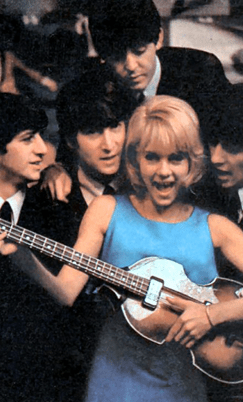
How popular was Sylvie in the mid-60s?  In 1964 at the Paris Olympia, she appeared as the main attraction on the same bill as the Beatles.

image

Pretty awesome.  Pretty.  Awesome.