Web 2.0 Wars: Round 2

It’s time for Round 2 in Newsome.Org’s Web 2.0 Wars. The contestants and rules are here.

This is the final heat of the first Round. The playoffs will be next.

Other Rounds:
1 | 2 | 3 | 4 | 5 | 6 | 7 | 8 | 9 | 10 |
11 | 12 | 13 | 14 | 15 | 16 | 17 | 18 | 19 | 20

Here are the contestants for Round 2:

Scobee
Shadows
Gravee
YouTube
Zimbra
Furl
Smugmug
Newsgator

Scobee is an event planning service. I already reported on it here. My conclusion then: “too early to tell, but I’m not blown away by the concept.”

Shadows is a social bookmarking service. It looks like it’s shooting for a combination of Technorati and Delicious. I couldn’t find too many results for my test tag “memeorandum” without creating an account and logging in. There may have been more results had I logged in.

Gravee needs to change its logo because it looks like Grovee. It’s a community powered search engine that somehow shares revenue with sites that appear in its search results. It’s a pretty crowded field with some formidable competition and I can’t imagine the revenue share would be all that significant, but the search engine was fast and reliable based on my test tag and my test blog (Newsome.Org, of course).

YouTube is a video hosting, sharing and search service. It’s free and seems fast and reliable.

Zimbra is an open source collaboration tool. I don’t really understand the description, which means that a lot of other people don’t either. There simply must be a better way to describe itself than this: “Zimbra focuses on solving the cost and complexity for enterprises that run large email/collaboration systems. We accomplish this by combining industry-proven open source components with our experience in designing and operating large-scale messaging and mission-critical software systems….”. I learned the hard way in the last dot.com bust to avoid companies who can’t explain in simple terms what they do.

Furl is a information bookmarking and information clipping service that lets you store information you find on the web for easy access. It looks similar to Onfolio, but the information is saved online. I have an automated bookmark for it on my posts here, but I haven’t used it very much. It looks pretty cool, though.

Smugmug is a photo storage and sharing site, similar to Flickr. It lets you create a store to sell prints of your photos. Lots of people use Smugmug and it has both market share and brand recognition.

Newsgator is an online RSS feed reader, similar to Bloglines. The basic service is free. The premium services will soon include a synchronized copy of FeedDemon, a popular desktop feed reader. It’s a competitive field, but Newsgator has some market share and brand recognition.

Before Today I’d Heard of:

6 out of 8

And the Winner of Round 2 is:

YouTube in a battle. Lots of good contestants in this round. Some of the others suffered from an unlucky draw.

Technorati Tags:
,

No Comments: Old School or Playing Hooky?

[T]his is a safe place. A place where we can feel free sharing our feelings. Think of my [blog] as a nest in a tree of trust and understanding. We can say anything here.

Old School

Mathew Ingram has a compelling post today about the value of and need for Comments and the conversations they engender. This conversation arises out of Russ Beattie’s decision to remove Comment functionality from his blog.

First about Russ’s decision. While I agree that he sounds defensive if not petulant in his response to the brouhaha over his election to discontinue Commenting on his blog, I can’t help but believe that part of all this is a circling of the wagons after the absurd cease and desist letter he got with respect the that SMS.ac post. If I got attacked like that for merely stating my opinion, I’d probably circle the wagons a little bit too. That’s not being a jerk; it’s human nature. Maybe he made the decision about Comments before he got that letter- I don’t know. But, again, if I were in his shoes I might very well do the same thing, at least for a while.

Now about Commenting in general. I think it’s a huge mistake to remove Comment functionality from a blog. And while I think Russ is reacting too strongly to the rational parts of the debate about Comments, even Comments on his blog (we should all ignore the fringe cases who just want to scream), I don’t think he’s wrecking the blogosphere or trying to offend anyone.

Mathew mentions Dave Winer, who for whatever reason doesn’t allow comments on one of his blogs. I don’t know Dave, but he seems like an alright guy- I like people who speak their minds and don’t mind challenging something I or others want or believe. I don’t know why he doesn’t allow Comments, but I suppose if your Wikipedia entry reads like this, you don’t have to allow people to Comment on your blog. I would ask him about his Commenting policy in a Comment, except, well, you get the picture.

My bottom line on this is that I agree with Mathew about the value of Comments and the conversations they promote. But I recognize that others may or may not share my criteria for a good blog. If someone, be they Russ or Dave or anyone else, doesn’t want to read what I think about something, no worries. I’m sure I can find someone who wants to talk to me.

All those people who want to comment at Russ’s or Dave’s blog are free to comment away here and over at Mathew’s blog.

P.S. Mathew also has a very nice implementation of his coComment feed on the right side of his page. That looks really good.

Technorati Tags:
, ,

Steve Newson on Pandora

Steve Newson posted about his love for Pandora recently, setting forth why he likes it better than Last.fm.

I found two things interesting about his post.

First, he gets to the central difference between the two applications. Last.fm is based on what people who listen to the same artists you listen to like. It’s a social recommendation thing. There’s nothing wrong with that- it just is what it is. Pandora, on the other hand, actually plays songs with the same musical structure as songs you have indicated you like.

It reminds me of a running debate I have with another songwriter I know. I believe very deeply that someone with a nice voice could sing any lyrics at all, even nonsense, and if the melody, arrangement and playing are great, the song will be generally considered a good song. I know that when I hear a song on the radio that grabs me, 95% of the time it’s because of the melody and arrangement and the playing- not because of the lyrics. My friend thinks that’s hogwash and that a song needs strong, well crafted lyrics to be good.

He’s a Last.fm guy and I’m a Pandora guy.

Second, Steve mentions Howie Day. Here’s a small world moment: a good friend of mine (who grew up in Maine) is a friend of his. I heard about Howie long before he became popular. I still haven’t heard much of his music, but I’ve heard a lot about him from my friend.

I enjoy both Last.fm and Pandora. I just find that the new music I hear on Pandora is consistently closer to what I like than the new songs I hear anywhere else.

More RSS Feed Problems

A bunch of my older posts and the newest one just showed up in Bloglines as partial feeds.

As I mentioned the other day, I have my accounts configured for full feeds. I am trying to figure out why this happens occasionally. But rest assured, I am a firm believer in full feeds.

‘Tis But a Firewall

google

Google, taking a break from trying to build some more internets, has announced that it will combine its instant messaging service with Gmail, its web based email service. No word yet whether there would be one joint service for all internets or a separate service for each of the internets (can you tell I am irritated by the prospect of Google’s new internets?).

Anyhow, the idea seems to be that you’ll be able to chat directly from your Gmail account, without having to log into a separate chat program. Google figures that saving those 5 seconds will cause a cyber-stampede of users to drop their AIM and Yahoo IM accounts and thunder on over to Google. Somebody needs to tell Google that most companies not owned by Google block chat and web based email programs so their employees will actually do some work.

The good (by good I mean only mildly ludicrous) news is that the chat application will be able to communicate with other chat programs, including Earthlink’s chat program. It will be handy to be able to chat with the nine people who use it. Still no interconnectivity with AOL, Yahoo or MSN for all the reasons I talked about back in August.

I’m starting to think that Google took all that money it should have used to buy Flickr, Delicious and Technorati and bought some lost episodes of Monty Python’s Flying Circus.

Hawkzilla vs The Sock Puppet

Let me begin by saying that I don’t know if this allegation is true or not. I don’t play computer games anymore- not because I wouldn’t love to, but (a) I don’t have time and (b) if I want to keep my kids from discovering what an X-Box is, Daddy can’t sit around playing Civ IV all day.

But I do know a lot about message boards, having founded and developed some very popular ones. And, unfortunately, I know about the sock puppet problem. A sock puppet is a separate account (or many separate accounts) that a user creates to support a message or position he or she wants to promote on a message board. We had that problem the day ACCBoards.Com went live, and we still have it today. The first cousin of the sock puppet is the shill poster- someone who has an undisclosed relationship with the original poster and whose primary purpose on the message boards is to further the agenda of the original poster.

The most common reason someone creates a sock puppet is to avoid or delay getting banned from a message board. If someone posts objectionable material at ACCBoards.Com they get banned. It they have another account or accounts in their pocket, they can continue the disruptive behavior using the other account.

You also see this on some of the penny stock message boards, typically by short sellers who want to trash a stock they have shorted. Another good reason never to read stock message boards. I learned that lesson the hard way back when I was otherwise doing very well in the market. My story about avoiding stock boards made the cover of Money Magazine, but I digress.

The other reason for a sock puppet is to try to take a short cut to credibility or respect. If every time someone posts something, 5-10 sock puppets (controlled by the original poster) post messages agreeing with whatever was said, it gives the temporary and false impression that the original poster knows what he or she is talking about. I say temporary because in my vast experience in this area, sock puppets are always discovered and the puppeteer subjected to harsh criticism and ejection from the message boards.

A sock puppet is the message board equivalent of setting up a bunch of other blogs and linking like crazy to your own posts. I’m sure it happens. I’m also sure it would be apparent to anyone who looked closely.

sockpuppetAnyhow, The Consumerist has posted an article indicating that computer graphics card manufacturer Nvidia may have hired people to post on gaming message boards in a manner favorable to Nvidia graphics cards.

According to a follow-up post at The Consumerist, the Public Relations Director of Nvidia responded to the original article with an email (I presume it was an email, the follow-up doesn’t say how the response was delivered) that does little to dispel the allegation. The quoted response says, in part:

AEG [the company alleged to have hired the sock puppets] helps us to manage the online community – we engage with some NV fans to help educate people on the web.

They are NOT hired actors!

They are NOT “shils”!

I know I’m from the country but “manage the online community” sounds like one of those pre-owned cars words. It sounds good, but doesn’t tell us much. Again, I don’t know if Nvidia hired sock puppets or not. It may not have. My point is about the need for message board integrity- not about what Nvidia may or may not have done.

And even if a mistake was made, as Thomas Hawk points out, we’ve all made them. The important thing is to admit them, apologize and learn from your mistakes. Sony learned something about that lately.

But I will say this. If a company did hire people to go to message boards and acquire multiple accounts for the purpose of gaining an audience and then posting favorable comments about its product, that would concern me greatly as a member of that message board community and as a consumer.

There’s more at stake here than what video card someone buys. It’s the expectation on the part of message board users that the people they are interacting with there are who they claim to be. Not someone paid to be there for some other purpose.

Paid representatives are fine- they provide a presence, promote good public relations and give quick, if unofficial, technical support to users. But such people need to disclose that relationship, in their signature or at least in their profiles.

It’s all about disclosure.

What a difference a signature (the end of a post message board kind) makes.

Thomas Hawk has posted updates to his original post linked above. It seems he has emailed with and spoken to the same Nvidia representative. I can’t tell exactly what the actual relationship is between Nvidia and the people, if any, who are paid to post on message boards, but Thomas seems to be asking the right questions.

Newsome.Org’s Web 2.0 Wars

93136022_25afa7e458-721640

A larger version can be viewed at Flickr.

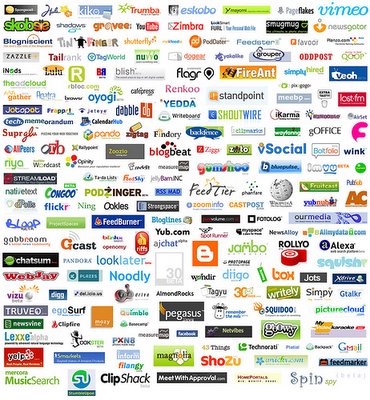
This aggregation of Web 2.0 logos has been floating around the internet today. I decided to count how many of these companies I have heard of (a low standard, since it doesn’t require that I know anything substantive about them) and how many I haven’t.

By my rough count, I have never heard of over half these companies, and I follow and write about this stuff. So either I’m in store for some treats as I learn about these companies (my wish) or there are too many companies chasing too little demand (my hunch).

Introducing the Newsome.Org Web 2.0 Wars

I like a good contest, so I am going to create my own little face off. Here’s how it’s going to work. I have divided the companies into groups based on the line on which their logo appears above. I will take a look at the web site of each company and then pick the one I think has the best prospects. There will be one winner for each group (no ties). After that, we’ll move to the semi-finals and then crown a champion.

Yes, I use some of these services now, and that may give those companies an advantage. But I will try to minimize that influence and I will mention it when I already use a service.

Without further adieu, here are the contestants for Round 1:

Spongecell
Hula
Kiko
Trumba
Eskobo
Mayomi
Pageflakes
Vimeo

Spongecell is a web based calendar. You can text message to add events, and it recognizes “Dinner with Om at 8:00 to discuss why he hasn’t linked to Newsome.Org in 513 days” as an event and adds it to your calendar. Sounds interesting, but it’s in a bit of a crowded space.

Hula is also a web based calendar. Novell has something to do with it. It is open source.

Kiko is also a web based calendar. Drag and drop functionality, but the demo (still in beta) has a less than appealing interface.

Trumba is, you guessed it, a web based calendar. You can get a free trial, but it costs $40 per year to use. PC Magazine likes it- says it would be a good choice for families and groups. It better be really good if they want people to pay for it (that may be sad, but it’s the reality of the Web 2.0 customer mindset).

Eskobo is not a calendar. It’s a content aggregator similar to Netvibes. It appears to be in early beta, as the “About” page is blank.

Mayomi is a “mind mapping tool.” I’m not really sure what that means, but it sounds like project or goal charts with a database sharing element.

Pageflakes is a content aggregator, like Eskobo and Netvibes. It looks very similar to Netvibes (I don’t know which came first). It seems further along than Eskobo.

Vimeo is a video sharing and search service. I can’t tell if they host video content (like Castpost) or not. There is very little information available on the front page.

Before Today I’d Heard of:

0 out of 8

And the Winner of Round 1 is:

Pageflakes in a squeaker over Trumba. I imagine Trumba is pretty cool, but there’s that money thing. None of them blew me away.

Technorati Tags:
,

Why Isn't There a Texas Version of Gillmor Gang?

I just listened to the latest Gillmor Gang podcast. Gabe Rivera of Memeorandum was a guest. Mike Arrington seems to have joined the gang. Doc Searls, Dan Farber and Steve Gillmor were also in attendance.

Lots of great conversation both with Gabe about Memeorandum and about blogs and meme trackers in general. I really enjoyed listening to this podcast.

Why isn’t there a local, Texas based, group podcast with a similar tech-wide approach? I like reading these guys’ blogs, but the interaction on the podcast was so interesting.

Or is there a local group podcast like this that I don’t know about?

Dwight Silverman, James Kendrick (who does a great mobile tech podcast already), other Texas based tech bloggers: why aren’t we doing something like this?

I realize that Gillmor Gang is a hugely popular podcast of national interest, but it seems to me that something like this would be of interest to local readers and listeners.

Tags:

My Football Evolution

It’s Superbowl Sunday. Pre around 1980 I would be really fired up about that and anxiously waiting for the game. We’ve got the pool heated and the new play yard ready for our Superbowl party- 4-5 families and lots and lots of kids. I love get togethers like this and can’t wait for everyone to get here.

But I don’t care a whit about the game. I’ve been thinking about how little I care about NFL football and trying to map out how I got from huge fan to not even remotely a fan.

I still watch a lot of sports, but almost all of it is college sports. I still like major league baseball a little- the Astros’ trip to the World Series is a “pinch myself” moment for me. I haven’t watched one consecutive minute of the NBA in years- I don’t really consider it basketball. It’s more like entertainment for the X-Box generation.

But football. Where did I lose my love of pro football?

I remember as a kid pulling for my favorite teams. First, the Colts with Johnny lamonica-750166Unitas. Then briefly the Dolphins, and ultimately the Raiders. From Daryl Lamonica to Kenny Stabler, the Raiders were my team.

But somewhere along the way our country’s obsession with money infected pro sports. Golf used to be measured by average score or maybe tournaments won. Now it’s measured (in the paper and on the course) by how much money you’ve won. Similarly, the NBA has lost generations of fans by becoming a league of tattooed, jewelry wearing mercenaries. As I have said here before, I know very few, if any, people who go to NBA games on their own nickel.

While I used to love watching Magic Johnson, Kareem Abdul-Jabbar, Larry Bird, Doctor J, Hakeem Olajuwon and Charles Barkley play, sitting here today I can’t match 10 NBA players with their teams. Why? Because I find the product the NBA is selling to be utterly uninteresting.

tigger_football-700164The NFL has done a better job than the NBA at keeping at least some of the focus on the sport as opposed to the money and the lifestyle. But the almighty dollar and the bling bling lifestyle have affected the NFL as well. Players like TO have done more to turn me off of the sport than the Kenny Stablers, Walter Paytons and Earl Campbells did to make me love it. When I see some guy start to dance like Tigger after making a tackle or getting a first down, I switch channels. I don’t hate them for acting like idiots. I just find it boring.

I remember one year, around 1980, when I had to choose between going skiing or watching the superbowl (the Raiders were playing, but I had abandoned them as my favorite team after Stabler left). I went skiiing. Had a lot of fun and never looked back.

And before someone reminds me in a Comment, going to school at the football powerhouses of Wake Forest and Vanderbilt probably didn’t help my football fan development either.

But at least college football is still a little about the sport. They keep the Ikky Shuffle problems somewhat under control.

It’s still sports, mostly. The NFL just isn’t sports to me anymore.

But the commercials are good and The Stones are playing at halftime. And the pool is heated. And some other folks, most of whom care little about the game, are coming over.

Life is good.

coComment: Comment Tracking

One of the hot topics on the internet the last couple of days has been the private beta launch of coComment. coComment allows you to track comments you make on other blogs and display them via a customized page at coComment, a side bar component (like I do with Most Recent Inbound Links on the right side of the main Newsome.Org page) and/or via an RSS feed. The service is free and it looks very promising.

Solution Watch has a very good summary of how it works.

Here’s what I have been doing to track my comments and my initial impressions of coComment.

My Old Plan

Previously I have been bookmarking my comments on other blogs via Delicious with a “mycomments” tag. Here is that page on Delicious. Then I use RSS-to-Javascript to create a java script that I display on my Comments Elsewhere page (Update: no longer in operation). I didn’t think this up. I read about it on A Consuming Experience or Fresh Blog or somewhere similar.

It works pretty well, though occasionally RSS-to-Javascript is slow or down. But it has been a pretty reliable system so far.

My New Plan

Now I am going to start doing my comment tracking and serving via coComment. There’s not much I can add in the way of an introduction to the service that isn’t covered by the Solution Watch post, but here are my initial impressions. I’m not going to talk about bugs and whatnot, since that is the whole purpose of beta testing and I’ll post those reports in the coComment beta forum. But here are my initial thoughts on the service.

The bookmarklet that you use to integrate your comments into the coComments feed is simple to install (at least in Firefox) and very unobtrusive. It only requires a single click before posting a comment to another blog and a little icon appears in the comment box to indicate that you’re good to go. All in all, the commenting process is the same as it was before, with only a single additional click required. This should solve one of the concerns Mike Arrington had yesterday about using a third party service for commenting. It’s much more like Delicious in this regard than it is a third party central commenting platform (which is a good thing).

So the comment tracking seems to be very well implemented and easy to set up and use.

The side bar comments serving is also an improvement over my current approach. I have not added that content to the main Newsome.Org page yet, but I have been testing it on a separate page. I don’t know if I’ll add it to the main page or not, but at a minimum I’ll reconfigure my My Comments Elsewhere page to use coComment.

The most promising feature is the RSS feed of your comments. I am still playing around with this feature and will talk about it more in my next coComment article.

Current Conclusions

A very promising service. Wonder if they can figure out a way to do the same thing with inbound comments?