Let’s Not Forget the Other B Word

Heather Green has a timely article today wondering if we are in the middle of a great boom or heading towards another bust. It’s a great question, and one I have wondered about too as I see Gather getting crazy money and hear rumors of Digg getting bought for $30M.

Back in the nineties, I and many others, bought stock in companies that were going to change the world and make a ton of money in the process. Study the phrase “were going to” in that sentence. We ignored it at the time, but “were going to” is very different from “were.” Back then, nobody expected these companies to make money right away- we were in the middle of a tech revolution that was going to change the way things worked and create tons of revenue for every smart idea. Here’s a list of some companies that proved to us that a smart idea does not ensure profitability, or even survival: Exodus, 360Networks, JDS Uniphase, ICGE, Enron, VerticalNet, Wind River Systems, Portal Software- you get the picture.

The combination of too much money, the greater fool theory, a media frenzy over dot.coms and good old fashioned momentum chasing led millions of people into the tech fray. And millions of people got slaughtered when the gig was up. All because the investing world got too enamored with tech and stopped caring about investing fundamentals.

Are we in danger of the same thing today?

Hopefully not on anything approaching the same scale. But if enough of these startups with good ideas and bad balance sheets catch come of the crazy money out there looking for deals, we could start moving towards the cliff. There are two ways these good idea companies can hit a homerun: get bought by a Yahoo-equivalent (e.g., del.icio.us) or do an IPO and get bought by you and me. The Yahoos can take care of themselves. If we start hearing rumblings that some of these startups are going public, then I think we need to proceed with caution.

There’s something else I wonder about. If everyone is out there trying to hit that $30M homerun, will there be any money left over for a truly useful application or product that has reasonable prospects? In other words, is there money for a company that hits singles and doubles.

Our economy was built on singles and doubles, but these days it looks like everyone is swinging for the fences.

And that makes for bad baseball and bad investing.

FeedLounge: What Am I Missing?

feedloungeI’ve read some good reviews of FeedLounge, the premium (meaning you have to pay for it) RSS feed reader. So the other night I decided to give it a whirl.

I signed up, paid via Paypal (the official and convenient payment service for Web 2.0) and imported my feeds. To say I am underwhelmed would be an understatement.

First of all, the layout is nothing revolutionary. Granted, you can easily switch between 3 different views (3 pane vertical, 3 pane mixed and 2 pane), but there’s nothing particularly novel about the way content displays. You can tag RSS content, which would be great if I could think of a good reason why I would want to. Tagging is like Pink Floyd’s song Money– the first 10,000 times I heard it I thought it was cool. Now I’m sick of it, but it still gets played about every half hour.

But none of that is the real problem. The real problem is that FeedLounge seems slower than freeze dried molasses. By comparison, Bloglines seems like greased lightning. At times, FeedLounge seems to be about as responsive as Bloglines. At other times, it seems much slower. I might pay for a lot faster. The same or slower doesn’t seem all that pay-worthy.

Another problem is the updating formula. Bloglines FAQ says it checks for updated content every hour. I didn’t have my team of mathematicians with me so I couldn’t decipher the FeedLounge FAQ on this point, but it seems that FeedLounge checks for updates somewhere between every half hour (twice as good) to every 48 hours (48 times worse).

Someone please tell me what I’m missing.

What in the World is this Guy Talking About?

gibberishDennis Howlett is howling about how Tech Memeorandum is somehow hosing him and some other guys (literally if you buy his metaphor) by not somehow linking to enough stories “impacting business.” Then he proceeds to dump all over Scoble and Dave Winer over all sorts of perceived injustices.

He posts part of an email from Gabe Rivera, the creator of Memeorandum, that explains how Memeorandum’s algorithm selects what shows up on the page, and even says that Gabe manually added the allegedly excluded site to Memeorandum’s database. Yet somehow Memeorandum is not doing its job because their posts aren’t showing up.

I love Memeorandum. I read it daily. I’m no A-Lister, but my posts show up there regularly. It’s one of the very few places in the Blogosphere where new voices have a chance to be heard.

It’s not perfect. As I have mentioned before, sometimes my posts disappear there for days at a time only (so far at least) to reappear. I wrote Gabe about it a few weeks ago, and I got a similar response to the one posted by Dennis. Sure, I’d love to be assured that all of my applicable posts will show up on the Memeorandum page immediately, but that’s not how it was designed and that’s not the way it works. What we have is still way better than watching the pigs fly by our window while we wait for that link from Om or Mike.

Gabe was brilliant in several ways by leaving the selection process to the algorithm. First, it levels the playing field a little. You still need links, which a lot of the A-Listers won’t give- or at least won’t give to me. But that’s not Gabe’s fault. Additionally, it provides for a good answer when I, Dennis and others make inquiries.

Now about that business stuff. Right now there are 17 main stories on the Memeorandum page. All but 5 of them definitely concern businesses more than the consumer and the other 5 at have at least some relevance for business. Granted, Memeorandum’s not the online edition of the Wall Street Journal (ZZZZZ…), but that’s why so many people like it.

As everyone knows, I think the Blogosphere is somewhat of a closed society. But if we want to start pointing fingers about why that is, Memeorandum is not the place to start.

In Defense of My Yahoo

Brad Feld talks today about what he believes is the coming irrelevance of My Yahoo, and presumably other portals. We talked about this the other day when I provided my initial defense of portals.

Like me, Brad has used his customized My Yahoo page for many years, primarily to track stock prices and news for the public companies he follows. He has decided that his My Yahoo page has become less useful because he no longer checks stock prices several times a day and because he feels like he’s missing newsworthy stories by relying on My Yahoo’s relatively static content.

As I said the other day, I still find My Yahoo very useful.

myyahoo1-300x180

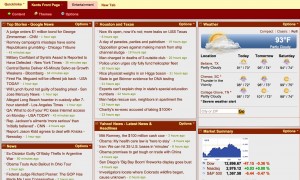
I don’t check my stock prices daily either, but I really like having my entire portfolio listed on the left side of My Yahoo page- right below the overall market charts and summaries. I use the headlines, business, sports and tech stories in the middle of the page as a newspaper substitute. And I like the weather and sports scores on the right side. I think you can get more information faster from My Yahoo than you can sifting through a bunch of RSS feeds (having a separate RSS feed for every stock I follow seems highly cumbersome to me). Plus, as Fred Wilson points out, you can easily add and intermix any crucial RSS feeds with the other news feeds on your My Yahoo page.

One thing I very much agree with Brad about is the overwhelming effect of trying to list the news stories for all of your stocks on your main My Yahoo page. It is absolutely overwhelming. I tried it briefly and then decided to move all of my stock news to a separate My Yahoo page- you can have several and navigation back and forth is easy via the drop down menu at the top right of the page. So now I have a second page called “Investing” where I display the stock news stories. That page is still a little overwhelming, so candidly I don’t use it that much. But the information is there when I want it and it keeps my main My Yahoo page uncluttered and more newspaper-like.

As an aside, I use Morningstar for my stock news tracking purposes. You can customize your email alert preferences to get one email per day with links to all news stories about the stocks in your portfolio. I find this to be the perfect solution.

So while I am a big user of RSS feeds, I don’t think they serve the same purpose as My Yahoo or any similar portal. RSS feeds aren’t a good substitute for the morning paper, whereas My Yahoo is. That’s why I’m still a big fan of My Yahoo.

Tags: ,

Only Their Hairdressers Know for Sure

First Yahoo was going to buy Digg. Now it’s not. Yahoo gave up on search. Wait, no they didn’t.

I feel like I’m at the playground with my kids and all of their friends when someone runs up to me every three minutes and shares a breaking story about who used potty talk and who isn’t sharing his or her toys.

When I speak of bloggers talking at and not to each other, this is what I’m talking about. Someone throws a topic out there and like a nineties dot.com stock everybody buys it immediately. Few people stop to wonder if it’s a good buy or not. Most just start reporting the news and/or telling us what they think about it.

And while I’m on the topic of nineties dot.com stocks, if Yahoo does pay $30M for Digg, I am going to sell all of my tech stocks because another dot.com bust is headed our way.

Cool is good. Digg is cool. Traffic is good. Digg has a lot of traffic. To warrant a $30M price tag, however, lots and lots of revenue needs to be in the pipeline, not on the drawing board. Digg has revenue, but I’d be very surprised if anything close to a $30M price tag isn’t some combination of betting on the come (which lost us all a ton of money back in the nineties) and the greater fool theory (which is the basis of far too much of our markets at this point).

When I see these sites, even great ones like Digg, get mentioned in the same breath as $30M, I wonder what, if anything, we learned from the last dot.com boom and the portfolio killing bust that naturally followed.

Tags: , ,

Is Web 2.0 Only for Geeks?

geek

I’ve been thinking and posting about all these new Web 2.0 applications a lot lately. There’s no doubt that there are some great applications our there, most of them free, that can greatly enhance, simplify and organize our lives.

But here’s what starting to bug me: does anyone other than us know about them? Is Web 2.0 about everyone, or just the geeks (like me) who follow technology closely?

I can’t even get my friends and family to use Flickr, so how am I going to get them to use any of these things?

After I posted my mini-review of the best of the Web 2.0 applications, I asked some of my non-geek friends if they saw the post. Many of them said yes. But when I asked what they thought, they almost universally said that they didn’t really understand what all those programs did, and that they didn’t have the time (they meant inclination, but were being gentle) to try to figure it out.

There’s an obvious and substantial payoff to learning how to use Flickr. Our jobs require us to use email and Word. But the payoff for a lot of these Web 2.0 applications is more subtle, more remote. If Flickr is on the wrong side of the effort line, where does that leave these other applications?

So I wonder if the rest of the population really cares about Web 2.0? Is it enough that the technorati follows the development of these applications and eagerly uses them? I bet even the technorati’s use of many of these applications tapers off over time. I love to try out these new applications, but maybe one in ten becomes a part of my core application list (Flickr, Del.icio.us and Technorati being the big three so far).

Maybe over time all this stuff will be second nature to all the moms, dads, students and teachers. But we aren’t there yet (by a long shot) and it seems to me it will take some time to get there.

What does this mean for Web 2.0?

Will it change the world or is it just a passing fad of the technorati?

Is There a Place for a Portal…

In this web 2.0 world?

Tom Morris (whose blog is one of the first things I read every morning) was talking earlier today about my mini-review of Web 2.0 applications. He made a good point about Netvibes and My Yahoo, saying there are really portals and not truly Web 2.0 applications.

Although I have only recently started talking about Web 2.0, having tried unsuccessfully to never use that phrase, I agree that Netvibes and My Yahoo are portals. And I agree that they are different from a lot of the other Web 2.0 applications we have been discussing.

Tom goes on to say, however, that he doesn’t understand why anyone would use Netvibes or My Yahoo. He prefers the greater scale and flexibility of an RSS reader.

While I get most of my information via RSS feeds, I still use two portals. I use The Home Place, my personal portal, and My Yahoo every day because they are better at aggregating the non-RSS stuff I want to see every day. My My Yahoo page has my stocks and mutual funds on one side, the weather and sports scores on the other and news headlines in the middle. Some of those headlines are old media- AP, Reuters, USA Today, etc. And some are new media- blogs and other converted RSS feeds.

The Home Place has links to web sites that I used to visit all the time (ESPN, some newspapers, etc.) and links to my websites for easy access. It has a Google search box (which is now largely unnecessary in light of the Google Toolbar) and some other search boxes.

I guess My Yahoo is my newspaper alternative and The Home Place is my bookmarks alternative. Clearly, my RSS feeds have rendered a lot of what’s on The Home Place unnecessary (for example, I now keep my blogroll at Bloglines). But my RSS feeds don’t really give me the same stuff my My Yahoo page does- at least not yet. Granted, I could set up RSS feeds for my stocks and for weather and for news, but I like the fact it’s all there on one handy screen.

So yes, they are portals, but I still need them. Or at least I think I do.

On a related Web 2.0 note, Virtual Karma has put together a complete list of Web 2.0 applications. It’s a great reference for what’s out there.

The Great Compromise: Ads for Free Content?

MobHappy asks the question– will people accept ads in exchange for free content.

In general, I think the answer is absolutely not. Here are the 3 reasons why not:

People want less ads and will go to great lengths to avoid them.

Just about every piece of media equipment I have is designed to avoid ads. TIVO, DVD Player; XM Radio; DirecTV satellite service; anonymous call blocker on my phone, caller ID on my cell phone; email spam filters; voice mail at the office. Almost everyone I know has a similar fortress protecting them from people who want to sell them something. Large companies are founded on the basis of protecting privacy, which for purposes of this conversation means…no ads.

There will always be too much other similar content available without ads.

Even if you have to pay for it, it will be deemed worth it. I can’t imagine what sort of content it would take to get me to agree to hear or see ads to get it. Just about everything I want to see or hear is available to somewhere without ads. I may have to pay a little more, but I am happy to pay for an ad-free life and so is almost everyone I know. After having XM Radio for a few years I literally cannot imagine listing to one second of ad-infested, over the air radio. I’d rather listen to nothing.

Even if we would accept ads, it would be the ineffective kind.

I don’t mind unobtrusive ads on web pages. But I have never, once clicked on an ad banner that wasn’t on a page I owned. Never, ever. Not one single time. And I bet there are a lot of others who could say the same thing. So if you want to put an AdSense ad or a banner on a web page, I don’t care. I won’t notice it and you’ll get very few clickthroughs. Add pop-ups or unders or, even worse, those irritating mouse traps and I’ll never return to your page.

The bottom line is that the cost to get permission from people to bombard them with ads would be more than any realistic revenue model could absorb. Pay for my gas for a year, and you can send me a few ads while I drive to and from work. Give me a top of the line Treo and service for a year and you can send me text message ads. Nothing that will fit in your pro-formas will be enough.

Advertising in its traditional sense is dying along with its original home- the printed newspaper. People don’t like ads and people don’t like other people dreaming up new ways to force advertising on them.

So if you really want to make some enemies, start tracking people via GPS and spamming their cell phones.

Mercurytide Presents a Web 2.0 Handbook

In one of the best and most useful posts I have read in a long time, Mercurytide has posted a white paper entitled A life online: living decentralised.

The Mercurytide paper is a virtual handbook for Web 2.0 software and services, providing a service by service summary of the most useful applications. The paper is a must read for anyone who uses or wants to use the internet to become more organized and efficient.

Here’s my brief take on the applications and services mentioned:

Netvibes is a service that allows you to make a custom, highly configurable internet home page. Not a blog, but an internet starting page where you can keep information, links, and data feeds that you use all the time. Sort of a turbo-powered My Yahoo page or a web-administered version of The Home Place, my internet portal.

I’ve used Netvibes a little, but it hasn’t displaced the combination of The Home Place and my highly customized My Yahoo page yet. Yet being perhaps the important word in that sentence.

Writely is a web based word processor. I’ve read about it, but I haven’t used it, so I can’t really comment on it other than to say it’s probably the leader in the clubhouse as far as online word processors go. But Microsoft and others are still on the course.

Gmail is the tendered choice for web based email. I use it and it’s a good choice, especially along with Firefox and the Gmail Manager extension. Yahoo and Microsoft have new versions of their web based email applications coming out soon. Yahoo won’t send me a beta test invitation, so I can’t comment on its new product, but the new version of Hotmail, called Windows Live Mail is pretty spiffy, particularly if you use Internet Explorer as your browser.

Delicious is clearly the bookmarking service winner. I and almost everyone I know in the tech world use it daily. While not an organization tool in the same way a lot of these applications are, I’d add Technorati to the list of must-use Web 2.0 services. If not for tagging, then certainly for finding relevant content via searching.

Num Sum, an online spreadsheet, is the one on the list I had not heard of. It calls itself the “social spreadsheet” and looks to be the spreadsheet counterpart to Writely.

Flickr is Mercurytide, my and everyone else’s hands down choice for photo management, storage and sharing. It’s more than just a place to keep your photos- it’s an entire community built around digital photography. And the posters, prints and photo books are pretty cool too.

Openomy is an online file storage service. You get 1 Gigabyte of storage and, according to Mercurytide, you can use RSS to integrate your stored files with Netvibes. I’ve heard of Openomy, but I haven’t used it. I definitely intend to check it out.

Backpack is an online organizer. It can be private or shared among multiple people (a family perhaps?). Steve Rubel likes it, so it must be a well done and useful application. I am going to try to get a Newsome family Backpack page started so I have some idea where I have to be and when. Most of the time I feel like a dog looking out the window: I’m happy to be along for the ride, but I have no idea where we’re going.

Bloglines is (after my very rocky start) an excellent online news reader. I use it. Good suggestions for my blogroll are welcome via Comments.

CalendarHub is an online calendar. I haven’t used it, but it looks pretty full featured. My hunch is that some of these scattered applications (like the word processor, spreadsheet, organizer and calendar) will ultimately consolidate, either via acquisition or via some as yet unknown new application.

These Web 2.0 applications and others like them are changing the way we connect and stay organized. If you’re looking for a handbook on what’s out there and how to use it, the Mercurytide article is the place to start.

Thanks to Thomas Hawk for the heads up on this great article.