Google.Me: Filters, Lists and Privacy Driven?

Gina Trapani, who is always among the best sources on the internet for reliable, well presented information, has another interesting post today about Google.Me, Google’s forthcoming Facebook competitor, clone and/or killer.  Embedded into Gina’s post is a 224 (long-winded much?) slide presentation given recently by Google’s Paul Adams.

I read the presentation for as long as I could, until exhaustion, hunger and that “will this never end” feeling I last had when I tried for the third time to slog my way through 100 Years of Solitude overcame me.  When I awoke from my slumber, I had a new vision of what Google.Me may be all about.

While I’m still very concerned that it is getting cobbled together and will be thrust upon us in an unfinished condition, Paul’s slides lead me to believe that it will be built around some combination of filters, lists and easy to understand and implement (unlike its nemesis Facebook) privacy controls.  Given how important the proper use of filters is to a decent Facebook experience, there is the potential to do some good here.

I don’t “friend” my kids or their friends on Facebook.  I also don’t generally “friend” my co-workers on Facebook.  But if I did (or ever do) I can completely understand how hard it would be to adequately compartmentalize those areas of your life within a social network.  And I’m positive that most people on Facebook don’t understand how to implement its byzantine privacy controls.  For example, I am amazed at the number of people who have managed to protect some of their information, but leave other parts (often their photos) wide open to view by anyone.  Not to mention the risk that search engines and third party apps may penetrate the privacy walls that are (sort of) in place.

buckets-300x300I also believe that there is real benefit in grouping people by relationship proximity.  While I don’t take the “all-comers” approach used by many of my fellow tech-bloggers, I have a couple hundred Facebook “friends.”  I care about all of them, but I care about some a lot more than others.  Everyone has similar groups.  The problem is focusing on and targeting one without over-including or neglecting the other.

If  Google can make an application that looks and feels like an integrated platform, and not a bunch of random parts tossed together (which is exactly what Google Apps looks like), add a way to easily create buckets of “friends,” and make it really, really easy to slice, dice  and deliver content to the various buckets, it might be onto something.

Ideally, Google.Me will serve as a hub for all or most of its users’ Google-created and third party content.  Foursquare, Skype, Yelp, Twitter (?), etc.  This would allow for deeper integration, and consolidated sharing with the relevant buckets.  Likewise, there needs to be filters on the receiving end, to spare me from Farmville and other stuff that make me want to set my hair on fire, and to keep Dwight from ever actually meeting me in person.

The way Paul’s presentation keeps returning to the groups of friends concept is strong evidence that buckets are a big part of Google’s strategy.  I just hope Google builds something new and exciting and doesn’t try (again) to force us to embrace our Google Profile.  At least not without completely reinventing Google Profiles.

If they get it right, cool.  If not, there’s always this.

Why Jesus Was Wrong About Apple Television

Jesus Diaz, that is.

I don’t know if Apple plans to manufacture a television or not, but it should.  If I had to guess, I’d say it will and that the current Apple TV is giving up its name for its forthcoming big brother.

atv-300x255

Why should Apple make a television?  I’ll give you 6 reasons:

1.  The trend is towards content on demand, and away from traditional content providers.  Netflix, Hulu, etc. are prime evidence of this.  In fact, I’d dump DirecTV and its never-ending “Searching for signal in Satellite In 2” message in a heartbeat if I could access most of the shows I care about online.  Apple is very good at identifying and accelerating trends.  I think on-demand TV via the internet is the next big thing, and I think Apple may be the one to ultimately drive the masses that way

2.  Everyone hates their current content provider.  I have fought with DirecTV for months trying to get a permanent fix to my signal problem.  DirecTV sent yet another repair tech out a week ago Thursday.  A week ago Saturday, the message returned.  I’m paying for service I’m not getting, for months on end.  Cable is no better (though in the absence of a third option, I may soon be a cable customer again).  There is a very dissatisfied population of satellite/cable customers waiting for a way to stick it to their current provider.  Apple may show them the way.

3.  Everyone loves Apple.  Apple has incredible brand loyalty, which is why people (like, say, me) stand in line for hours to buy the newest iPhone.  Part of love is trust, which means that consumers will trust a product delivered by Apple more than one made by another brand.  Recent antenna problems notwithstanding, Apple has a pretty good track record of delivering quality products.

4.  Who cares if you can buy televisions for less than $2,000?  You can buy every single product Apple makes for way less.  Apple is living at the high end of the market, where $2,000 for a television is not the hurdle it would be at the middle and lower end.

5.  It’s not really $2,000 anyway, when you consider all the gear it would replace.  You’d no longer need a separate DVD player, home theater receiver (assuming the Apple sets have adequate speakers and audio outputs) or universal remote control.   Depending on the OS and available apps, you might be able to get rid of a computer and monitor or two as well, along with the associated peripherals.  $2,000 for the iMac of home theaters would be a pretty good deal.

6.  Perhaps most importantly, it doesn’t have to be an either/or thing.  By the time any Apple television comes to market, there will be even more streaming and downloadable content available.  An Apple set, with an OTA antenna or just basic cable service, would still be a whole lot cheaper than the couple hundred dollars a month many people currently pay their cable or satellite provider.  That monthly savings would allow for a lot of iTunes purchases.  I think that’s Apple’s end-game.

If I were a satellite or cable provider, I’d be very nervous.  As a consumer, I’m hopeful.

How to Make Your Crappy Netbook Awesome with Jolicloud

I have bought some stupid gear in my time.  Really stupid.

Now I’m never going to top this, which was undoubtedly the stupidest thing I’ve ever wasted my hard earned money on.

image 
Yes, I actually bought a Samsung Q1

Honestly, I can’t believe that someone who can get through grade school, much less college and grad school, would be dumb enough to buy one of those.  But this isn’t about that.  Thankfully.

This is about what could be the second stupidest thing I’ve ever bought.  An HP 2133 netbook.  After I was overcome by its itty bitty screen and general lameness (and that was before the iPad rendered all netbooks null), I quickly hid it in a cabinet in my study, hoping that no one would know.  As luck would have it, Cassidy found it the other day and asked me if she could have it.

I previously tried to install Ubuntu on it, specifically the Netbook Edition (which looks really, really cool), but was once again foiled by the Broadcom wireless card incompatibility, which kills Ubuntu buzzes the way sledgehammers kill gnats.  So I reinstalled Windows (let me say again how much I love TechNet).  And handed it to Cassidy, telling her she could have it as long as she told people she found it in a dumpster, and not in her daddy’s study.

It took about 3 minutes for her to declare it unusable.  With any version of Windows, the screen is just too small to do anything other than, maybe, read an email.  Opening programs is a crap shoot, with the success rate at actually opening the program you’re aiming for with the touchpad and tiny screen at around one in three.  Cassidy tried to work on a short story she is writing, and quickly gave up.  Just about anything drove the netbook to a screeching, time draining, hour glass spinning halt.

So she gave it back.  Emphatically.

Since it’s been sitting on the counter in my study, taunting me, I decided to try and save it.  And I decided to use Jolicloud to do so.  Jolicloud is described as “a super-optimized Linux that makes the most of your netbook hardware, battery, graphics and connectivity with a cool interface that will make your life easier.”

Let’s see how it goes.

Before

IMG_1089 

I’d turn it on, but I’d die of old age before it booted into Windows.

Getting Jolicloud (Harder than it Should Be, But Worth It)

I almost abandoned this experiment, and turned this post into an anti-Jolicloud rant when I found out you can only get Jolicloud via a BitTorrent client.  I don’t know anything about torrents, and I don’t want to know anything about them.  This pissed me off, but I was invested so…

I went to download uTorrent.  And look at this little gem:

image

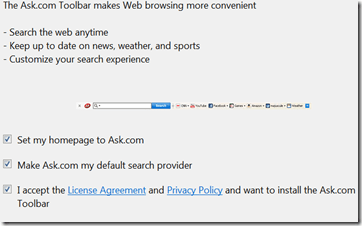
Really?  Are you serious?  How completely bush league is this?  I must have been right to avoid all this torrent business.  How desperate must Ask.Com be to sneak onto computers to have to resort to semi-trojan status?

I was getting madder by the minute, but nothing is as bad as seeing that useless netbook on the counter, so I unchecked the boxes and proceeded. 

Torrent movies must be really fun, it’s telling me I have 11 hours to go to download a 689 MB file.  This is almost as fun as typing on a netbook.  At the end of the day, it took something less than 11 hours, but a long time nonetheless.  At a screaming 1.x kBs a second.

Creating a USB Installer

Next you download the USB Creator, thankfully without uTorrent.  Hopefully, now that I have the iso file things will be back to sane.

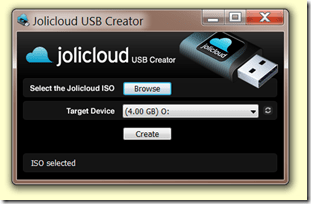
To create the USB installer, you install and run the USB Creator, and point the application to the downloaded iso file and an inserted USB stick.  The approach is identical to other USB installations I have done, including the lamentable Windows>Ubuntu>Windows installations on this netbook.

image

Other than Microsoft Security Essentials asking about the Jolicloud files and whether I wanted to send them for a risk assessment, things went smoothly.  It took about 3 minutes to create the USB installer.  After uTorrent, this seemed like warp speed times infinity.

Installing Jolicloud

This is where things took a turn for the good.

I stuck the USB stick in the netbook and fired it up.  Well, maybe not fired.  I turned it on and it slowly chugged to life.

Jolicloud recognized and connected via the wireless card.  A+ for that!  Ubuntu still hasn’t gotten that part right.

Full installation is a 7-step, easy process, during which you choose your language, set your local time, pick your keyboard layout, decide if you want to delete any existing partitions (yes, in my case, as I want the netbook to be Jolicloud-only), decide if you want a single or side by side installation (single in my case, for the same reason), and pick a user and computer name.  This process seems really well implemented and takes just a few minutes.

You then create an account.  I used Facebook Connect, and was connected with my Facebook account instantly.  Then you create a Jolicloud name and password.  Easy peasy.

You are given the opportunity to connect with any of your Facebook friends who are already using Jolicloud.  My pal Rick was already using Jolicloud, and I was prompted to connect with him.  I’m not yet sure what happens after you connect, but it’s a cool feature.

Did I mention that I’m happy about the wireless card thing?

After the installation process is over, you restart and you’re ready to go.  And go you can.  Jolicloud boots up quickly and has the chops to perform all the usual tasks- only this time without pulling your hair out.

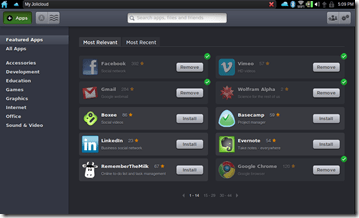
There are a ton of apps available, with more to come.  You can even see what your Facebook friends like.

image

After

IMG_1093

Very nice.  Now if I can just keep Cassidy from taking it back.

Net Neutrality and the Least Unacceptable Alternative

The internets (now apparently using the plural isn’t as cute and clever as it used to be) are abuzz (pun semi-intended) with talk over Google and Verizon’s Joint Proposal for an Open Internet.

I don’t profess to be an expert in Net Neutrality, other than a pretty strong feeling that I am for it, and that it is good for the consumer.  One thing I am an expert in, however, is negotiation.  I get invited all over the country to speak on negotiation strategy.

image In negotiation strategy, there is the concept of “least acceptable alternative.”  The idea is that if you know you aren’t going to get what you really want, you have to seek something you can live with.  For example, if I want to go to a ballgame, but it’s our anniversary and my wife wants to go to the ballet, I should reevaluate my goals and try to end up at a concert.  It’s not the ballgame, but it’s a hell of a lot better than the ballet.

When things are really stacked against you, the least acceptable alternative morphs into the least unacceptable alternative.  I hate all of the alternatives, but I hate this one less than the others.

The question we should be asking about this policy and the roadmap it contemplates is not if it is exactly what we, the consumers, want.  It’s clearly not.  The question is if the proposed plan is the least unacceptable alternative, and if not for whose advantage was the true least unacceptable alternative abandoned.

Figure that out, and we’ll know how all this is shaping up.

Is Google.Me Getting Cobbled Together via Acquisition?

cobbledAs those participating in the lively and interesting discussion in the comments, Google Reader comments and (maybe) Google Buzz surrounding my last Google-related post know, I am pulling for Google.Me.  I think it is facing a monumental task in trying to divert the flow of attention from Facebook, but I hope it succeeds.

But the more data points that trickle out about Google’s forthcoming Facebook killer, the more concerns I have.  A combination of one thing we think we know and one thing we know for sure is driving me crazy.  Conventional wisdom is that Google.Me will launch in the near future, perhaps even imminently.  We know that Google has been on a buying spree, most recently buying something called Jambool, for a measly (in this messed up industry) $70M.  Just the other day, Google bought something called Slide (at least it has a name that doesn’t make me want to club a kitten to death).  There have been others, and there will certainly be more.

How can you assimilate the mad buying spree and the pending launch and not be afraid that Google.Me is going to be another tossed-together mishmash?  Like Google Apps, except worse.  The biggest problem Google has across all of its non-search apps is inconsistent (in function and looks) design and an almost complete failure of consistency.

How can the same company create something as elegant as Google search and as inelegant as just about every other product?  I don’t get it.

TechCrunch leads the Jambool story with this sentence:

Google continues to gobble up companies that will form the backbone of its new social strategy and the upcoming war with Facebook.

It’s really, really (like almost impossible) hard for me to envision an elegant platform arising out of cobbled together parts.  I’m looking for Jessica Biel and they’re gearing up to give me Frankenstein.

Granted, Facebook is not the most well-put-together web site in the world.  But I want this to be a race for the top, not a race to avoid the bottom.  I’m just not sure buying a house room by room is the way to go, if you’re really striving to turn heads (and the herd).

I’m still hoping Google can pull it off.  But I’m getting a little concerned.

Aren’t you?

Is Google Buzz Dying or Just Waiting for the Cavalry to Arrive?

Recently we’ve learned two interesting things Google-related.  One, Google Wave is dead.  And two, Google is working on a comprehensive social networking platform, supposedly to be called Google.Me, to compete with Facebook.  Let’s think about this a moment.

image

I think Wave is an interesting application that could have become a useful tool, had it not become the latest Google project to fall off the wall due to an complete lack of post-launch support.  I’m not a fan Google’s “throw a bunch of stuff at the wall and see what sticks” approach to application deployment.  I’d also venture that the success rate of apps launched that way is about the same as my success rate in getting Disqus to accurately compute Reactions to my blog posts.  Low, really low.

image

Google must know that approach doesn’t really work, given the complete opposite approach it took with Google Buzz.  Google bolted Buzz onto Gmail accounts, guaranteeing a large user base, even if portions of that use base don’t know anything about Buzz.  I think the fact that Google launched Buzz in this aggressive manner is very telling.  It tells me that Google really wanted Buzz to succeed.  It also makes me wonder if Buzz has a more important purpose than serving as the Twitter clone-of-the-week.  Like serving as the advance guard for a greater invasion.

First of all, isn’t it interesting that Buzz has been around for so long and the average Facebook fanatic still couldn’t tell you what Buzz does and how you use it?  Facebook (big time) and Twitter (supposedly) hit the big time when they penetrated beyond the Nerd Kingdom into the larger realm.  So I think we can stipulate that to be successful Google Buzz- or Google.Me- will need to do so as well.  So why does Buzz seem like the Masons, all cloaked in mystery and whatnot?  Heck, I’m not sure I know what Buzz really does, and I’m interested in this sort of thing.  How little do you think the average Facebook fanatic knows about Buzz?  I’m thinking nothing.

If Google had merely tossed Buzz against the wall, the way it did Wave, Buzz would already be dead.

What’s really going on here is that Google is just treading water pending the great (or not, we’ll see) unveiling of Google.Me.  In fact, it wouldn’t surprise me to learn that Buzz was merely an advance guard, used to set up camp in our browsers until it is replaced by the (Google hopes) mighty occupation forces of Google.Me.

Either way, I am profoundly ambivalent about Buzz.  Google.Me?  There is great potential for Google to build a better Facebook.  Facebook in many ways is broken, hobbled by its back-end and its origin as a place for college kids to hook up (“Poke” someone? Seriously?).  The harder part will be nurturing the application once it is live.  That is not Google’s strong point.  The hardest part, which could be an insurmountable problem, is getting the non-nerd herd at Facebook to migrate to Google.Me.  I’d say the odds are long, but not impossible.  Personally, as long as I can push my Google.Me content into Facebook (not a sure thing by any means), I’d use Google.Me if it were a more robust platform.  I still miss Pownce, but maybe that’s just me.

As an aside, Google also needs to push this stuff into Google Apps much faster.  Another example of Google’s haphazard development style.

In the meantime, I’d be inclined to ignore Buzz completely, but several people I know and whose opinions I respect seem to like it.  Maybe they always pull for the underdog, I don’t know.  Louis Gray thinks Buzz will survive.  Thomas Hawk also likes it a lot, but it could be the yang for his Flickr angst.

At the end of the day, I keep wondering why Google doesn’t use more glue when it tosses these applications up there.  Maybe in the case of Buzz, stealth was or perhaps became the plan. 

I guess I’ll wait and see what comes (or goes) next.

The Mac-age: I've Seen the Deal-Stopper, and Its Name is Video

It’s no secret that I have been considering going all-Apple, which at this point would only require that I dump my HP desktop for an iMac or more likely one of the forthcoming new Mac Pros.  All of my other important gear is already Apple.  Until last night, things were looking good.

I’ve concluded that routine computing (email, Google Reader, web browsing, Facebook, and word processing) works very well on a Mac.  In fact, in many ways I like the vibe and feel of OS X better than that of Windows 7.  I was surprised by how much I like Safari.  I still haven’t installed Firefox (fading) or Chrome (rising) on my Mac Mini.  Add the superior handling of audio-video content via Front Row and Plex, and it was starting to look like I might soon get my official Apple fan-boy card.

Prior to last night, the only things left to check out were video editing (which I do a fair amount of, for home movies and the occasional short film), and music creation (which I used to do all the time, haven’t done much lately, but may do more thanks to the reunion of my friend’s band (yes, that’s a hint of things to come)).  Given the conventional wisdom that Macs are so much better for creative work, I didn’t expect a problem.

Boy, was I wrong.

I bought Final Cut Express (called FCE by those in the know), and installed it on my Mac Mini.  The program has that odd Apple organizational structure all over it, but there’s no denying that it is a powerful tool.  So I concluded it would be just a matter of learning my way around it.  If I can figure out Photoshop, no software can defeat me.

And then I tried to import some AVCHD files.  You know, those HD files that just about every HD camera in the known universe uses.  No go.  Can’t do.

Seriously?  I thought Steve Jobs’ General Order #1 was to make things easy for the consumer?  Isn’t that why Apple keeps competing apps out of the App Store?

I understand and sometimes even agree with Apple’s app-control policies (for example, I’m glad Apple tries to keep certain family unfriendly content out of the App Store).  But Apple is simply not going to change the entire home video industry by limiting AVCHD compatibility.

Someone is going to tell me how you can import AVCHD files into FCE, if you do it directly from the camera or maybe if you copy over the entire file structure from the camera.  Well guess what?  That’s not how I do it.  I copy all of the video files into production folders on my network storage and then pick and choose from there.  This works just fine for Windows applications (though I remain worried that Corel is going to screw up Video Studio Editor, which is my Windows app of choice; and I have to point out that VSE doesn’t like QuickTime files either).  I don’t know the background of this frustrating incompatibility, but Corel and Apple need to face the fact that (a) most video cameras record in AVCHD and (b) all iPhones record in QuickTime (.mov).  All of these things need to play well together.

Someone else is going to tell me about these programs that will convert the AVCHD files to MP4, which FCE can import.  Why?  Why in the world should that be necessary?  Furthermore, I tried one.  It took forever to convert the files (remember my theme that time is a precious commodity), and the quality of the converted video was close to horrible and far from HD.

So, until further notice, my all-Apple plan is on hold.  I’m not going to pay a fortune for a Mac Pro only to make tasks harder.

What a shame.  I was looking forward to getting my fan-boy card.

About this Spotify Thing

Or non-thing, as the case may be.

First, some brief background.  I am a recorded songwriter, and a huge music fan.  I have hundreds of my songs available on the dreaded internet, for free.   I also have a huge library of purchased music on our family’s music server (where my kids ignore the Allman Brothers in favor of some Disney Channel media creation, but I digress).  Many thousands were legally ripped from the thousands of CDs that have spent the last decade stored in boxes in the garage.  Several more thousand were purchased (DRM-free) from Amazon (which is the only place you should ever purchase music, but more on that in a moment).

Photobucket

As I’ve said a few times, I am bored beyond description by all the hoopla surrounding Spotify.  Either launch in the US, and I’ll take a look, or don’t.  But fish or cut bait.  Poop or get off the can.  Play your music or shut up.  There hasn’t been this much attention paid to something that doesn’t exist since Y2K.  Seriously, my kids don’t love me as much as some bloggers seem to love this vapor-service.

Paul Carr writes an absolute must-read (and I use that term rarely about things not written by me) article about Spotify and some other service called (stupidly) Rdio (is Ry Prker Jr. the singer?).  I haven’t used Rdio, and I probably won’t.  Partially due to Paul’s description and partially due to the indisputable fact that:

1.  I simply don’t want to rent my music.   I can understand renting a house.  They cost a lot of money.  I can sort of understand renting a car.  They cost a lot of money.  I rented a tuxedo a few times, because I was only going to wear it once.

Image Source,Photobucket Uploader Firefox Extension
I rented this fancy tux back in 1977

But songs cost around a dollar.  I don’t rent gumballs or stamps, so why in the name of all four Elvises (Presley, Costello, Grbac and Dutton) do I want to rent a dadgum song?  If I don’t know that I’m going to play it more than once, then I shouldn’t be renting or buying it.  You can preview songs, or enough of them to know if they suck or not, lots of places, for free.

2.  I’ve tried similar services, and while the are intriguing, they didn’t work for me.  When I first stumbled onto the dreaded internet back in the day, music files were in Real Media format.  That’s because we were all on dial up, and the pipes were the size of fishing line.  But I dutifully encoded all my songs (as in the ones I wrote) in Real Media format (that was a fun few days), put them up on a flashing (not flashy) web page and waited patiently for George Strait and/or Bruce Springsteen to discover them.  Somewhere along the way, I made the epic mistake of installing the Real Player on my Compaq 386.  It tried to take over the entire Risk board from the safety of my 200 MB hard drive.  It was horrifying and irritating.  After I finally succeeded in removing all of the remnants of that application…

I turned around and jumped back into the molasses by installing Rhapsody (when it was an on-demand service; it may still be- I have anything Real-related blocked by redundant firewalls guarded by rabid German Shepards with fully-charged Tasers in their mouths), so I could listen to music on demand.

3.  Rhapsody was sort of appealing.  I liked the catalog and it was easy to use.  What it wasn’t easy to do was cancel.  It would be easier to get Dave Winer to admit that he didn’t actually invent everything than it was to successfully cancel the Rhapsody service.  The almost as big problem was that, while I could listen to that big library while sitting at my computer, it was either technically or practically impossible to take the songs with you or burn them to a CD without, you guessed it, buying them.  I could rent to buy.  Like a fake leather sofa or an off-brand TV.  Awesome.  Not.

Anyway, after making about 300 calls, sending about a thousand emails, and seeking counsel with a Jamaican shaman, I finally got free of Rhapsody.  I promised never again.

Never.  Again.

So here’s the thing.  Music just isn’t that expensive.   If I want to hear a type of music, then I use Pandora, which with a little care and feeding can give you a really targeted playlist.  Targeted to your actual musical likes, and not bound by genre.  If I really like something and want to take it with me, I buy it at Amazon. Because you get unrestricted MP3s.  iTunes would be a decent alternative, except for the fact that iTunes, the application, sucks so bad.

At the end of the day, all I really want is for people to stop yammering on about Spotify.  At least until it launches.  Then we can go all Flipboard again, and claim it is the iPhone killer of the day.  Or something.  Everything has to kill something.

Until (and likely after) then, I’ll take my music now.  On my hard drive,  CD and/or iPhone.

Exposing the Fatal Flaw in Social Network Marketing

I read (via a link from Hutch Carpenter) with absolute glee today an article at the Harvard Business Review that points out what I and about 3 other voices have been screaming from the wilderness for years- customers don’t really want to “socialize” with companies:

Maybe customers are shifting toward self service because they don’t want a relationship with companies. While this secular trend could be explained away as just a change in consumers’ channel preferences, skeptics might argue that customers never wanted the kind of relationship that companies have always hoped for, and that self service now allows customers the “out” they’ve been looking for all along.

In fact, the trend has long been towards company avoidance, with two very different exceptions, which we’ll get to in a moment.

First, let’s look at how most people shop and consume today.

My Time is Not Your Money

Time is precious in this day and age.  I buy virtually all of my products, other than groceries, online.  Even at the grocery store, we are in the middle of a shift to self-checkout.  I thought that was an insane idea the first time I saw it.  Now I use it all the time.  It’s all about saving that precious commodity- time.

It takes a fraction of the time to buy a product online, and my goods get delivered to my doorstep.  Amazon Prime delivers by second-day mail.  I have found Apple and even Dell to be very fast shippers, with items often arriving even before the estimated date.  All of this gives me more time to do what I want to do, whether that’s make more money for me, or spend some extra time goofing off with my kids.

If you want to talk to me, in whatever capacity, that takes time.  Time that I probably don’t want to give you if the idea is to part me with my money.  The fact that I can read (or click, in the case of buying something online) faster than you can talk is why I get my news online and not on TV, and why I have never been into the video-blogging thing.  I want to consume information and goods at my pace, not yours.

Time being such a precious commodity, why in the world would people want to prolong the process they have to go through to get the goods they want?  In other words, people, even those who play Farmville, are smart enough to know that (a) some company who invades Facebook is there, ultimately, to make money off of them, and (b) time spent on some pseudo-conversation with a company representative (or likely a series of them) could be better spent looking for lost chickens (or whatever you do in Farmville).

The Tupperware Effect

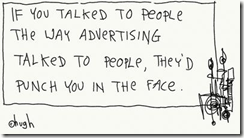
I have never been to a tupperware party, OK?  But I know that the idea is to get a bunch of people you know together, have some sort of faux party and try to sell them something.  There are a million different versions of this “monetize your friends” angle.  The problem is that when you’re gathered in a circle talking about the newest Apple rumor and half the people are secretly trying to sell you a sandwich container, it’s only a matter of time until the conversation goes from iMacs to re-sealable sandwich holders.  In other words, the conversation quality is lower.  If you are only waiting for me to shut up so you can make your pitch, what’s the point?

image 
Art by Hugh

I’m clearly not the only one who feels this way.  Listen to Kathy Sierra talk about social networking at something called the Gov 2.0 Expo.

On TIVOs and DVRs

If I’m right- and I am- that all of this social network marketing is really just some new age, dressed-up advertising, then how long before the conscripted universe of potential customers rebels?  I have spent thousands of dollars on satellite TV, XM radio (though Mojo Nixon is in the process of single-handedly driving me away from it), TIVOs and the like, all in the name of ad-avoidance.  Hell, I just bought a season pass of the current Big Brother season, just to avoid having to fast-forward through the ads.  There are entire industries based on avoiding the very thing marketers want to subject us to.

It boggles my mind that so many people are betting so much on the infinite willingness of people to be marketed to.

Anyone Remember Email?

At the end of the day, most of this social networking business is just an email replacement that people use, generally on their own time, to communicate with friends and have fun.  Business, even if you try to disguise it, thrust into a goodtime is a buzz kill.  Period.  It’s spam 2.0.

If we react so negatively and passionately to spam in our email inbox, how can anyone expect us to allow spam in our social stream?

We won’t.  Because at the end of the day, people hate advertising.  They always have and they always will.

What About the Two Exceptions?

I’m glad you asked.  There are exactly two times when people will seek out contact with companies.  To get something cheaper and when something is broken.  These are very different situations, and only one of them is an opportunity for companies to improve their brand.

I don’t like coupons, and I hate rebates.  That whole business makes me feel like a lion standing in front of a burning hoop.  It would be more fun to bite the head off of the person expecting me to jump through it, but it would be easier (i.e., it would save me a few dollars) to jump.  No company has ever made me feel affection by offering me a coupon or a rebate.  Sure I may buy your product and fill in your stupid rebate form, but I’ll hate you for it.

The way to my heart is to forget marketing and just make a great product.

Product support is a different story.  When something breaks, I want to get it fixed, quickly (because, again, time is precious) and permanently.  There have been many instances in which a blog post here or a post on Twitter has resulted in a email from a support person offering assistance.  That makes me feel warm and fuzzy.  Your third request that I “Like” your Facebook page, not so much.

Companies should send their support department to the social networks, not the
ir marketing department.

The Bottom Line

People hate ads.  People want to buy things their way, on their terms and without a lot of hoopla.  Nothing is going to change this.  If companies want to improve their brand via the social networks, they have to stop trying to turn the internet into a giant tupperware party, and focus on giving customers what they really want- a great product with great support.