
Why the Blogosphere is Still a Growth Area

Frank Ahrens of The Washington Post takes his turn today at the latest old media one question meme: has the blog movement peaked?

This is one of those questions where the goal is not to find the exact answer, because the exact answer cannot be found. It’s more about expressing your opinion about the status of the blogging movement and wondering aloud where it’s headed.

Blogging and the Bubble
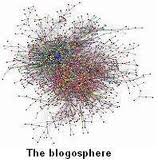
blogosphereI think too many people get blogging confused with other troubling memories of days gone by, such as Bubble 1.0 and all the non-companies that made the lesser fools wildly rich and the greater fools more poor back in the nineties. Yes, I think we have a lot of people huffing and puffing beneath Bubble 2.0 in the hopes that a new investing frenzy will permit a second generation of lesser fools to get rich, but that has very little to do with blogging.

For every lesser fool blogging about how the next social bookmarking service is going to change the world, there are two others blogging about how it won’t. Blogging doesn’t discriminate between the absurd and the realistic. And blogging is no more a cause for bubble growth than the pen or keyboard.

So is the Party Over?

I don’t think the blogging movement has peaked and I certainly don’t think it has entered its twilight. I think it’s simply maturing a little. This is about math, not rejection.

When anything new is invented, manufactured and first sold to the public, there’s always a ramp up as the pool of existing customers buy it. Whether it’s a car or a DVD player, millions of people who already travel or watch videos, are out there ready to replace their inferior tools (wagons and VCRs) with the better technology. The result is a ramping up of market penetration on the front end, which tapers off as the market is saturated. It certainly doesn’t mean the technology is losing its relevance or mindshare.

It simply means that most of the current customers have already bought it. Millions of new people (younger people; people in other parts of the world, etc.) are still moving into the customer pool all the time. Frank points out this possibility:

And it could be that the people who wanted to start a blog already have. Like settlers joining the land rush to Oklahoma, bloggers charged into the ‘sphere, chunked down their URLs and set up shop. Everyone else stayed back East.

All those people back East may one day get on the wagon train and become a citizen of the new media state. And if they don’t, many of their children will.

Blogging is Not New, Just Easier

Blogging is not a new and different activity. It’s merely an easier way to publish and manage internet content. Sure, it makes it easy enough that someone who wouldn’t otherwise have tried to create an internet presence might do so now. But unless and until people lose the desire to put content on the internet, blogging is not going to lose its relevance any more than video cameras or word processors will. It’s a tool that helps satisfy a need that was there years before anyone combined the web and a log into the Reese’s Cup we know and (sometimes) love.

Growth Potential is Obvious

Oddly enough, the one thing that is clear to me is that there is tremendous growth potential for blogging. That’s not the same as saying it will grow, but it certainly makes it harder to say it’s in its decline.

The fact that we have empirical data demonstrating that so few people currently read blogs is proof positive that market saturation is not complete. It sounds more like the web back in the mid-nineties. I was on it then, and many of you were too. But to almost everyone else, it was a novelty. Today, even those who have never read on word on a blog use the web daily. For news, email, etc.

If you believe, as I do, that old media will move away from current distribution models towards distribution via RSS feeds, then you have to believe that RSS feeds will become more mainstream in the coming years. Once people know how to use RSS feeds (whether they know they’re RSS feeds or not) then blogs will become just another selection on the information menu.

I think blogging, along with reading RSS feeds, will take its place beside email in the mainstream. It will take a while.

But it will happen.

Three Cheers for the Liberty

Liberty

Cassidy’s basketball team, the Liberty, had their last game today. Afterwards they had a snack and got trophies and a DVD we made of one of their games.

It was a fun season, and even though Cassidy is a year younger than the rest of the girls, she played hard and had fun.

The other coaches and I had a great time and we’re all looking forward to next season.

Web 2.0 Wars: Round 8

It’s time for Round 8 in Newsome.Org’s Web 2.0 Wars. The contestants and rules are here.

This is the final heat of the first Round. The playoffs will be next.

Other Rounds:
1 | 2 | 3 | 4 | 5 | 6 | 7 | 8 | 9 | 10 |
11 | 12 | 13 | 14 | 15 | 16 | 17 | 18 | 19 | 20

Here are the contestants for Round 8:

Memeorandum
CalendarHub
Superglu
Pando
Zigtag
Findory
Backfence
Clipmarks
Wayfaring
gOffice
Fleck

Memeorandum is the King of the Meme Trackers. I use it every day.

CalendarHub is yet another web based calendar application. It looks nice, but what is it with a million online calendars.

Superglu is an application that aggregates your information from other services like Delicious, blogger, etc. It gathers your content from popular web services and publishes them in one convenient place.

Pando is an online application that lets you email any size file or folder to anyone, free. It’s not yet live, so I can’t say much more than that.

Zigtag is not yet live. They aren’t saying much about it on the web site.

Findory is a personalized newspaper that evolves, quickly, as you click and read. It creates personalized content as you read. Sounds like a web version of TIVO suggestions. Cool idea.

Backfence is a group of community based citizen media sites. It has sites now for cities in Virginia and Maryland. Where’s Bellare, Texas? Interesting idea in its early stages.

Clipmarks is a people-powered search engine where users rate web content, talk about it and connect with other people who share similar interests. There is a Firefox extension you install that lets you capture pages or parts of pages to Clipmarks.

Wayfaring needs a new logo. It looks like Wayfanng. This site lets you build maps, annotate and share them. You could use this to show all 10 Starbucks within 50 yards of you house, or something. It’s actually a neat application with lots of potential uses.

gOffice is a free online office suite, with word processing, desktop publishing, a presentation maker and a spreadsheet. Alas, no calendar.

Fleck describes itself as a “patent pending, world changing, paradigm shifting and user experience enhancing technology.” I think that’s a joke, since the same description saya “every Web 2.0 hype is covered.” It’s not live yet, so I can’t say much more about it.

Before Today I’d Heard of:

1 out of 11

And the Winner of Round 8 is:

Memeorandum in a landslide. Even with a scoring discount since I already use it, it still wins going away. Findory finishes second.

Technorati Tags:
,

This and That

Dave Winer posts a copy of an email he sent to the other side. As I’ve said before, I don’t know who’s right or wrong here, but this seems like a pretty reasoned letter.

Scott Karp has a good read on the sweetspot between old media and new media, which correctly says:

Old Media has the audiences, but doesn’t know what to do with them. New Media knows what to do, but doesn’t have the audiences.

Thomas Hawk demonstrates why he’s my favorite photographer. I absolutely love looking at one of his photos while reflecting on the name he gave it. You have to experience it to understand it, but the way he names his photos makes experiencing them like a little mini-movie. I love the way he names his photos.

Please join me in voting for JK’s excellent blog in the IT Community Choice Awards. JKOnTheRun in on the list as “OnTheRun,” so look in the O’s, not the J’s.

My Favorite Records:Emmylou Harris – At the Ryman

This is the another installment in my series of favorite records.

I’ve loved Emmylou Harris since the first time I heard her 1977 masterpiece Luxury Liner. And there are any number of her records that are worthy of my Top 50 list. But there’s one of them that’s just a notch above the rest.

That record is her 1992 live album, is At the Ryman.

I remember going to the Ryman to see the Grand Ole Opry when I was a kid, and I sure wish I’d been at the Ryman when Emmylou made this live tour de force. She joined up with the Nash Ramblers, one of the best backing bands in the history of recorded sound, led by Sam Bush and Roy Huskey Jr., and simply made one of the best live records ever. One of the best. Ever

From the opening chords of Steve Earle’s Guitar Town until the last chord of Smoke Along the Track, there’s not a song on this record that I’d rate less than a 9.5 on a 10 scale. The two best songs are covers of Bill Monroe’s Walls of Time and Get Up John (I can’t listen to a second of either one without feeling that beautiful tug of spiritual emotion). I expect Sam Bush’s fingers were in shreds at the end of Walls of Time. What a beautiful song.

This is a great album.

Technorati Tags:
,

MPAA: Grabbing for the Cat, But to What End?

Today comes word that the MPAA has filed a new round of lawsuits in a continuing effort to stuff the cat bag into the bag.

I have a few questions.

emptybagDo the MPAA and its even more aggressive cousin the RIAA really think they can curb file sharing by suing a bunch of random people once in a while? Do they also think it’s possible to make water naturally flow up hill?

I don’t think anyone at the RIAA or the MPAA really believes they can curb file sharing. It’s too late and they have to know that. So what is the real goal here? Are they trying to slow down the growth of file sharing while they come up with some technological solution?

Do they understand that the only people they are hurting by mandating DRM-infested product are themselves and the remainder of their once loyal customer base? Surely they know hacker technology will trump copy protection every time.

Is the plan, or part of it, to force us to buy the same thing over and over? Is that how they think they can save their dying business model?

If it’s OK to sue a search engine that allows someone to search for pirated material, where’s the line? Is it OK to sue the companies who make the computers that allow someone to access the search engine that allows someone to search for pirated material?

I want someone of importance at one of these organizations to tell me what the real goal is here? Not the scorched earth campaign to spread fear of litigation, but the realistic one that they must have talked about.

So tell me, exactly, what is the end game in this futile effort to stuff the cat back into the bag.

I really want to know.

Tags: ,

Soundbite or Corporate Policy

That’s the only question that needs to be asked to Yahoo following the statement by Yahoo Music chief Dave Goldberg that record labels should sell music without copy protection.

Everyone knows that the DRM-infestation that has ruined online music and put the screws to consumers to buy multiple copies of the same thing is horse manure (to put it mildly).

But until one big company who has both skin in the game and enough mindshare to kick-start a movement calls foul and stops pushing this crap on consumers, this is just a soundbite. There’s no need to “prompt industry-wide discussion.” It’s being discussed now, but since the record label cartel has all the bargaining power, we’re not getting anywhere.

The prospect of getting booted off of Yahoo’s music service would create enough bargaining power to at least bring the record labels to the negotiating table.

Yahoo, tell the record label cartel no. Make your music store DRM-free. Don’t toss out some unwanted, non-binding advice.

Take a stand. Make it happen.

Blogs are Really Just Better Homepages

I think Rex Hammock nailed it the other day when he said:

When you set up a weblog, don’t think of it as launching a “publication” or any other “mass media” and don’t measure success in terms of “size of audience.” Think of it simply as having a place on the web to easily post messages, photos and other digital files. Think of it as having something like email, but you don’t send it out — however, your friends or associates can “subscribe” to it, if they want to. Don’t make this too complicated.

erectorset-745745Many of us, myself included, are inclined to think about blogs as being more revolutionary than they really are. Yes, I write about how a blog is really just an online diary, etc. And most of the time I remember that. But then my erector-set personality fools my brain into thinking that all this blogging stuff is some new creation that is rapidly shifting all of our paradigms.

The fact is that blogs are changing things, primarily by making it easier to do what we’ve been trying to do all along. We wanted to have distributed, archivable conversations with people all over the world back in the nineties. The problem was that we didn’t have today’s blogging platforms to help publish and manage our content.

Blogs are really just a technological advance in the personal web page. They make it easier for us oldtimers to manage our content and they lower the technological barrier to entry, which gives more people a place at the table. Good, yes. World changing, not really.

Look at what Newsome.Org looked like back in 1999 (ignore the date near the top, that’s some code that continues to do its job).

no1999
Click for larger view

See the “Latest News” in the middle column? That’s a primitive Perl based predecessor to a blogging platform. I didn’t call it blogging back then, but that’s what I and countless others were doing. We just didn’t know it.

Note the empty box in the right hand column where the Chat Room used to be? 2006 so far is the year of the blog-based chat room. But we had them back in 1999.

See the classified ads link in the left hand column. Again, primitive and Perl-based, but we had them way back then.

Scott Karp gets it too:

So what is a blog? It’s a content management and publishing platform. All online publishers use a content management and publishing platform. The difference with blogging software is that it doesn’t come with the huge price tag.

Blogs are just a better and easier way to do what we were doing back then.

And we didn’t even know it.

Steve’s Social Media Tour

Steve Rubel is doing a really neat thing.

He is going to devote an entire day (12 hours, less lunch breaks, etc.) to doing as many podcast and blog interviews as he can fit in. He’s taking all comers (as time allows- but 12 hours is a long time).

Not only that, he’s going to turn the tables a little and ask questions to the people who interview him.

Talk about knocking down the gates. This is like Second Opinion on steroids!

I am very excited about watching, reading and listening to this, and I will cover as much of it as I can here.